
The most popular advice in copy trading is to sort the leaderboard by profit and copy whoever sits at the top. That advice measures the wrong thing. A leaderboard number is the leader's fill, at the leader's size, with the leader's exit, all booked in a wallet you don't control.
Your copy lands later, at your size, at a different price. On a thin Solana token that difference is the whole trade.
This piece covers what a crypto copy trading bot does, the controls that cap what one bad copy can cost, and the measures that tell you whether a trader is working for your wallet or only for theirs. No promises. Copy trading carries risk and you can lose what you put in.
Table of Contents
- What a Crypto Copy Trading Bot Does
- How a Copied Trade Opens, Scales and Closes
- Sizing, Guardrails and Leverage Limits
- How to Judge a Trader Before You Copy
- Why a Copied Trade Lands at a Different Price
- Slippage, Sandwich Attacks and Key Safety
- Set Your Limits Before You Copy a Trader
What a Crypto Copy Trading Bot Does
A crypto copy trading bot watches a trader you picked and places the same buys and sells in your own wallet, at a size you set. A mirror is the right picture. It reflects the other person's moves, while the size, the limits and the exits stay yours. Every copy is a real on-chain swap or perp order, so it fills at its own price, not at the leader's.
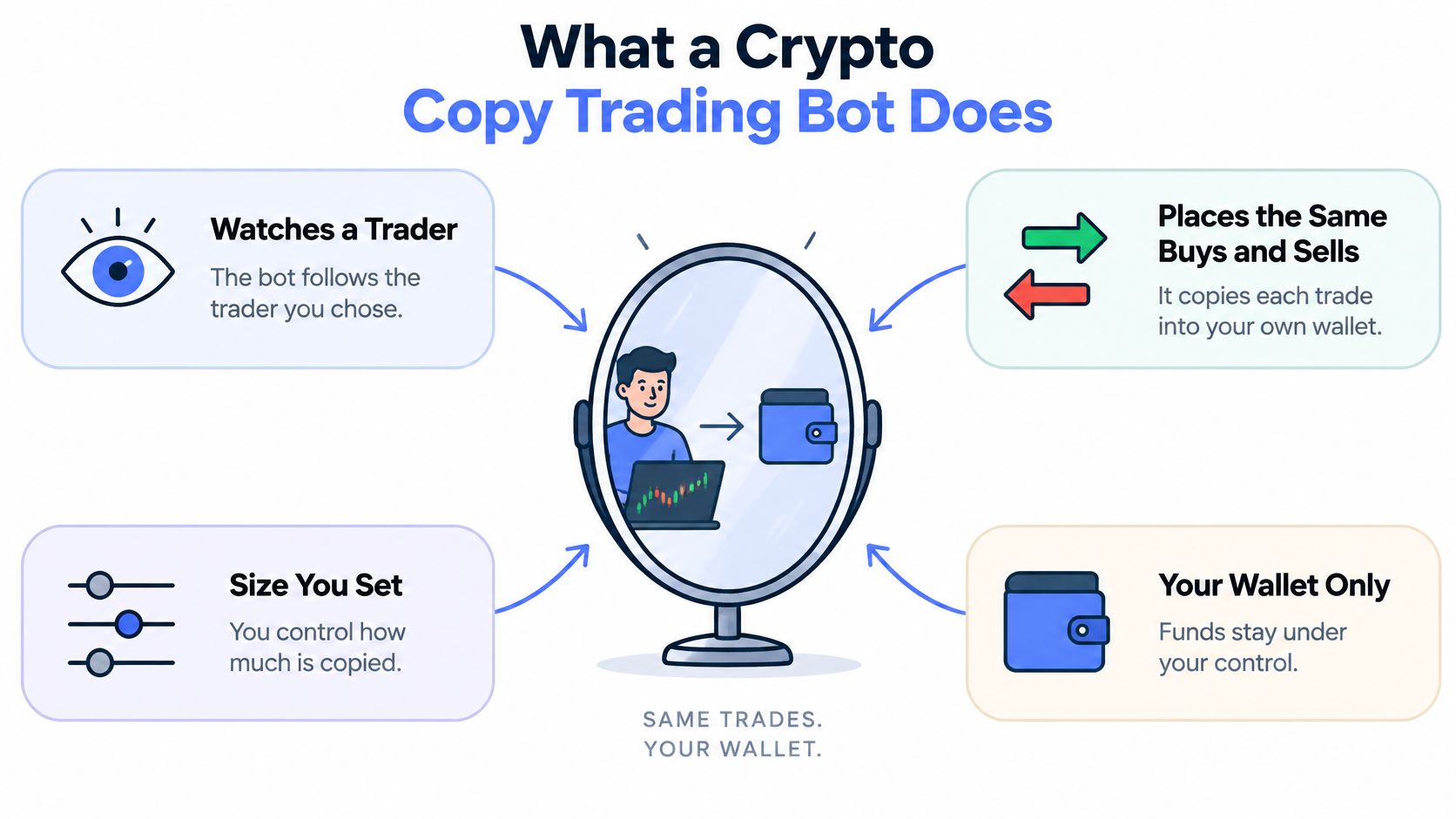
Custody is the first thing to check, before PnL and before win rate. A custodial bot holds your funds and trades from its own account, which makes the provider a counterparty on top of the market. An on-chain, non-custodial bot keeps the wallet in your name, so you sign and you control the funds, and key security becomes your job.
| Model | Who holds the keys | Where trades settle | Main risk to check |
|---|---|---|---|
| Custodial bot | Provider | Provider's account or exchange | Counterparty and withdrawal risk |
| On-chain, non-custodial bot | You | Your own wallet on the chain | Key security and execution speed |
| Hybrid or bridged setup | The provider, or a bridge contract | Provider account first, then your wallet after the bridge | Read the custody terms before funding |
The rest of this article assumes the non-custodial model, the one copy.top uses. The wallet belongs to the user and the key can be exported at any time. That property outranks any feature list, because a bot you can't withdraw from isn't a tool, it's a counterparty.
Five Questions to Ask Any Provider
- Who holds the keys, and what happens to your funds if the provider goes offline mid-position.
- Which chains and perp markets are supported, so you're not bridging into a chain the bot can't sell on.
- Whether trader records are public, with realized PnL, median hold time and open positions shown before you commit.
- What the provider discloses about custody and withdrawals, in writing, not in a marketing page.
- Whether you can stop copies and keep control of your own wallet, including after you've stopped.
The single question that settles most of it is who holds the keys. If the answer isn't you, you're accepting counterparty risk on top of price risk. Memecoin, perp and prediction market trading is risky, and users can lose what they put in.
How a Copied Trade Opens, Scales and Closes
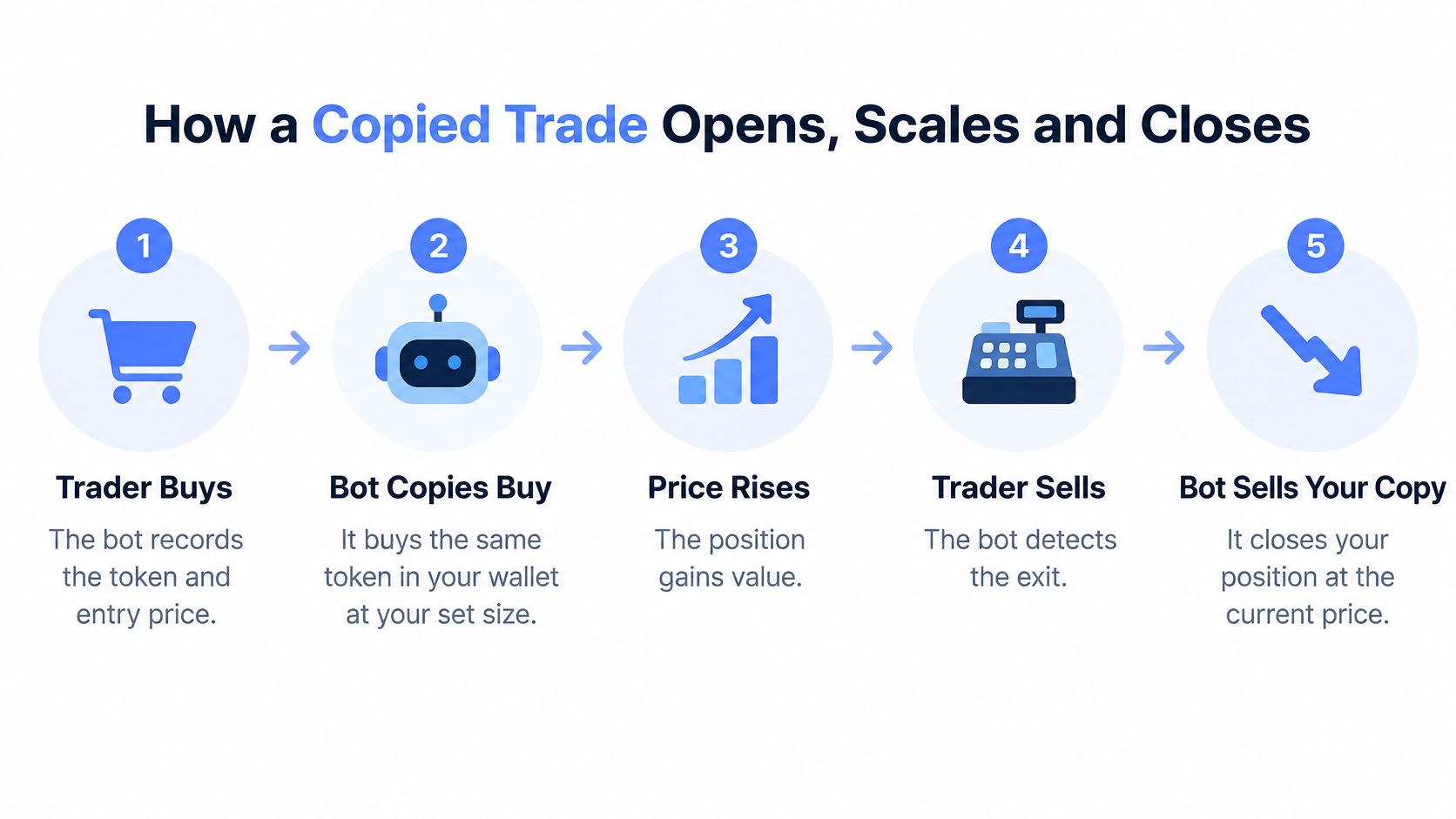
Walk one copy from start to finish. Say a trader on fomo buys a pumpfun token at 3 am your time, and you're asleep.
The Five Steps
- The trader buys. The bot records the token and the entry price, plus the market cap at that moment. Nothing is sent yet.
- The copy is sized. A fixed ticket spends the same amount on every buy. A share of the trader's buy scales your order to theirs, with your cap applied on top. The size is yours even when the trade isn't.
- The order goes out with a slippage limit. The limit is what protects you from filling at a price the market has already left. It's also what decides whether a fast move becomes a fill or a failed transaction.
- The fill is recorded, including the market cap at entry, so you can compare your entry against the leader's later.
- The trader sells, and the sell is copied. The position closes with them unless one of your own exits fires first. A bot that only copies buys leaves you holding a bag the trader has already dropped.
Transaction freshness is where most copies break. Solana slots target approximately 400 milliseconds and can run between 400 and 600 milliseconds, while a recent blockhash stays valid for only about 151 blocks, roughly 60 to 90 seconds at that pace, as the Solana transaction confirmation guide explains. A bot that queues a copied order without refreshing the blockhash submits an expired transaction.
The practical fix is unglamorous. Fetch a recent blockhash close to signing, set an explicit commitment level, retry a failed broadcast, and track whether the transaction is processed, confirmed or finalized. A processed transaction isn't settled money.
Why the Copy Still Opens While You Sleep
The 3 am problem is the reason people use a bot at all. A copied trade still opens while you're asleep, at your size and capped at the limit you set. You wake up holding the same token the trader bought, at whatever price the market gave you, not the price on their profile.
That's the honest trade-off. You get the entry. You don't get their fill.
What Stopping a Copy Actually Does
Stopping a copy isn't an exit. Nothing is sold, the position keeps its PnL, and your own take profit and stop loss keep protecting it. That distinction matters, because traders often assume the stop button closes their book. It stops new copies, not the position already open.
Practical rule: decide before you start what happens to a position when you stop following the trader. If the answer is "nothing", set the take profit and stop loss first.
Sizing, Guardrails and Leverage Limits
A trader's size is not your size. The settings decide how much one bad trade can cost you, and they're the only part of a copy you fully control.
| Control | What it limits | When to use it |
|---|---|---|
| Fixed ticket | Spend per buy, the same every time | Keeping each copy the same size |
| Share of trader buy | Your size scales with their buy | Following large traders without oversizing |
| Per-trade cap | Maximum spend on any single copy | Stopping one big buy draining the wallet |
| Leverage cap (perps) | Notional size against margin | Keeping liquidation distance wide enough |
Fixed Ticket, Share of Buy, and the Cap
A fixed ticket is the simpler of the two sizing modes. Every copied buy spends the same amount, whether the trader put in $200 or $20,000. That makes your worst case predictable and keeps a whale's conviction from turning into your oversized position.
A share of the trader's buy scales with their order. Follow at 10% and a large bet becomes a small slice of your balance. The trap is that a trader who doubles down on a loser doubles your exposure too, in the same direction, at the same moment. Size down when the position is already underwater.
The per-trade cap sits above both and isn't optional. One copy should never be able to take a meaningful share of the wallet. If a single buy can hurt you, the sizing is wrong regardless of how good the record looks.
Exits deserve the same treatment. A take profit closes at a gain level you set, and a stop loss closes at a loss level you set. Those levels are yours, not the trader's, and changing either one applies to everything you already hold, not only the next trade. If you've read much about position sizing for copy trading, the rule is the same one that applies to any trading book: risk per position, not per idea.
Perps Copy Risk as Well as Direction
Perpetual futures don't copy like spot. Borrowed exposure magnifies an adverse move and can trigger automated liquidation once margin falls below the maintenance threshold. Perps also have no expiry, so funding payments flow between longs and shorts for as long as you hold, and a copied position's economics depend on funding as much as price.
A large on-chain study of Hyperliquid, filed as a comment with the SEC on perp market structure, found that forced exits are a principal wealth-transfer mechanism. Exposure to debt turns an adverse move into a liquidation executed at materially worse prices than a voluntary trade, and auto-deleveraging may return only part of the loss. The same analysis argues a copy bot shouldn't clone a leader's nominal exposure blindly.
What to do instead is mechanical. Translate the leader's position into your own notional cap, set a maximum account-risk percentage, and reserve margin for funding and volatility. Watch entry price, mark price, liquidation distance, maintenance margin, funding rate and slippage as separate numbers, because a liquidation you can't see coming is a liquidation you didn't size for.
Copy reductions and closes promptly, and keep the ability to stop new copies on your own. A trader with strong realized PnL can still be unsuitable if those returns come from large borrowed positions or a few concentrated positions. Perps remain high-risk instruments, and users can lose what they put in.
How to Judge a Trader Before You Copy
Start with the public page, not the rank. A trader's page should show realized PnL, win rate, median hold time, open positions and recent trades before you commit a cent. Those five numbers answer different questions, and one without the others tells you almost nothing.
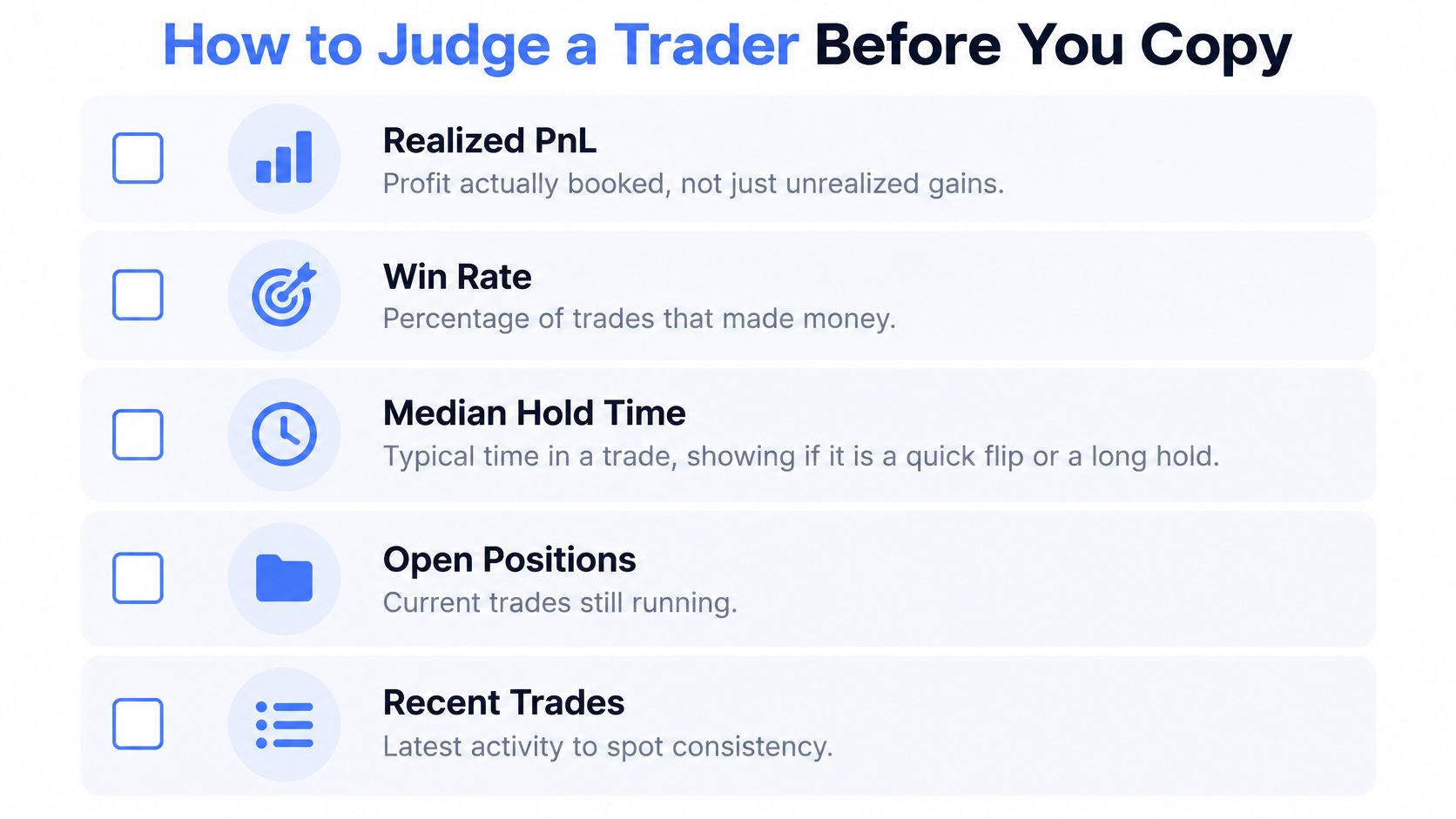
| Metric | What it shows | Red flag |
|---|---|---|
| Realized PnL | Profit from closed trades only | One large win carries the total |
| Win rate | Share of trades that closed in profit | High win rate with small wins and large losses |
| Median hold time | Typical length of a trade | Holds too short for you to follow the fills |
| Open positions | Exposure the trader holds right now | Large share of the book in one illiquid token |
| Recent trades | Current size and frequency | Sudden jump in size or trade count |
The Leaderboard Is Not a Ranking of Skill
A 2024 quantitative study of two major copy trading platforms tracked what happens after a portfolio gets promoted. Copiers tended to profit for approximately one week after the leader gained leaderboard exposure, after which portfolio profit and loss deteriorated and could turn negative.
The tail was ugly. Portfolios in the bottom 25% of the platform's "Gold" group lost more than USD 15,000 within ten days of promotion to that tier. The authors concluded that copying the highest-ranked leaders did not produce substantial investment profits, and that ranking systems create an incentive for leaders to optimize visibility rather than durable performance.
Read that again in plain terms. A high rank tells you about distribution as much as skill. The study also found leaderboard visibility influenced follower behavior more than demonstrated long-term performance, and reported that the average leader was entrusted with more than USD 10,000 of follower funds.
The Checklist
- Realized PnL over several weeks, not one good day. A record that only works in a single session is a snapshot, not a track record.
- Win rate next to average win and average loss. A trader winning 80% of trades with small wins and one catastrophic loss is a coin flip with extra steps.
- Median hold time against your reaction speed. If the median trade lasts four minutes, you're copying a scalper with a slower feed.
- Open positions sized against the account. Six positions in one illiquid token is one position wearing a disguise.
- Recent trade size and frequency. A sudden jump in size usually means the strategy changed, and you weren't told.
The record on the page is a starting filter, not a verdict. Past performance does not predict results.
Why a Copied Trade Lands at a Different Price
A profitable trader and a profitable copy are different outcomes. An industry research summary covering more than 100,000 copy trading outcomes reported that 48.48% of followers were profitable over 90 days, compared with 97% of leaders. Leader and follower results are measured on different trades, so a leader's record does not guarantee a copier's result.
Where the Gap Comes From
A late entry is one cause. A trader buys a thinly traded token, and the copy fills after the price has moved while the transaction is being built, signed and confirmed. On a token with shallow liquidity, even a short delay can mean a noticeably worse price.
A missed or delayed exit creates another gap. If the trader sells but the copy does not, you remain exposed after the trader has closed the position. The copy then carries a different risk and potential PnL.
Position size matters as well. A fixed ticket that is large relative to a thin pool can move the price against you more than a smaller order. Two followers can get different fills on the same token, even with the same trader. Setting slippage tolerance helps define which prices you will accept, but it cannot remove the market impact of an order.
Measure Copy Fidelity, Not the Leaderboard
Copy fidelity compares your fills with the leader's. Track these measures to see where your results diverge.
| Measure | How to calculate it | Warning sign |
|---|---|---|
| Entry-price difference | Your fill price minus the leader's entry price | Your entry is consistently worse on thin tokens |
| Exit-price difference | Your exit price minus the leader's exit price | Exits filled well below the leader's exit |
| Fill rate | Copied trades divided by the leader's trades | Fill rate well below 100 percent |
| Delay | Time from the leader's trade to your fill | Delays that push entries after the move |
| PnL after costs | Your realized PnL net of slippage and fees | Large gap from the leader's realized PnL |
Review these measures weekly. If your entry price is consistently worse on thin tokens but comparable on liquid ones, token liquidity may be driving the gap. If your fill rate is well below 100 percent, your results reflect a different set of trades from the leader's.
The useful question is whether the trader's strategy still works at your copy size and execution speed. A leader's reported PnL alone cannot answer that.
Slippage, Sandwich Attacks and Key Safety
Automation doesn't make execution safer. It broadcasts your order into a market where other bots are paid to notice it.
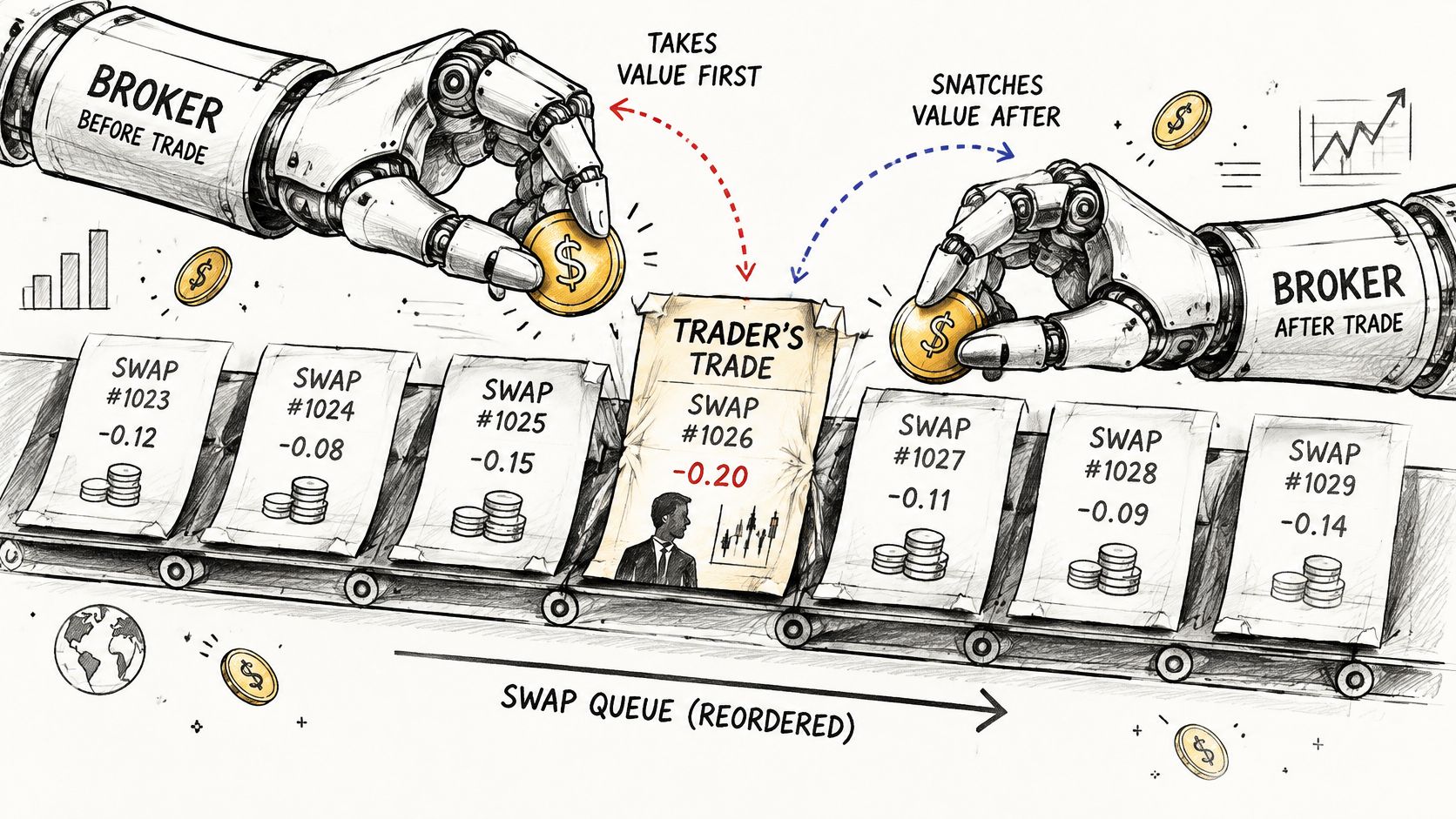
A sandwich attack works like this. A bot sees your pending swap, buys ahead of it, lets your own order push the price up, then sells after your fill lands. You pay the difference. Nothing about that is a copy trading bug. It's a property of broadcasting trades into a public mempool with loose limits.
The scale is worth knowing. An analysis of MEV and sandwich attack data estimated that sandwich attacks extracted about $60 million from Ethereum traders in the twelve months through October 2025. On Solana, the same summary cites 6.9 million sandwich attacks affecting 2.2 million wallets and generating $29.7 million for bots before costs.
Normal Impact and Hostile Ordering Are Different Problems
Price impact is the market reacting to your order. A thin memecoin moves when anyone buys, and no setting changes that. Hostile ordering is someone else profiting from the order you've already broadcast. You can reduce the second with tighter limits. You can't reduce the first, only size for it.
The slippage number is the lever. The Solana analysis found that 96% of attacks targeted memecoin infrastructure, and that transactions allowing 20% to 50% slippage were attacked far more often than those allowing less than 3%.
That pattern is logical. A 40% slippage allowance is a standing invitation. It turns a failed trade into an expensive fill, and the fill goes to the bot that front-ran you. The slippage on every copied trade is printed for you to check, which is the point. A number you can't see is a number you can't tighten.
A Short Checklist
- Chain. Know which chain the copy settles on and whether the bot can sell there.
- Route. Direct pool or aggregator matters, because the route decides how much impact your order creates.
- Liquidity. Skip copies into pools where your ticket is a large share of the depth.
- Per-trade limit. A hard cap on any single copy, set before you fund.
- Emergency stop. You should be able to stop new copies and close positions independently of the trader.
The Sell Side and the Keys
Copying sells matters as much as copying buys. Failing to reproduce an exit leaves you holding a position after the trader has closed, which is the single most common way a mirrored trade stops being mirrored. The Solana summary makes the same point: a copied entry without the matching exit creates asymmetric exposure you never chose.
Keys are the other half. In a non-custodial wallet, the key is your responsibility and nobody else's. Keep seed phrases offline, never share a key with anyone who asks, use a separate wallet for copying, and export a key only in private. A bot that holds your key for you has answered the custody question in the wrong direction.
Memecoins, perps and prediction markets remain risky, and automated execution doesn't remove the possibility of rapid losses.
Set Your Limits Before You Copy a Trader
A leaderboard shows the trader's realized PnL, not the result your wallet will get. Set your own limits first, then check whether the trader's record and trading style fit them.
- Set a per-trade cap and a total exposure ceiling. Choose the most a single copy can spend and the total amount you are prepared to put at risk.
- Set take profit and stop loss levels. These exits use your levels, not the trader's. They apply to copied positions you already hold, as well as new ones.
- Check the trader's record and open positions. Compare realized PnL with win rate, median hold time, recent trades and current exposure. A strong headline return alone does not show how your copied trades may perform.
- Start small and compare fills. Track your entry prices and exits against the trader's. Your result can differ because your trades execute at different prices or sizes. Review that gap before increasing your copy size.
copy.top covers tokens on Solana, Base, BNB Chain, Ethereum, Robinhood Chain and Arc, and perps on Hyperliquid. Polymarket traders can also be followed and copied on copy.top. Browse traders at copy.top/traders, see what top traders are buying at copy.top/coins, or follow perp traders with a budget you set at copy.top/hl.
Copy trading carries risk. You can lose the amount you put in, and past performance does not predict future results.
copy.top is a non-custodial, multichain copy trading web app. You choose a trader from a public leaderboard, set your copy size, and their buys and sells are copied into your own wallet. Trader pages show realized PnL, win rate, median hold time, open positions and recent trades. Use those figures to assess the trader, then compare your own fills with theirs: the gap between your result and the trader's realized PnL is a better measure of copy fidelity than rank alone.