
Most copy trading fails before the first trade. Not because the trader picked a bad token, but because the copier picked an anonymous wallet, sized the position by feel, and had no rule for getting out.
The most popular advice on this topic is "follow smart money". That isn't a strategy. It's a hope with a wallet attached. A wallet address tells you nothing about who's behind it, what they hold, how long they hold it, or whether the money moving is even theirs.
The seven strategies below replace the hope with checkable choices: who you pick, how much goes in per trade, how exits get mirrored, and what rules cap the damage when a trader is wrong.
One plain note before anything else. Copy trading carries risk. You can lose what you put in, and past performance does not predict results. Nothing in this list changes that.
Table of Contents
- 1. Leaderboard-Ranked Trader Selection
- 2. Track Record and Hold-Time Filtering
- 3. Fixed-Size Copying
- 4. Proportional Copying by Share of the Trader's Buy
- 5. Full Mirror Copying of Buys and Sells
- 6. Guardrail-Based Copying
- 7. Hyperliquid Perp Copying with Budget and Leverage Control
- Seven Copy Trading Strategies Compared
- Pick a Trader, Set Your Rules, Start Small
1. Leaderboard-Ranked Trader Selection
Start where the figures are public and sorted.

A leaderboard ranked by realized pnl shows what a trader has already closed: settled gains and losses you can read, rather than open marks or a screenshot. On copy.top each trader carries a named profile with a public track record, so the shortlist starts from numbers you can check rather than a wallet with a cartoon avatar.
That order matters more than it sounds. A rank is a filter, not a verdict. Board position only says who closed the most profit in the window the board uses.
The evidence on visible rankings is uncomfortable. In a controlled market experiment run through the University of Essex, 35% of participants given a copy option used it, 88% of those copiers chose a trader who had picked the riskiest available asset in the first block, and the share making the riskiest choice climbed from about 32.5% in the baseline group to 51.6% in the copy group (copy trading experiment, University of Essex). Visible success pulls people toward risk, not away from it.
Reading a rank in five minutes
- Check the trade count behind the pnl. A number built on six trades tells you almost nothing about the next six.
- Look at whether profit is broad or concentrated. One lucky token can carry an entire record.
- Read the profile before the rank. Style, open exposure and recent closes explain more than board position.
Open three profiles from the top of the board and compare them before choosing one. Rank order is a sort key. The profile is the decision.
There's a fuller walkthrough of how to read a copy trader's profile, and the live list sits at copy.top/traders.
2. Track Record and Hold-Time Filtering
A win rate alone can hide an ugly return profile. Eight wins out of ten tells you little if the two losses outweigh the gains.

Hold time helps show whether a trader's pace fits your routine. A strategy built around quick trades may be hard to follow if you cannot monitor positions. Longer holds demand patience and leave capital committed for more time. Compare hold time with performance rather than treating either figure as a verdict.
A study of social trading analyzed 87.5 million anonymized trades and 825,000 mirroring relationships from August 2010 through December 2013. It found average individual trade performance of about -7.67 basis points, and about -10.98 basis points for social learners on eToro (social trading study). Popularity was a weak guide to performance. Users who revised their mirroring choices did better than those who left them unchanged.
The ranking problem nobody mentions
Rankings can influence copying decisions without proving that a trader will perform well. An IOSCO copy trading report identifies timing and pricing risk: followers may enter after a leader and receive different prices.
Use profile details to assess fit, not to predict a guaranteed result:
- Compare win rate with hold time. One describes the frequency of profitable trades; the other shows how long positions tend to stay open.
- Review recent trades for changes in pace or approach. A past record may not reflect a trader's current style.
- Check open positions. They show what the trader holds now, alongside the historical record.
The live copy.top leaderboard lets you compare trader profiles, including win rate, median hold time and open positions. Read those details before deciding whether a trader's style fits your constraints.
3. Fixed-Size Copying
Set $50 a buy. Every copied entry is $50, whether the trader spent $200 or $20,000. The strategy is that simple. You can price one fill before it happens.
What you give up is the trader's own bet size. A $200 probe and a $20,000 commitment copy as the same ticket. That is deliberate. You are not matching their conviction. You are fixing your dollars in advance, on a flat amount stored for that trader.
A flat ticket does not cap the book. Ten entries at $50 put $500 to work, and a wallet can empty through ten ordinary fills. A share of the trader's size can take a cap as well, so fixed size is not "the only mode you can bound." It is the mode where every entry starts from one number you chose.
A budget beats a size. The per-trade amount is the small decision. The total across all followed traders is the one that decides whether a bad week is survivable.
Sizing for the losing run, not the single trade
- Assume a run of losses. Size each buy so five in a row doesn't drain the wallet.
- Keep one total budget across every trader you follow. Per-trade limits hide aggregate exposure.
- Review after a handful of trades. Adjust the amount once you can see real fill quality. Each copied trade prints its slippage, which is the check.
The arithmetic behind a ticket, a run of losses, and a book-level budget is laid out in this guide to sizing crypto positions.
4. Proportional Copying by Share of the Trader's Buy
Proportional sizing follows conviction. If the trader doubles the position, your copy doubles with it. You pick the share, the trader picks the pace.
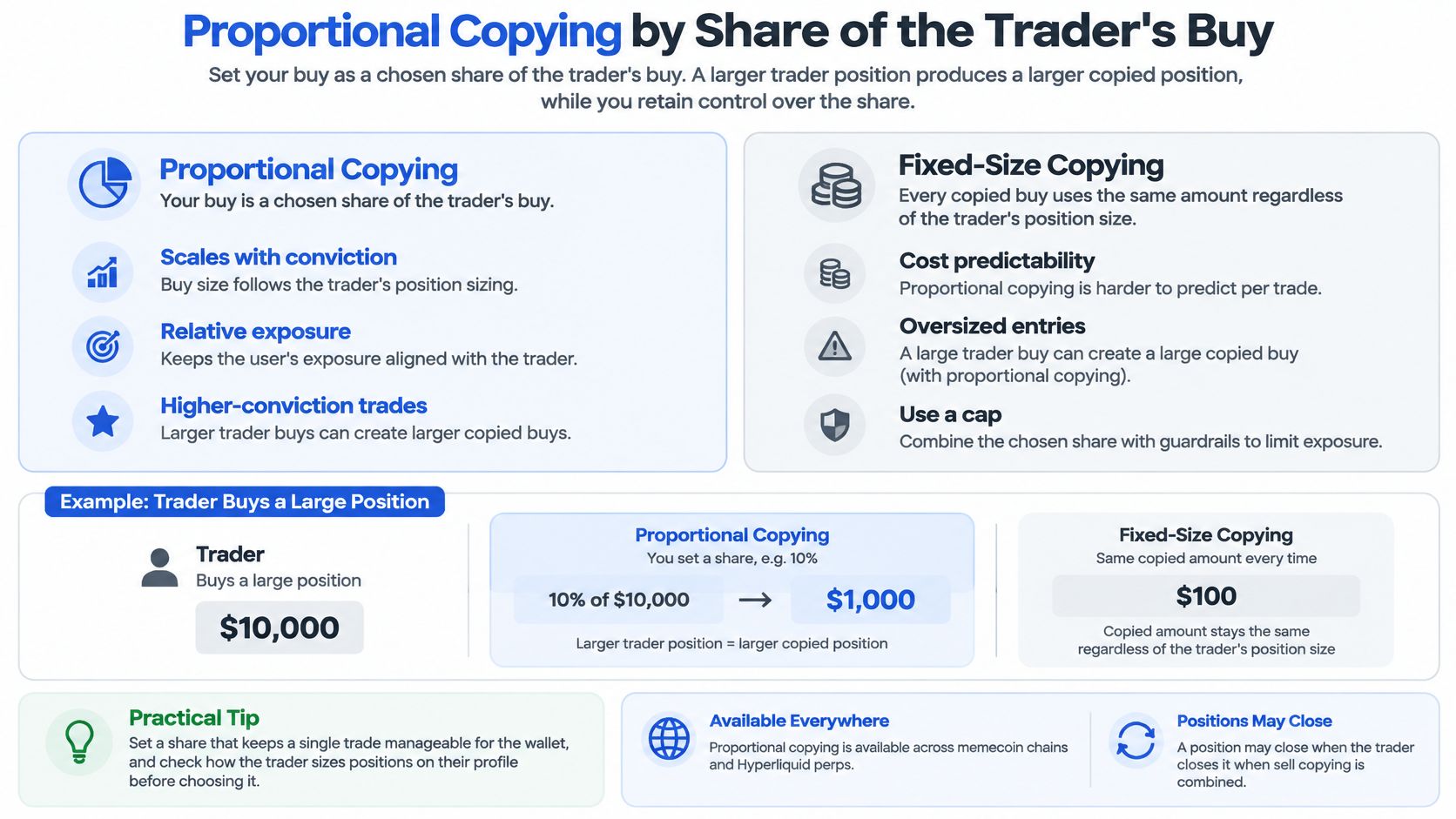
That's the appeal and the trap. A trader who commits a large slice of their book pulls a large slice of yours with no extra decision from you. In a perp with borrowed funds, the amplification is structural. The CFTC's advisory on virtual currency trading states that borrowed funds amplify the effect of changes in the cash price, that a trader may have to add margin or close the position when it moves against them, and that losses in futures trading with borrowed funds can exceed the initial investment (CFTC investor advisory).
Read a trader's sizing pattern on the profile before you choose a percentage. A trader who routinely opens with a third of their balance behaves nothing like one who scales in.
Setting the share with a ceiling
- Pick a share that keeps one trade small. If a single copied buy can't be absorbed, the share is too high.
- Add a cap. A maximum per copied trade turns proportional sizing into a bounded rule.
- Watch the first few proportional copies. Fill quality tells you more than the profile does.
The honest trade-off: proportional sizing tracks the trader's conviction, and it also imports their worst sizing days. Fixed size gives that up in exchange for predictability.
5. Full Mirror Copying of Buys and Sells
Half a mirror is worse than no mirror. If buys are copied and sells aren't, you're holding a position the trader already left.

Mirroring exits is what makes a copy a position rather than a bag. When the trader trims, your position trims by the same fraction. When the trader closes, you close. That matters most for traders who take profit in stages or cut a losing entry fast, because their edge often lives in the exit.
Product type changes what an exit even means. Prediction-market shares settle at $1 or $0 on a discrete event outcome, while perps are continuous positions whose value moves with the underlying and carries funding and margin requirements (Polymarket documentation). A leaderboard that mixes both without showing the product next to the record is telling you very little.
- Expect worse exit fills. Exits copied into a fast market fill differently from the trader's own.
- Use a stop as a backstop. Mirroring covers the trader's decisions, not their absence.
- Check recent trades for how they exit. Scaling out looks different from one clean close.
A mirrored exit can still land at a worse price than the trader got. That's the cost of following rather than leading.
6. Guardrail-Based Copying
Rules on top of automatic copying are what separate a plan from a subscription. The options worth knowing are first buy only, sell with the trader, take profit and stop. Each one bounds how far a copied position can run or bleed.
The regulatory record on excessive borrowing is the strongest argument for them. ESMA's product-intervention analysis found that 74% to 89% of retail investor accounts lose money when trading contracts for difference, with average losses per investor ranging from approximately €1,600 to €29,000 in the national analyses it cited (ESMA product intervention notice). That evidence underpinned EU restrictions introduced in 2018, including borrowing limits and margin close-out rules. A European Commission analysis cited in the same body of work found borrowing limits improved outcomes for the highest-borrowing clients by 18 percentage points per month and cut their losses by 40%.
Those figures aren't a measurement of copy-trading accounts. They're a benchmark for what happens when position limits exist versus when they don't.
Setting levels before the first copy
- Set the stop first. Decide the loss you'll accept before you decide the entry.
- Test at small size. Watch how often a guardrail fires before trusting it with real capital.
- Review the trigger rate. A stop that fires constantly is a sizing problem, not a stop problem.
The University of Essex research repository notes that allocation limits, maximum position sizes, drawdown controls and explicit risk disclosures are technically important guardrails, and that historical pnl and leaderboard prominence shouldn't be treated as sufficient suitability signals (Essex research repository). For the practical sequence of setting them, see how to copy trade.
7. Hyperliquid Perp Copying with Budget and Leverage Control
Perps carry a cost that never shows up on a spot chart. Funding.
On Hyperliquid, funding is exchanged directly between longs and shorts rather than collected as a platform fee. The rate comes from the gap between the perpetual price and the underlying spot price, payments occur every hour, and the documented rate is capped at 0.5% per hour. The payment is position size multiplied by oracle price and the funding rate (Hyperliquid funding documentation).
That makes funding a separate exposure from price movement, and it's the reason a copy of a perp trader can drift away from the trader's own result even when direction is identical. Different size, different entry, different holding period.
Set a budget you can lose entirely, then look at margin use on each open position rather than at headline performance. Copying a perp trader with a small budget and visible position size is a different activity from matching their direction and hoping.
Reading a perp trader means reading three things at once: the position, the leverage behind it, and the funding clock running on it.
The perp side of copy.top is covered at copy.top Hyperliquid, and coin-level data with live price and funding sits at copy.top/coins. Perp trading is risky, and users can lose what they put in.
Seven Copy Trading Strategies Compared
| Strategy | Main Focus | Control Level | Best For | Main Risk |
|---|---|---|---|---|
| Leaderboard-Ranked Trader Selection | Choosing traders by realized PnL and public profiles | Moderate; user selects who to copy | Beginners seeking a clear starting point | Realized PnL can hide risk and does not predict future results |
| Track Record and Hold-Time Filtering | Matching traders by win rate, hold time, and recent activity | Moderate; user filters and selects traders | Users matching trading style to their schedule and risk tolerance | Metrics may mislead or fail to reflect current behavior |
| Fixed-Size Copying | Using the same set amount for each copied buy | High control over per-trade size | Users who want predictable trade costs and easier budgeting | Multiple trades can accumulate; each position can still lose money |
| Proportional Copying by Share of the Trader's Buy | Copying a chosen share of each trader buy | Moderate; share is user-set, but trade size varies | Users who want exposure to scale with trader position size | Large trader buys can create oversized copied positions |
| Full Mirror Copying of Buys and Sells | Copying both entries and exits | Moderate; exits follow the trader | Users seeking aligned entries and exits | Fast markets can cause worse exits or lock in losses |
| Guardrail-Based Copying | Applying entry, take-profit, and stop rules | High; user defines trade boundaries | Users who want preset limits and less constant monitoring | Rules may trigger at unexpected prices or close positions prematurely |
| Hyperliquid Perp Copying with Budget and Leverage Control | Copying Hyperliquid perp traders across markets | Moderate to high; user sets budget and can review leverage | Users seeking managed-budget access to perp markets | Leverage, funding, and liquidation can cause rapid losses |
Pick a Trader, Set Your Rules, Start Small
Seven strategies, one sequence. Run them in order and the decisions stop being guesses.
Filter first. Sort traders by realized pnl, then read profiles for median hold time, win rate and open positions. Drop anyone whose rhythm doesn't match the hours you have. A trader who holds minutes and a copier who checks in twice a day is a mismatch no amount of skill fixes.
Then choose a sizing mode. Fixed size if you want every entry identical and the arithmetic simple. Proportional if you want your size to track the trader's conviction, with a cap so one call can't dominate the wallet. Either way, set a total budget across all followed traders, not just a per-trade amount.
Confirm the exits are mirrored. Buys without sells leave you holding positions the trader abandoned. Guardrails like first buy only, take profit and stop sit on top of that, not instead of it.
A workflow that fits many traders: one trader from the top of the board, fixed size at an amount five losing trades wouldn't hurt, a stop set before the first copy, and a review after two weeks. Add a second trader only when the first is boring to watch.
copy.top is one place to run that workflow, with a public leaderboard, named trader profiles and both buys and sells copied from your own wallet.
Copy trading carries risk. You can lose what you put in, and past performance does not predict results. Start smaller than feels exciting.
copy.top gives you a public leaderboard of traders ranked by realized pnl, with realized pnl, win rate, median hold time and open positions visible on each profile before you commit anything. You set a fixed amount per buy or a share of the trader's buy, add take profit and stop levels, and both the buys and the sells are copied automatically from a wallet you control. Visit copy.top to pick a trader and start copying.