A strong realized result on a trader's page is not the fill your wallet gets. The leader's entry is a past price. Your order arrives later, at your size, into whatever liquidity is left.
That is the gap most leaderboard talk skips. A trade copier does not hand you the trader's economics. It hands you a new order, with its own time, price, and risk.
Table of Contents
- What a Trade Copier Does for You
- How Trade Mirroring Works From Signal to Fill
- Execution Delay and Why Copied Prices Differ
- Trader Records and Risks Before You Copy
- Sizing Each Copied Trade
- Handling Partial Sells, Full Exits and Your Own Levels
- Custody and Keeping Control of Your Keys
- Start Your First Copy With Limits Set
What a Trade Copier Does for You
A trade copier works like cruise control set by someone else's driving. The lead car sets the pace. You still set the speed limit, and you can take the wheel whenever you want.
In practice, the tool watches a trader you chose and places matching buys and sells from your own wallet, at the size you set. Entries go out without you sitting on a chart. Exits follow the trader, unless a level you set fires first. The funds stay in your wallet the whole time.
The same phrase also covers MetaTrader account copiers used in forex, where one master account is mirrored into follower accounts at a broker. This guide is about wallet trades on Solana, Base, BNB Chain, Ethereum, Robinhood Chain and Arc, and about perps on Hyperliquid. You trade from your own wallet. copy.top is independent and is not affiliated with fomo, pumpfun, Hyperliquid or Polymarket.
People use one because of time zones, sleep, and the lag between seeing a trade and acting on it. A copied trade can still open while you are asleep, at your size and inside the cap you set.
It does not do three jobs people often assume it does.
- It does not pick the trader. A public record is something you read, not a verdict.
- It does not match the leader's fill. Your order is a new execution.
- It does not remove risk. Memecoins and perps can move fast, and you can lose what you put in.
By the end you can follow a copy from the trader's fill to yours, set size and exits, see why the two prices differ, and know who holds the keys.
How Trade Mirroring Works From Signal to Fill
The path is short, and every step is a new decision rather than a replay of the leader's ticket.
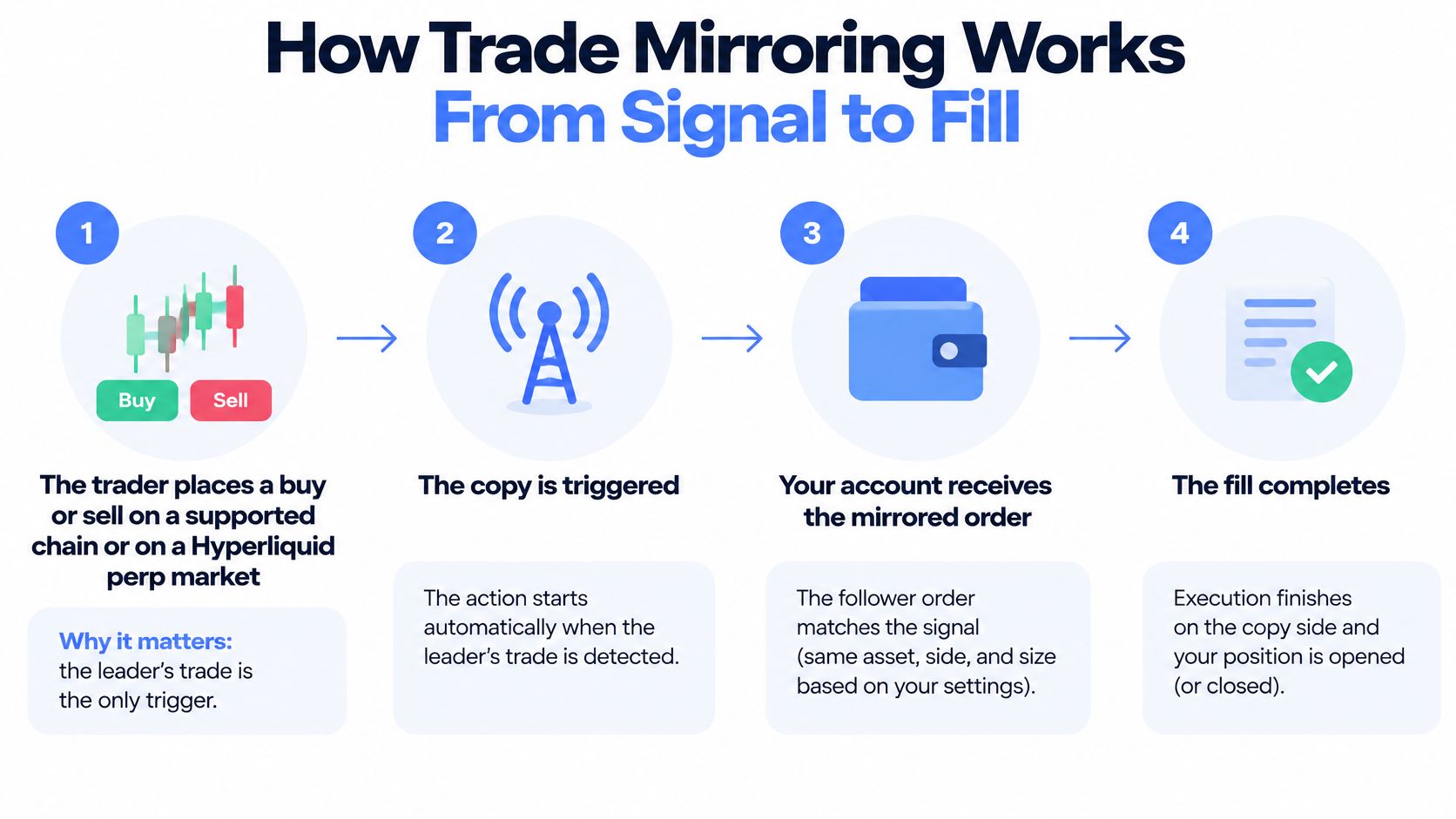
- The trader trades. They buy or sell on a supported chain, or in a Hyperliquid perp market. Their fill is the only trigger. Nothing starts because a chart looks good.
- The copy starts after that fill. It does not start before the trader is filled, so you cannot get in ahead of them. On our side, entries and exits are mirrored in both directions about one second after the trader's fill.
- Your rules set the size. The flat ticket or the share, plus any cap, is applied before an order goes out. The trader's size is an input, not your order.
- The order leaves your wallet. Copying arms at the end of the copy flow, and a copy fills once the wallet holds the cash it needs. No cash means a missed copy, which is different from a late one.
- The fill is the price then available. That price is usually after the trader's fill. This gap is the main reason your result and theirs split.
- It keeps running on rules you already set. Sleep does not stop a copy. It also does not raise your cap or rewrite your exits.
The ESMA supervisory briefing on copy trading treats each copied order as exposed to timing and pricing risk. IOSCO flags those risks, and the briefing says firms that handle copied orders should judge whether the instrument fits the client's knowledge and experience, and warn the client when it does not. Network delay, confirmation, routing, thin liquidity, and price movement all sit between the two fills. A leader price is not a price you can assume you will get.
Before copying a buy, we check that the trader paid for it. A buy that cannot be confirmed is not copied.
A correct copy shows the size you set, the entry time, and the fill price, so you can line it up with the trader's trade. You set those rules before the first copy, not after it.
The short walkthrough below shows the same sequence as a timed flow, from the leader's action to the copy side.
If the leader closes and your sell cannot complete at once, a silent leftover position is the failure mode. You want a retry, a size check, and a visible position, especially in thin memecoins and perps, where slippage and liquidation can widen the split. Trading these markets is risky, and you can lose what you put in.
Execution Delay and Why Copied Prices Differ
A copied order works like a market order sent after seeing someone else's fill: the print is real, but it is not the quote waiting for you. The table below separates the ways that gap opens, so a leader's pnl does not get mistaken for the pnl a follower can capture.
| Factor | Why it matters | What to check |
|---|---|---|
| Signal timing | The copy follows the trader's fill, so price can move first | Compare the trader's entry price with your copy price |
| Slippage | The copy fills at the price available when it executes | Compare your fill price with the trader's fill on each copy |
| Liquidity | Thin pools can fill at worse prices | Compare trade size with the market depth |
| Partial fills | A copy can fill for less than the trader's size | Confirm the position size after each copy |
| Delayed exits | An exit may not execute at once | Keep your own take profit and stop loss active |
| Short holding time | The trader can exit before a follower can copy | Check median hold time on the trader's page |
Fast holds make this sharper. A trader can show strong realized results and still be hard to match when positions turn over quickly, because your order is priced after theirs. copyfomo mirrors entries and exits in both directions about one second after the trader's fill, and a copied buy lands within seconds, so the useful question is how much the market moved in that window.
What actually opens the gap
The copy follows the trader's fill, then takes the price available at execution. A thin pool can move that price. Limited depth can fill you for less than the trader's size. An exit can wait. The slippage printed on every copied trade turns that gap into a number on the ticket, and the slippage tolerance guide explains how much drift a late order can absorb before it stops looking like the same trade.
The same timing gap gets larger when size is involved: a small delay becomes a larger pnl swing because the position is bigger while the market is still moving. Settings that limit the gap sit on your side: a cap on each copied trade, an account-wide minimum trade and max chase, and take profit or stop loss levels that fire on your levels, with a stop loss set inside one trader's copy flow applying only to that trader.
Practical rule: Judge a trader by the price you can actually get, not by the entry printed on their trade.
Trader Records and Risks Before You Copy
A visible win changes how people bet. In a controlled experimental asset market covered by the Barcelona School of Economics note on copy trading, showing other traders' success significantly increased risk-taking, and a direct-copy option increased it further. The ranking works like a loud signal, and automatic copying removes the friction of judging size, volatility, and downside yourself. Regulators and researchers alike treat the timing and pricing gap between a leader's fill and a follower's fill as a real hazard of imitative trading.
A copy does not reproduce the leader's economics. Execution time, position size, liquidity, slippage, and your own exits all reshape the result. A leaderboard return is a starting point, not your result.
Read these on the trader's public page before you copy anyone. A closer pass at the same checks sits in this guide to judging a copy trader.
- Realized pnl, not unrealized pnl. Closed results are harder to dress up than open marks.
- Win rate. A high rate built on tiny wins and rare large losses is a different bet than it looks.
- Median hold time. Short holds are harder to match after a delayed fill.
- Open positions. This is the exposure you would be stepping into now.
- Recent trades. One lucky cluster can dominate a long average.
- Loss concentration. A few trades holding most of the damage show you the downside shape.
Then run an entry-to-copy check. Take a trader's recent entries and ask where a copy would have filled, not where the trader filled. If the fills cluster well above the trader's entries, the record overstates what you would have made. Rank is not a risk measure. Set a fixed maximum allocation per trader, plus your own take profit and stop loss. Those levels apply to everything already held and keep protecting a position even after you stop copying that trader, so one leader's profile cannot scale straight into your wallet.
A high rank is a signal. It is not a measure of how much you can lose.
Past performance does not predict results. Memecoin and perp trades can produce rapid losses, and you can lose what you put in. Traders on Polymarket, alongside Robinhood Chain, Base, BNB, and Solana, are copyable on copy.top today.
Sizing Each Copied Trade
Size is the control that limits how far a bad fill can go. The settings below are the ones that change your position on each copy.
| Setting | How it works | Effect on your position | Trade-off |
|---|---|---|---|
| Flat ticket | Fixed amount for each copied buy | Same exposure on every copy | Ignores how large the trader's buy is |
| Share of trader's buy | A fraction of the amount the trader spends | Copy size grows with the trader's buy | Large buys can produce large copies without a cap |
| Cap per copy | Upper limit on any single copy | Limits outsized copies | Some copies come in smaller than the trader's share |
| Minimum trade size | Lower limit on any single copy | Skips very small copies | Some small trader buys are never copied |
| Max chase | Maximum distance above the trader's entry price | Stops copies that enter too late | Late copies are skipped entirely |
Two modes, one cap
For each trader you choose either a flat ticket or a share of the trader's buy, and you put a cap on top of either. The fomo copy-trading docs describe the same split: fixed sizing, a maximum trade size, a minimum, take profit, stop loss, and a maximum chase distance, with exits copied as well as entries. When the trader sells, the copied position can be cut by the same fraction or closed in full, depending on the setting you picked.
Say the trader's next buy is much larger than the last one. A share setting copies a fraction of that larger spend, so your copy grows with it. A flat ticket stays the same amount every time, whether the trader went small or went large. Without a cap, one outsized buy becomes an outsized copy. With a cap, some copies land smaller than the raw share. That is the trade-off, and it is the one you want when a single ticket can hurt.
What applies where
A stop loss set inside one trader's copy flow applies only to that trader. A stop set from settings applies to every trader you copy. Minimum trade size and max chase are account-wide, so they filter every trader, not one profile. Changing a take profit or stop applies to positions you already hold, not only the next trade.
Copying a buy alone is not copying a strategy. Entry time, exit time, and your guardrails all shape the result. Copied execution can differ from the original trade, and losses can occur even when the public record looks clean. A practical walk-through of the same choice is in this position sizing note.
Settle one number before the first copy: the most you are willing to lose on that single trader.
Handling Partial Sells, Full Exits and Your Own Levels
An entry without an exit rule is an open bet you did not finish. These are the cases that decide whether your copy closes, shrinks, or just sits there.
| Situation | What happens to your copy | Your control |
|---|---|---|
| Trader sells part of a position | Your copy sells the same fraction | Pause copying to stop further mirroring |
| Trader sells everything, with "all at once" chosen | Your copy closes in full | Choose the exit mode for each trader |
| You stop copying a trader | Nothing is sold and the position stays open | Sell by hand from your portfolio page |
| Copying is paused | Mirroring stops and positions stay open | Sell by hand; take profit and stop loss also pause |
| You add to a token you already copy | The whole position stays covered by take profit and stop loss | Adjust levels per trader or account-wide |
Exits are mirrored in both directions. If the trader sells part of a position, your copy sells that same fraction. If you chose all at once and the trader sells the rest, your copy closes in full. That is the trader's exit, not yours.
Your levels, not theirs
Take profit and stop loss fire on the levels you set for that trader, not on the trader's levels, and they apply to copied positions. Change either level and the new level covers everything you already hold, not only the next trade. If you add to a token you already copy, the whole position stays under those levels. A token you bought yourself, outside the copy, is yours to sell from your portfolio page.
Pause is not the same as stop
Pausing the copying switch stops all mirroring and does not sell anything. Your take profit and stop loss pause too, and they resume the moment you resume copying. Paused positions stay open. You can still sell them by hand from your portfolio page.
Stopping one trader is narrower. Nothing is sold. The position keeps its pnl, and your own take profit and stop loss keep protecting it. You can still sell by hand if you want out.
Choose the exit mode and the levels before the first copy. After the trader has already sold, you are managing a leftover, not a plan.
Custody and Keeping Control of Your Keys
Non-custodial means the wallet is yours. We do not hold your funds. Each copy is an order from that wallet, and you can export the key.
A custodial setup is the opposite. The service holds the money and places trades from its own accounts. You get convenience, and you give up the ability to leave with the position still in your name.
The trade-off is blunt. Because nobody else holds the money, nobody else can freeze a trade by sitting on your balance. Nobody else can restore a lost key either. Backup and wallet security sit with you.
- Store the key offline. A cloud note is not a backup.
- Never share it. A support chat does not need it.
- Check the address before you fund. One wrong character sends the cash elsewhere.
- Keep only what you can lose in the wallet you use for copies.
Pausing copying stops mirroring and leaves positions where they are. Stopping a trader does not move them either. They stay in your wallet, and you can sell by hand from your portfolio page.
You keep custody, and you keep responsibility for the key. Copy trading carries risk, and you can lose what you put in.
Start Your First Copy With Limits Set
Work through this once, in order, before you leave a copy running overnight.
- Open the trader list and read realized pnl, win rate, median hold time, open positions, and recent trades on each candidate.
- Pick the chain: Solana, Base, BNB Chain, Ethereum, Robinhood Chain, or Arc, or Hyperliquid if you want perps.
- Set a flat ticket or a share of the trader's buy, and put a cap on each copy.
- Set take profit and stop loss, and decide whether they apply to that trader or to every trader.
- Fund the wallet so a copy can fill, then confirm copying is armed.
- On the first copies, compare size, entry gap, and fill price with the trader's trade.
The trader list is the screen you start from.
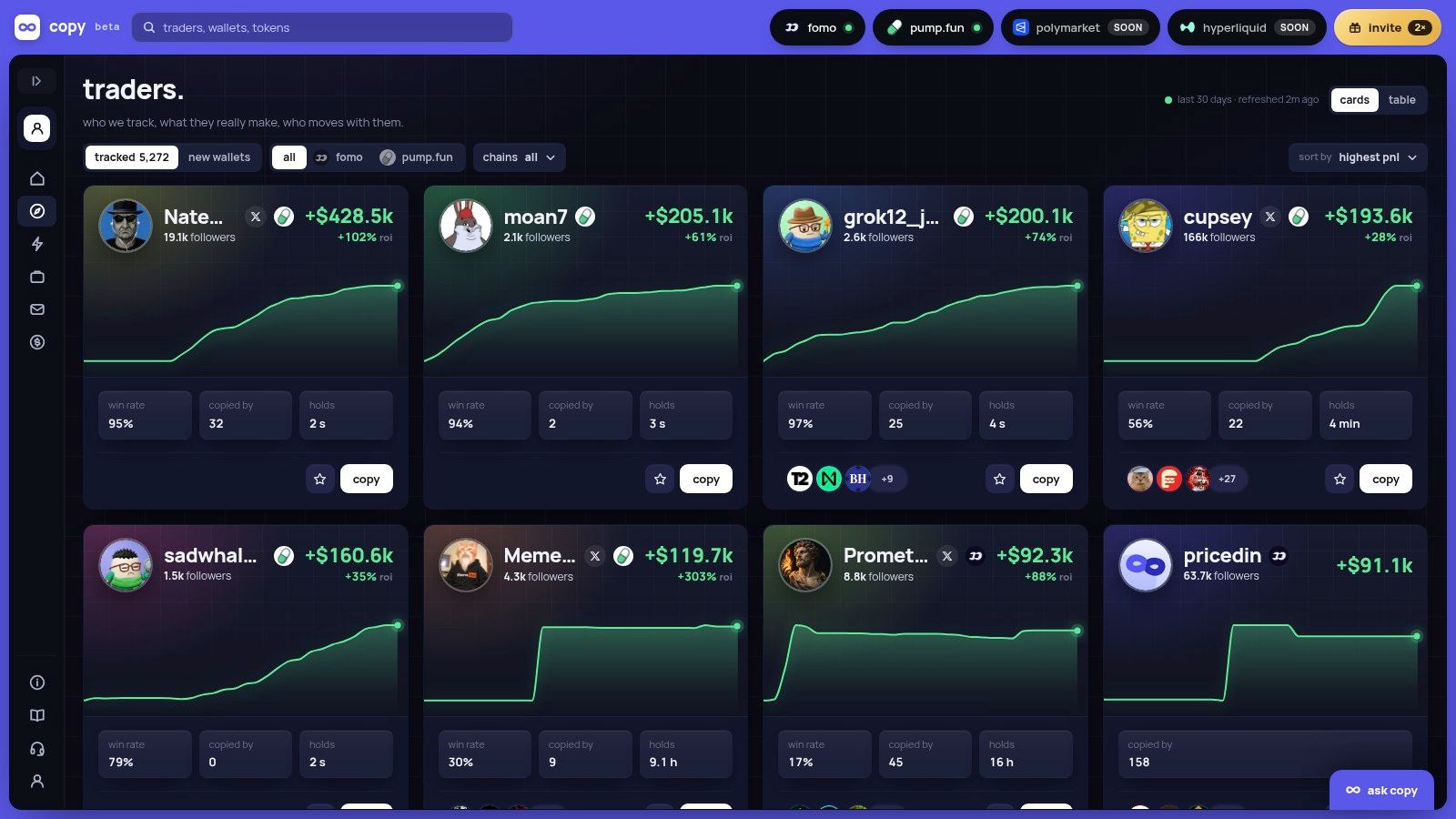
Use the coins view to see what top traders are buying, and the Hyperliquid markets view if you are copying perps. The copy.top blog has related notes on reading those pages before you size a copy. Polymarket is coming soon and cannot be copied today.
Copy trading carries risk. You can lose what you put in. Past performance does not predict results.
copy.top copies buys and sells from named traders on fomo, pumpfun, and Hyperliquid, from a wallet you control, at a size and cap you set first. Use the public numbers to judge the trader, then use your own fill to judge the copy. Pick a trader and start copying at copy.top.