 copy.top
The most popular advice about picking a crypto trading community is to find the one with the loudest wins and the busiest chat. That advice is backwards. A busy chat is a discovery engine, not a track record, and the loudest wins are usually the least repeatable ones.
What separates a community worth joining from one that drains an account is narrower than expected. It comes down to whether the numbers behind a trader can be checked, and whether you can get a fill anywhere near the one they got. Everything else, the vibe, the calls, the screenshots, is marketing until those two things hold up.
Table of Contents
- What a Crypto Trading Community Actually Offers
- Credibility Signals Worth Checking
- How to Vet a Community Before You Join
- Why Trader Records Are Not Comparable Across Markets
- Alerts Versus Fills in Three Cases
- Misconceptions That Cost Followers Money
- Pick a Trader and Start Small
What a Crypto Trading Community Actually Offers
A crypto trading community sells access, not outcomes. Strip the branding and the offer splits into three parts. Discovery is who is trading what. Evidence is whether a trader's record survives a check. Execution is whether you can get a fill anywhere near theirs. Most members collapse those three into one and then blame the call when a trade goes wrong.
You get this for a follow or a subscription.
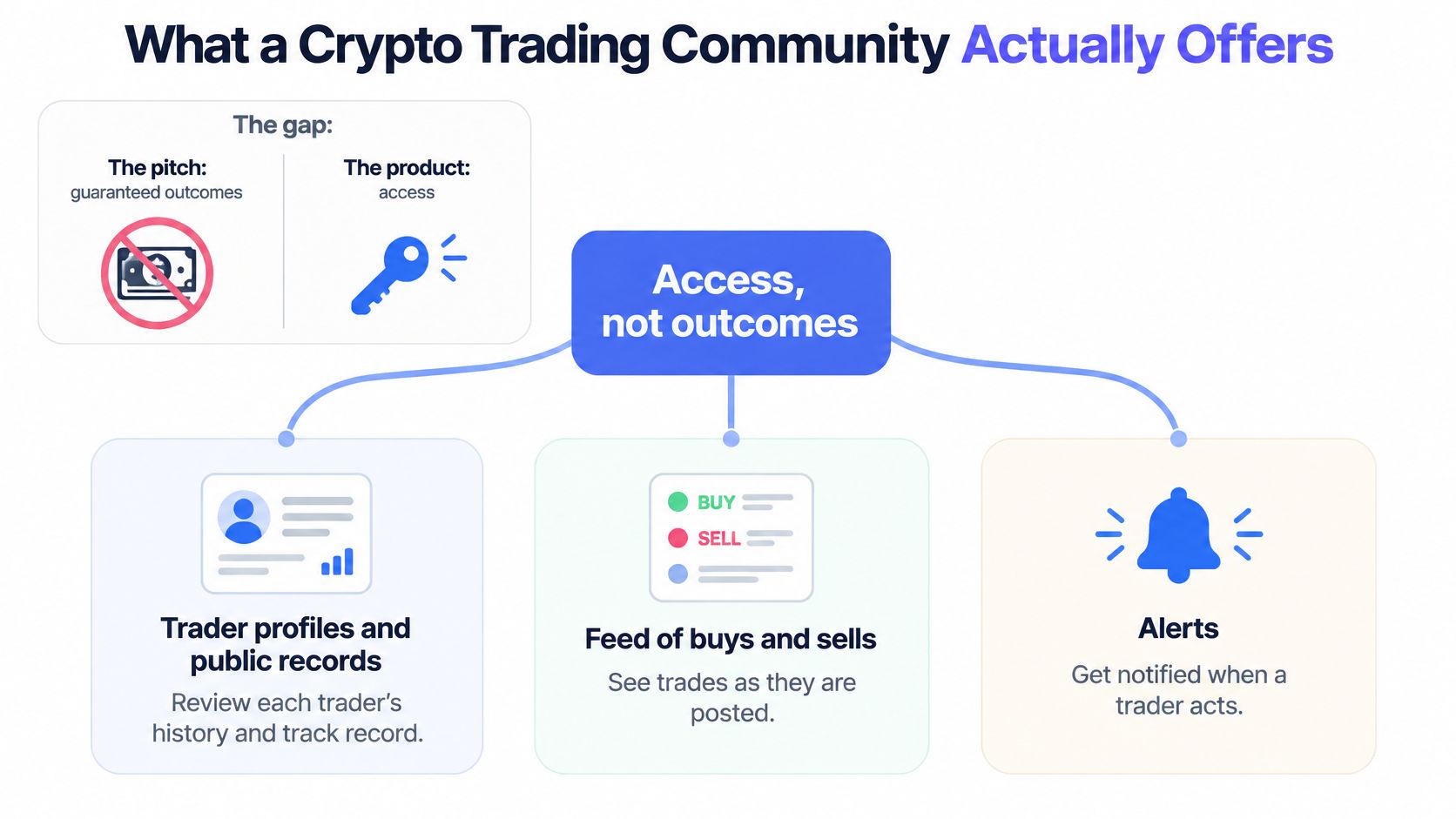
- Trader profiles and public records. A page showing realized pnl, win rate, hold time and open positions. Whether those numbers come from closed trades is the whole question.
- A feed of buys and sells. Useful for watching how a trader behaves. Less useful as a signal once you're the fourth person to act on it.
- Alerts when a trader opens a position. An alert tells you what someone bought. It says nothing about whether the entry is still reasonable by the time it reaches your phone.
- Shared research and theses. Often the most valuable part, and the part least often archived.
- Leaderboards ranked on realized pnl. A ranking is a filter for candidates, not a verdict.
- Peer discussion that flags tokens early. Speed of information, not accuracy of it.
The market these communities sit inside is global and spread across venues and regions. Chainalysis's 2025 Global Adoption Index ranks India first, the United States second, Pakistan third, Vietnam fourth and Brazil fifth, and its regional data shows Asia-Pacific activity up 69% year over year in the 12 months to June 2025. One chat, in one time zone, on one chain, is a narrow slice of that.
If you want a plain example of how service terms frame custody, risk and account responsibility before you sign up anywhere, the BUNCH cryptocurrency service terms are worth reading first.
The question worth carrying through: which parts of this offer can I check myself, and which parts am I being asked to take on trust?
Trading memecoins, perps and prediction markets is risky, and users can lose what they put in.
Credibility Signals Worth Checking
A community that publishes closed positions, realized pnl, win rate, median hold time and open exposure can be checked. One that posts screenshots and win announcements cannot. That's the dividing line, and it's binary. Read the table top to bottom on any trader page, then classify what you're looking at.
| Signal | Strong version | Weak version | What to do |
|---|---|---|---|
| Track record | Closed positions with entry, exit and size | Screenshots and win posts | Ask for the closed book, not the highlights |
| Realized pnl | Broken down per trade and per market | One headline number | Check whether one trade carries it |
| Win rate | Paired with median loss and worst loss | Stated alone | Compare average win against average loss |
| Open positions | Disclosed with size and leverage | Hidden or unmentioned | Treat unrealized gains as unproven |
| Hold time | Median hold shown | Not stated | Short holds mean alerts arrive too late to copy |
| Sample length | Covers a drawdown and more than one regime | Weeks old | Ignore records that have only seen a rising market |
| Venue clarity | Says which chain or market the record comes from | Blends memecoins, perps and prediction markets | Compare traders only inside their own market |
| Fair play | Flags traders who sell into their own followers | No disclosure | Read the flag before the pnl |
| Social proof | Discussion with reasoning attached | Calls only | Treat as a lead, not evidence |
| Costs to copy | Stated plainly | Buried or absent | Price the cost of copying before sizing a trade |
The strong column is checkable by you, today, without asking anyone's permission. The weak column requires faith. When a trader page has four strong cells and one weak one, the weak one is usually where the loss hides.
The traps that survive a checklist are the interesting ones. Headline realized pnl can come from a single outsized win on concentrated exposure, which makes a mediocre year look like a great one. A high win rate can sit on top of two severe losses that erase it, because win rate counts frequency, not magnitude. Open positions are unrealized and can reverse before you ever see them close. Survivorship bias hides everyone who blew up and left the board, so the visible population is the winners by construction.
The SEC investor alert on social media and investment fraud makes the same point from the other direction. It warns investors not to rely solely on social-media information or group-chat recommendations, and it notes that crypto assets can be exceptionally volatile and speculative, with some thinly traded and easier to manipulate.
How much weight a popular call deserves is worth calibrating. A 2026 survey of 1,200 active retail crypto traders found that 58% relied primarily on social media, compared with 21% using technical analysis and 14% fundamental analysis, according to Traders Union's retail crypto trading research. A crowded call is often a crowd, not a thesis.
A record is evidence only if it's public, closed, long enough to include a bad stretch, and it still holds up after you've looked at the open book.
Then size it yourself. Set allocation from your own portfolio, cap the amount per trader, cap aggregate exposure across correlated positions, and never mirror the leader's notional sizing. If you want a repeatable way to sanity-check a wallet's history before you commit, these onchain analysis tools cover the basics of reading flows rather than headlines.
How to Vet a Community Before You Join
Run this before you fund anything. Every step has a pass and a fail, and a fail is usually a reason to skip one trader, not the whole community.
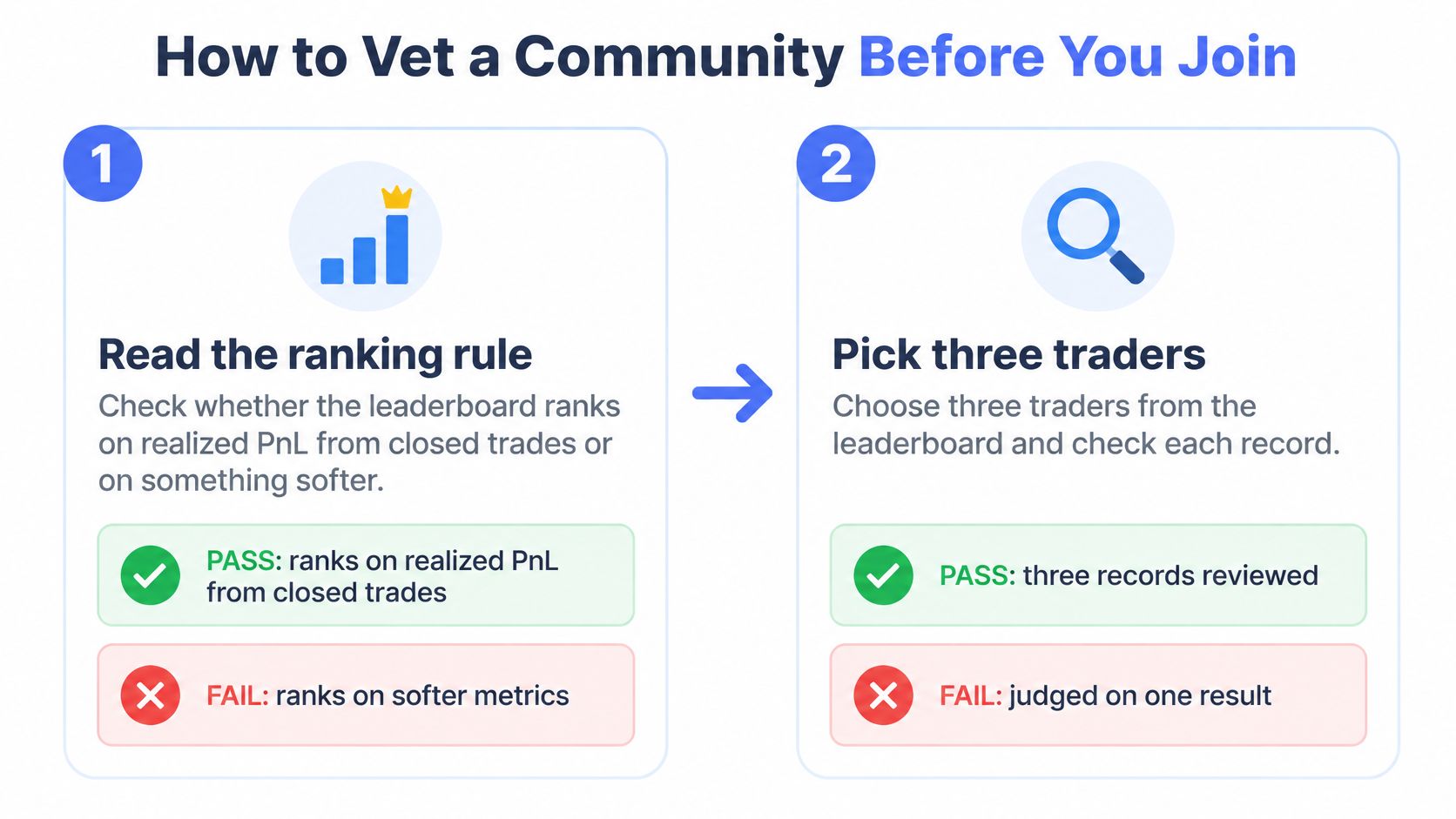
- Read the ranking rule. Find out whether the leaderboard ranks on realized pnl from closed trades or on something softer, like follower count or volume. Pass if the rule is published and closed-trade based, fail if it isn't.
- Pick three traders. Open their pages and write down realized pnl, win rate, median hold time and open position count. Pass if you have three records on paper, fail if you judged the board on one name.
- Separate closed from open. If the headline number depends on positions still running, discount it and look at what's booked. Pass if closed pnl carries the record, fail if the open book does.
- Test for concentration. Ask whether one token, one chain or one market makes the whole record. Pass if wins are spread across positions, fail if a single trade explains the year.
- Check the sample. Does the history include a drawdown, and does it cover more than a few weeks? Pass if you can see a bad stretch, fail if the record has only ever known a rising market.
- Read the disclosure. Look for a flag on traders who sell into their own followers and a plain statement that copying carries risk. Pass if both exist, fail if neither does.
- Compare execution. A trader holding minutes is hard to follow through an alert. One holding days is not. Pass if the hold time fits how fast you can act, fail if you'd be chasing every entry.
- Write the exit rule first. Decide what makes you close before you open anything. Pass if it's written down, fail if it's "when it looks bad".
- Size from your own collateral. Set the follower size from what you can afford to lose, cap total exposure to correlated positions, and keep the leader's position multiplier out of your account. Pass if the caps exist before the first copy, fail if they get set after a loss.
Most of those fails cost you one trader, not the platform. What should make you leave entirely is a community that won't publish closed records, doesn't disclose risk, or ranks on anything you can't audit.
Group chats bring their own noise. Bots, copy-paste shills and recycled calls bury the two people worth reading, which is why the ML-based spam detection for social platforms use is a reasonable mental model for how much of a feed is machine-generated. If you're following calls that arrive through Telegram, the same discipline in this guide to crypto signals on Telegram applies: verify the record, then decide.
Why Trader Records Are Not Comparable Across Markets
Crypto trading is one label over three different games. A record built on a token launch, a record built on perpetual futures and a record built on a prediction market measure different things. Reading them as one number is how a follower ends up comparing a scalper to an event trader and concluding the wrong one is better.
Memecoins trade against a curve, not a book
There's no order book to queue in. Price comes from a bonding curve, so every buy lifts the quote and every sell lowers it, and order size changes the fill you get. A copied buy can move the price before your order lands. A memecoin record is therefore partly a record of how much size that trader could push through a thin market, which is not something you inherit by following.
Perps carry leverage, funding and liquidation distance
A perp return means nothing without the borrowed size, funding cost and distance to liquidation attached. That borrowed size also creates a feedback loop. When collateral loses value, margin-backed accounts get forced to reduce positions, those sales add downward pressure, and the pressure triggers more margin calls. The Bank for International Settlements identifies forced liquidations of derivatives positions and DeFi loans as being associated with sharp price declines and volatility spikes. That's the mechanism behind the cleanest-looking record turning into a liquidation.
Prediction markets reward event skill, not tape reading
Growth in this venue is real but it isn't the same thing as broad trader success. CoinGecko's annual crypto research put prediction-market notional volume at $63.5 billion in 2025, up from $15.8 billion in 2024, a 302.7% increase. Volume growth tells you how much money changed hands. It tells you nothing about how many participants kept any of it, and realized profit in event markets can concentrate in a very small number of accounts.
The rule that fixes this: compare a trader only against traders in the same venue, and size your position from your own risk rather than the leader's notional.
Copying a sell adds its own problem. In memecoins and thin books, your exit can produce worse price impact than the one the leader got on the way out. Trading perps, memecoins and prediction markets is speculative, and users can lose what they put in.
Alerts Versus Fills in Three Cases
Three situations come up again and again. Each ends the same way: the record describes the trader's timing, not yours.
The launch buy. A member posts a buy on a fresh token launch and the price lifts as others pile in behind the alert. Later buyers get a worse entry, and the poster's pnl looks better than theirs for the simple reason that the poster was first. The pumpfun bonding curve documentation explains why: pricing is a constant-product function of virtual SOL and token reserves, larger orders get worse fills, and a copied buy can move the quote before it executes. The curve also charges a 1.25% total trading fee split between creator and protocol, which is a venue mechanic, not a copy.top fee. The costs to copy row would have flagged this before money moved.
The exit nobody saw. A trader with a short median hold posts a sell while followers are asleep. Anyone who treated the buy alert as a signal without a sell rule is still holding, now against a trader who's flat. fomo's own explainer makes the distinction plainly: an alert identifies what a trader bought, not whether the entry is still reasonable, and the followed trader may exit before the follower acts. The hold time row was the tell, and it was visible for free.
The clean perp record. A perp trader runs high borrowed exposure into a rising market and the history looks immaculate. Then collateral drops, forced selling starts, and the same exposure that flattered the record removes the account. The open positions row, read with size and position exposure attached, would have shown how little room there was before the first margin call.
In all three, the follower's own rule does the work. Fixed size, a written exit, and a cap on correlated exposure. A public record describes one trader's size and timing. It can't describe yours.
Misconceptions That Cost Followers Money
Four beliefs do most of the damage. Each one sounds reasonable and each one has a working replacement.
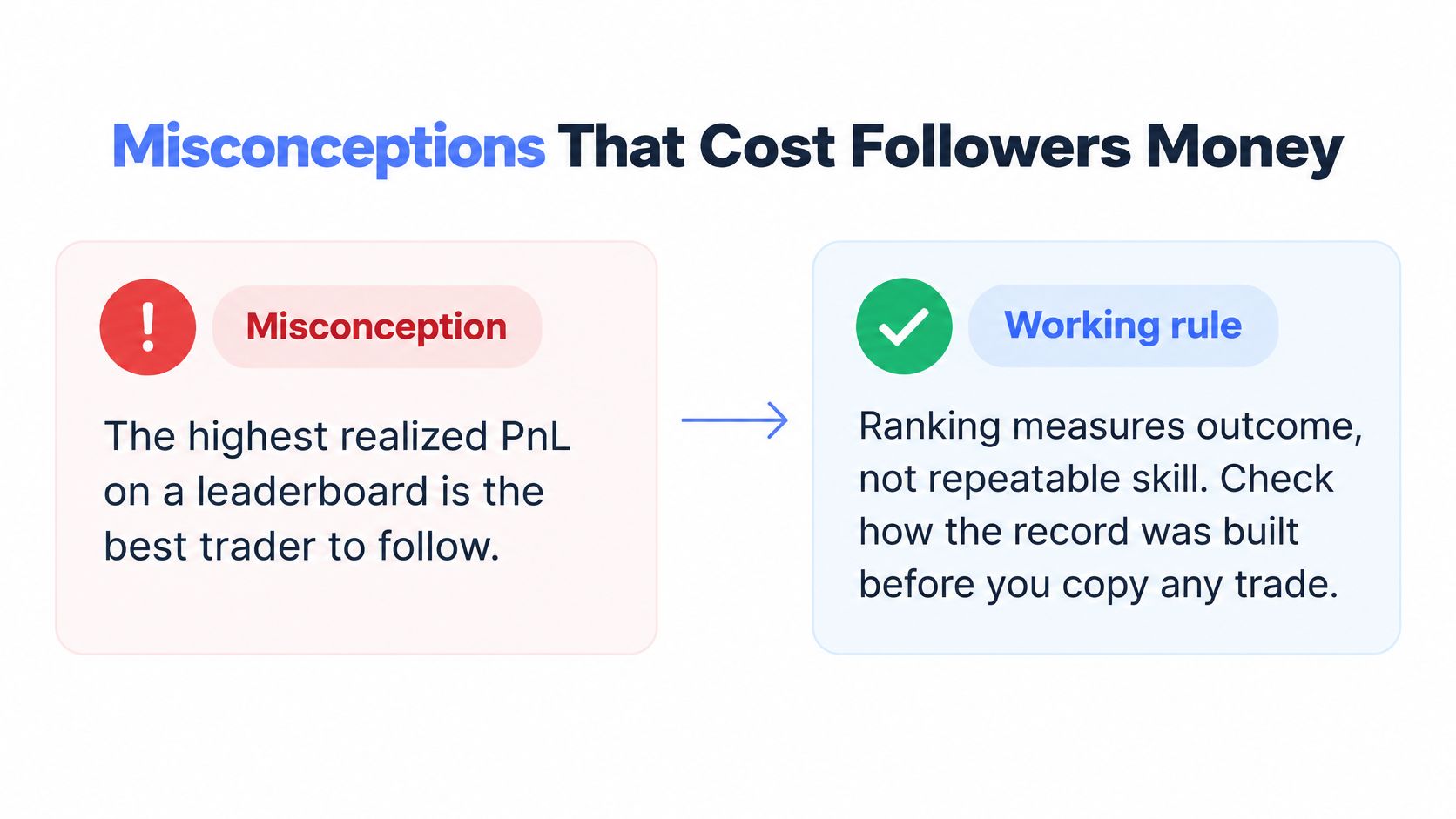
"The highest realized pnl on the leaderboard is the best trader to follow." Ranking measures outcome, not the risk taken to get there. Read drawdown, concentration and open exposure alongside the number.
"Following a trader means getting their results." You arrive at a different price, with a different size, usually later. Results diverge even when the trade is the same.
"A community's public calls are research." A call without the exit is half a trade. A leaderboard is a discovery tool, and discovery is the cheapest part of the process.
"Borrowed funds just make a good strategy bigger." It also accelerates forced selling when collateral falls. A record built in a rising market can look clean right up until volatility expands.
A good community makes records checkable and states the risk plainly. Everything else is decoration.
Trading memecoins, perps and prediction markets remains risky, and users can lose what they put in.
Pick a Trader and Start Small
Read before you copy, then size small. That's the whole method, and it takes about ten minutes to run on a live board.
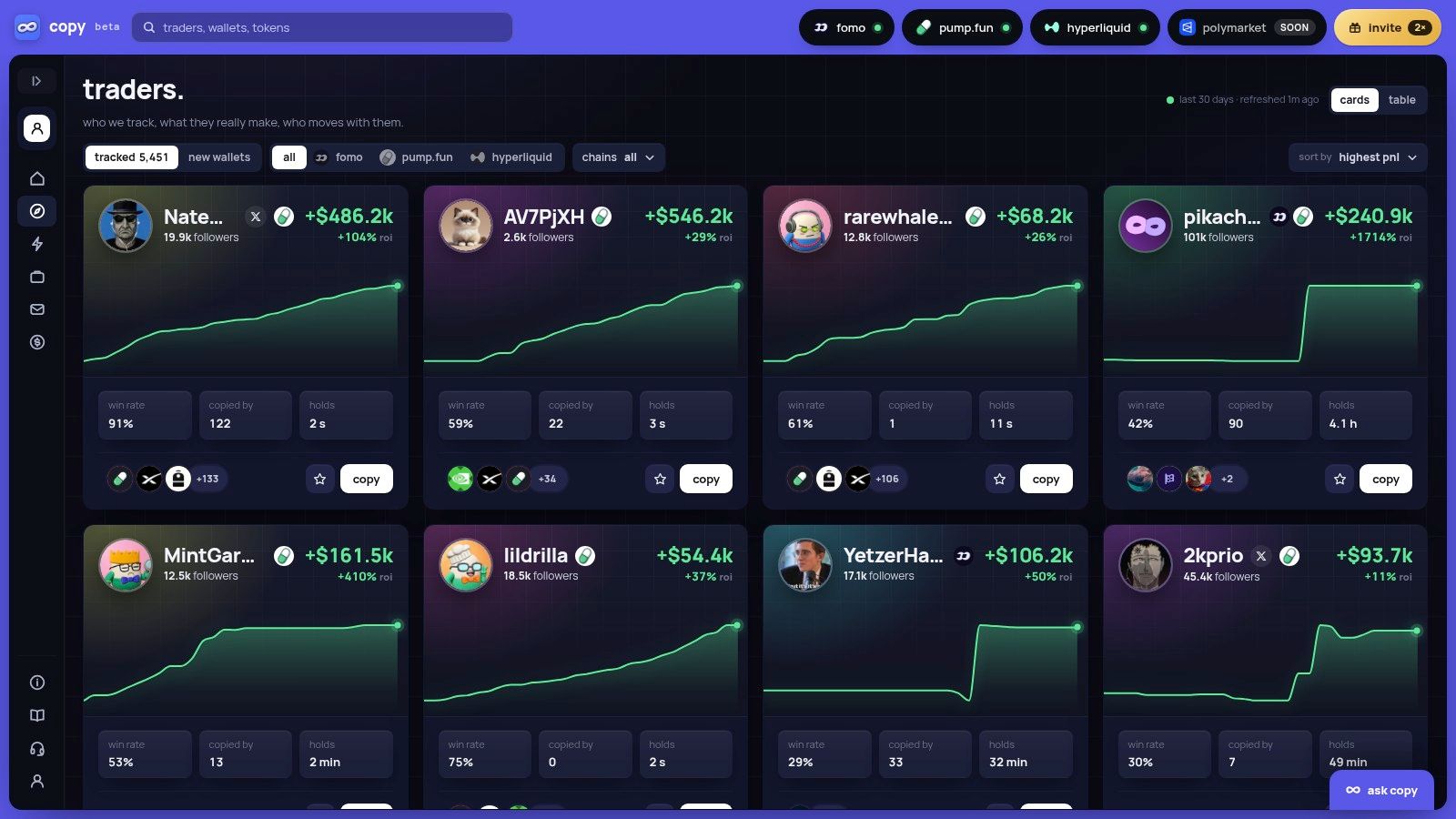
Open copy.top's trader leaderboard, sort it, and read two or three trader pages properly. You want realized pnl, win rate, median hold time, open positions and recent trades in front of you before anything else happens. Then check what's moving right now on the coins page and, for perps, the Hyperliquid trader view where positions, size and margin sit in the open.
The distribution surfaces matter less than the record. Memecoins come through fomo and pumpfun, perps through Hyperliquid, and prediction markets are coming soon, across Solana, Base, BNB Chain, Ethereum, Robinhood Chain and Arc, all from your own wallet. copy.top is independent and not affiliated with fomo, pumpfun, Hyperliquid or Polymarket.
Set the size at an amount you can lose without changing your month. As copyfomo states, trading involves risk and none of this is financial advice. Copy trading carries risk, users can lose what they put in, and past performance does not predict results. If you want the sizing math worked through before you commit, this guide to position sizing for crypto is the place to start.
copy.top is a non-custodial, multichain copy trading app where you pick a named trader from a public leaderboard, set a size, and mirror their buys and sells from your own wallet. Every trader page carries the numbers this article keeps pointing at, realized pnl, win rate, median hold time, open positions and recent trades, so the check happens before the copy. Go to copy.top, pick a trader whose closed record survives the checklist, size it at an amount you can lose, and start copying.