 copy.top

The standard advice is to sort a leaderboard by profit and copy the top name. That advice ignores who's on the other side of the trade. A Bank for International Settlements bulletin on crypto shocks and retail losses estimated that 73% to 81% of retail investors likely lost money on their initial Bitcoin investment. Someone booked the other side of those entries. A public PnL line tells you a trader won. It doesn't tell you whether you'd have won beside them.
Every tool below gets the same three checks. Realized performance: closed trades, not open paper gains. Trading history: how long the record runs, and whether it covers a falling market as well as a rising one. Risk: position sizing, exposure, exit controls, and who holds the funds while the copying runs.
This is a factual comparison, not a recommendation. Nothing here is financial advice, and no tool below removes the downside. Copy trading carries risk, you can lose what you put in, and past performance doesn't predict results. For the wider broker-side field, see this comparison of eToro and ZuluTrade alternatives.
Table of Contents
- 1. copy.top
- 2. eToro CopyTrader
- 3. Binance Copy Trading
- 4. Bybit Copy Trading
- 5. Bitget Copy Trading
- 6. Hyperliquid Vaults
- 7. Clona
- How the seven options compare on the attributes that matter before copying
- Copy Only What You Can Check, and Size for a Loss
1. copy.top
copy.top is a non-custodial, multichain copy trading web app. You pick a named trader from a public leaderboard, set a size, and that trader's buys and sells get copied automatically from your own wallet. Traders come from the fomo app, from pumpfun, and from Hyperliquid for perps. Token copying runs on Solana, Base, BNB Chain, Ethereum, Robinhood Chain and Arc. Perp copying sits in a dedicated Hyperliquid view. Polymarket leaderboards and trader data are live, but Polymarket copying isn't open yet.

What the record shows before you commit
Each trader page carries realized PnL, win rate, median hold time, open positions and recent trades, plus a fair-play rating that flags traders who sell into their own copiers. That last field matters more than the headline number. Sizing is a fixed amount per buy or a share of the trader's buy, with first-buy-only, sell-with-the-trader, take-profit and stop settings. The wallet is yours and the key can be exported at any time. Sign-in works with Telegram, Google or an existing wallet.
A trader's peak isn't your fill. Independent analysis of 100,236 copy trades over a 90-day sample found 48.48% of followers profitable against 97% of leaders, according to Dropstab's copy-trading research.
That gap is the reason to read hold time and trade size before you read PnL. A leader who scalps thin memecoin liquidity in seconds is hard to mirror at any size. A leader who holds for hours gives your order room. Our guide to top copy trading setups walks through the same screening order.
Strengths
- Named profiles: you judge a public record, not an anonymous address.
- Both sides copied: sells mirror too, so positions close when the trader closes.
- Your keys: trades run from your wallet, and the key stays exportable.
Limits
- Performance changes: a good record can stop being one, and you can lose your funds.
- Polymarket: data is available, copying isn't open.
copy.top is independent and isn't affiliated with fomo, pumpfun, Hyperliquid or Polymarket. Memecoins, perps and prediction markets are risky.
2. eToro CopyTrader
eToro runs copying inside a broker account, which changes the first question you should ask. You aren't mirroring a wallet on a chain. You're holding a balance with a intermediary and instructing it to replicate another customer's eligible trades. Eligible U.S. customers can browse investor profiles, review portfolio and performance information, set a loss threshold, and stop or adjust copying. Availability varies by state and by customer, so access is the first thing to confirm on the eToro CopyTrader page.

Copying a trader requires a $200 minimum. eToro says CopyTrader carries no additional charge, while its U.S. crypto page lists a 1% fee on crypto buys and sells. Read those together: the copy feature is free, the underlying trades aren't. There's also a demo account with a virtual portfolio, which is the cheapest way to watch how a trader behaves before funding anything.
Realized gains versus a green dashboard
A 2021 study in the International Review of Financial Analysis, listed on EconPapers, found traders didn't progressively increase the magnitude of their returns through learning, but did improve their ability to realize profits. That's the distinction to apply to any profile here. A trader who converts winning positions into closed gains is doing something different from one whose equity curve rides an open bag.
The three checks land like this. Realized performance is visible in portfolio and performance views, but you're reading broker-reported figures. History length depends on how long the investor has been on the platform. Risk control is a loss threshold plus your own decision to stop copying, and custody sits with the broker rather than with you.
3. Binance Copy Trading
Binance offers spot and futures copy trading in eligible regions, with lead-trader profiles, performance data, fixed-amount or fixed-ratio allocation, and risk controls. Access depends on location, and Binance.com copy trading shouldn't be assumed to exist inside the separate Binance.US service. Regular trading fees apply, and profit sharing for lead traders may also apply. The Binance copy trading hub documents the modes and the order-failure cases.
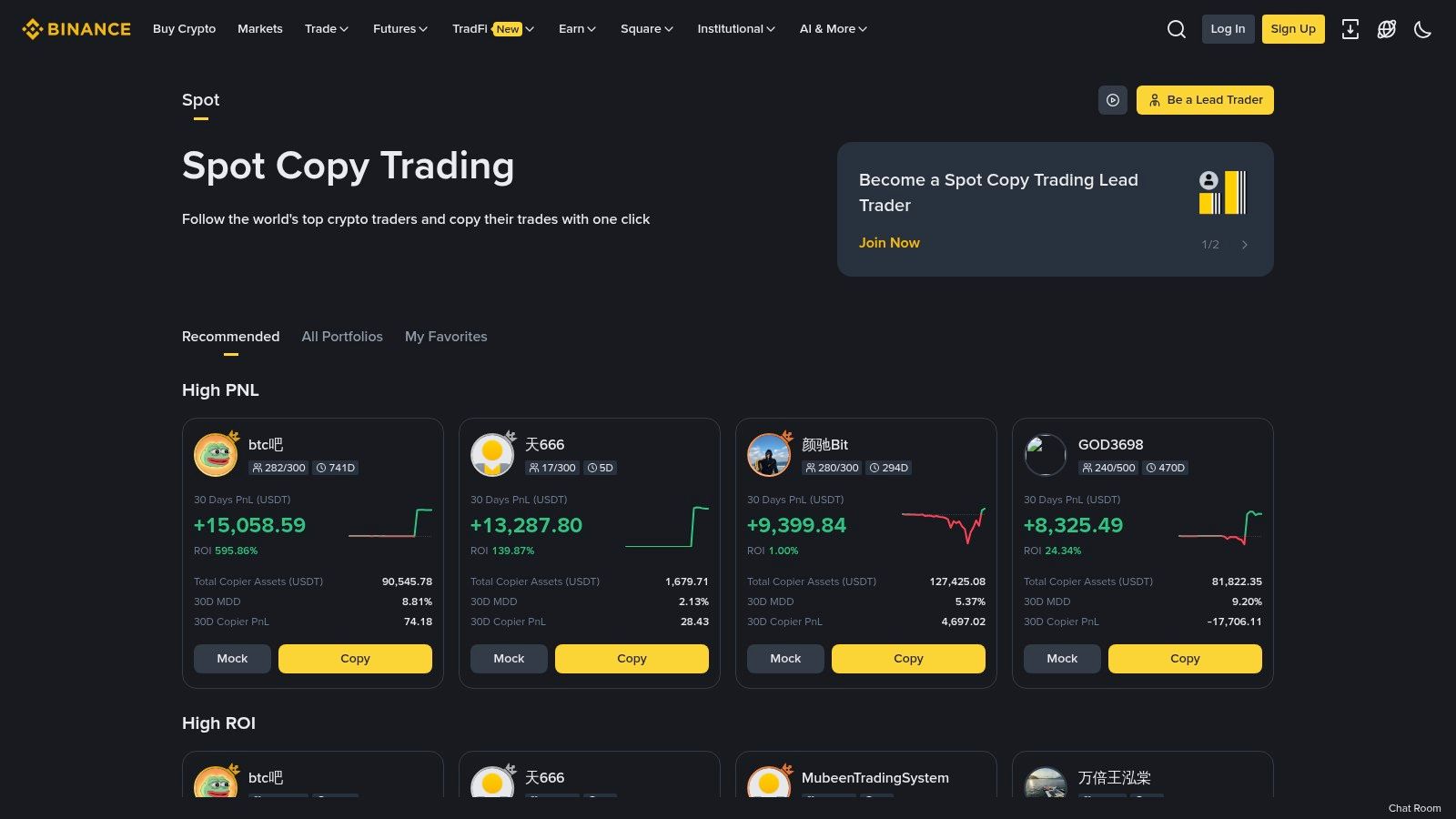
Scale is the reason traders look here first. In CryptoQuant's 2024 survey, published in January 2025, 53% of respondents named Binance as their primary cryptocurrency exchange and 48% held most of their crypto assets there. A large follower base is not evidence of a lead trader's skill. It just means more people are exposed to the same fills.
Execution check: fixed-ratio copying scales a leader's position into your account, including their leverage. Fixed-amount copying caps your exposure per trade. Pick the mode before you pick the trader.
On the three checks: realized performance and history are shown per lead trader, so compare several windows rather than the default one. Risk is where futures copying bites, since position size and liquidation distance decide whether a normal pullback closes your position. Slippage protection and stop-loss settings exist, but copied fills can still differ from the leader's. Our breakdown of copy trading platforms covers how allocation modes change outcomes, and this directory of crypto exchange advertising shows how heavily the category is marketed.
4. Bybit Copy Trading
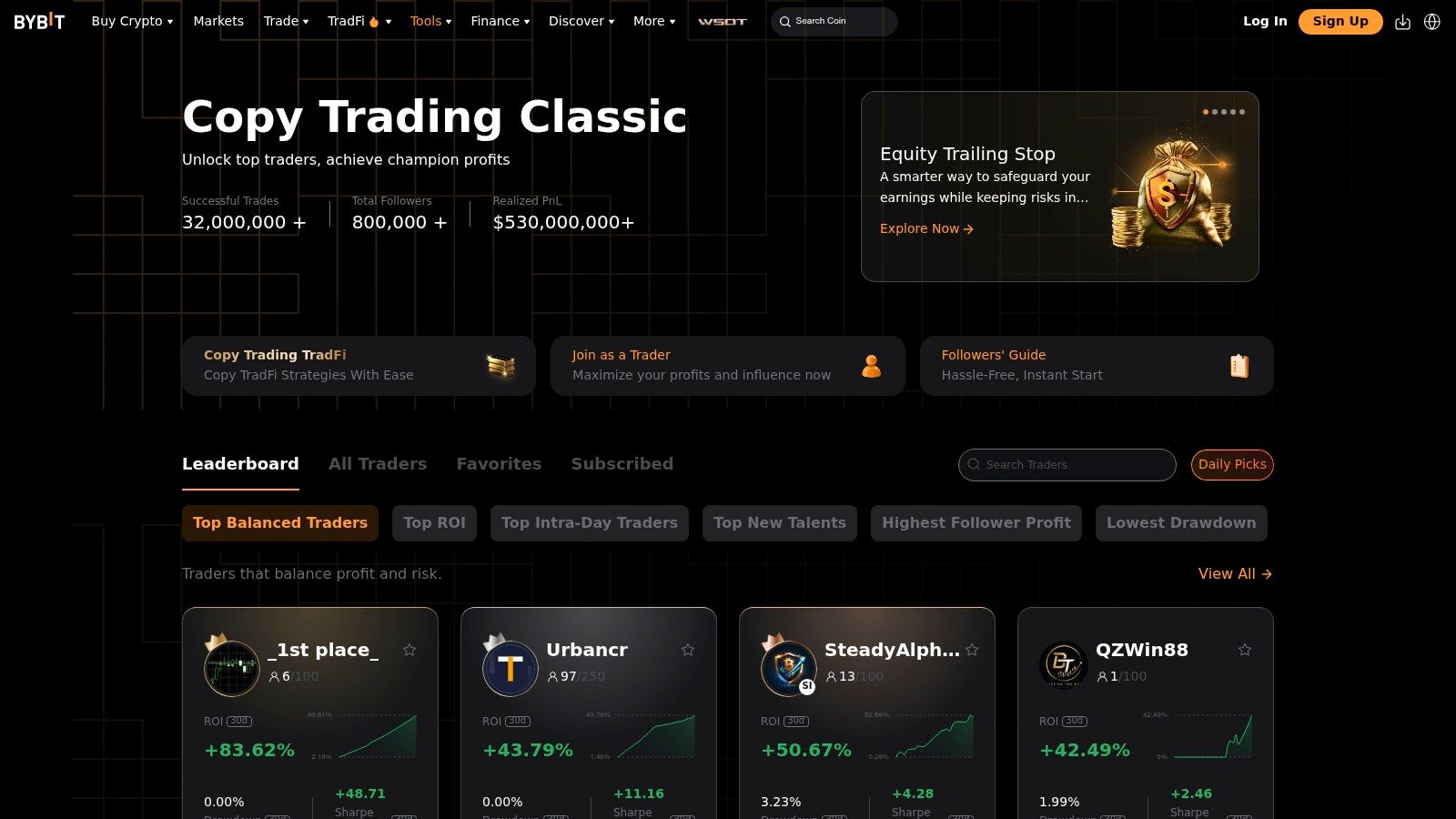
Bybit's marketplace lists master traders and replicates eligible trades into a follower account. Followers set investment amounts and slippage controls, plus take-profit and stop-loss settings on copied positions. Bybit's help center gives a typical minimum investment of 100 USDT, though individual traders may require more. Bybit lists the United States among the jurisdictions excluded from its copy-trading service, which you can confirm on the Bybit copy trading page.
Why follower results diverge
Bybit documents why a follower's position may differ from the master's. Slippage, latency and market depth all sit between the leader's order and yours. In a fast move, your entry is worse, your exit is later, or the order doesn't fill at all. That's mechanical, not a defect you can configure away.
Borrowing magnifies the divergence. A Bank for International Settlements bulletin on crypto market shocks notes that borrowed funds and automatic liquidation can intensify deleveraging in crypto markets. Forced selling feeds more forced selling. A master trader using substantial borrowed funds through a stress event may survive on margin timing you don't share.
- Realized performance: check closed results across more than one window, and treat a single explosive week as unproven.
- Trading history: look for a record that spans a drawdown, not just a rally.
- Risk: set allocation and slippage limits first, then stops, and assume liquidation is possible on any copy.
Custody sits with the exchange. That's the trade-off for automatic replication inside a derivatives account.
5. Bitget Copy Trading
Bitget supports copy trading across spot, futures and bots, with separate copy accounts and both fixed-ratio and fixed-margin modes. Its filters are the useful part. Spot traders can be screened over 7, 30, 90 and 180 day periods and compared on ROI, total profit, win rate and trade count. Bitget's terms list the United States as a prohibited country, and features and requirements vary by product and region, per the Bitget copy trading overview.
Multiple windows matter because memecoin profitability swings with the regime. Alchemii's memecoin profitability analysis reports the share of profitable wallets on pumpfun fell to 30.1% in June 2025, then rose to 73.3% in April 2026, a two-year high. The distribution behind that improvement is the part leaderboards skip: 65.14% of profitable wallets made only $1 to $500, while 5.37% made more than $1,000.
A high win rate in a month when most wallets were green tells you about the month. Sort by dollar-weighted profit and trade count before you sort by percentage.
Apply the three checks accordingly. Realized performance should be read as total profit against trade count, not ROI alone, since a handful of extreme winners can carry an otherwise flat record. Trading history is only as long as the longest filter window allows, so a 180-day record still may not include a serious downtrend. Risk depends on which product you copy: spot copying caps you at the amount deployed, futures copying adds borrowed exposure, and bot copying adds a strategy that can change behavior without changing its headline stats.
Copying doesn't eliminate losses, slippage or strategy drift. Funds sit in exchange copy accounts rather than a wallet you control.
6. Hyperliquid Vaults
A vault isn't a copy. You deposit into a pool run by a leader and share in its gains or losses, rather than holding each position in your own account. Vault pages show performance and total deposits, and trading activity can be checked against Hyperliquid's public data. Deposit requirements, withdrawal terms and leader profit shares vary by vault, as set out on the Hyperliquid vaults page.
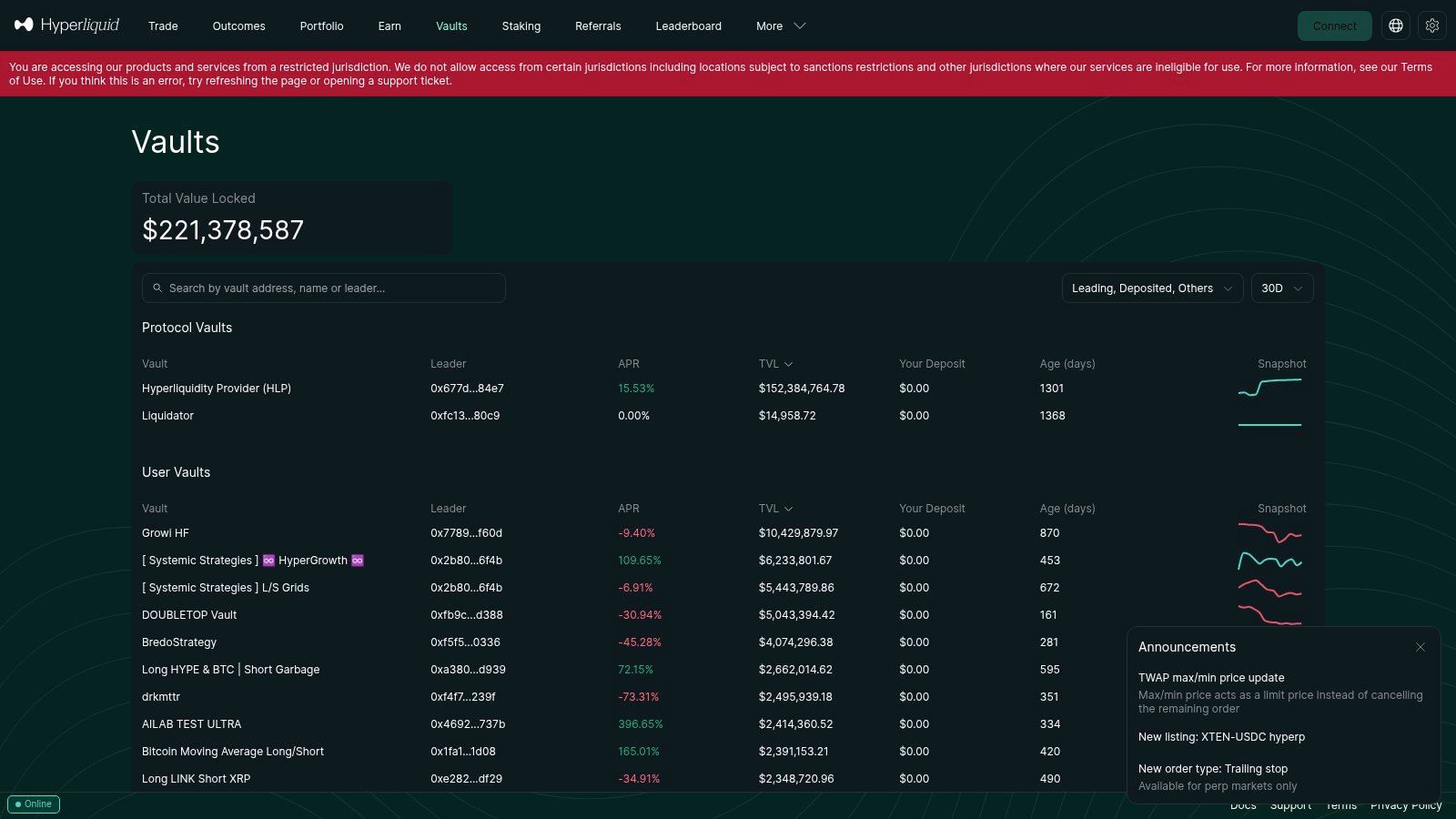
That structural difference drives all three checks. Realized performance belongs to the vault, not to the leader's personal account, and the two aren't necessarily the same book. Trading history is reviewable against public venue data, which is more than most interfaces offer. Risk includes withdrawal timing and open positions: you may not be able to exit at the moment you'd choose, and open exposure keeps moving while you wait.
Derivatives context helps size expectations. CME Group's Q2 2024 cryptocurrency report recorded cryptocurrency futures and options averaging 82,000 contracts per day in the first quarter of 2024, a 70% increase from the fourth quarter of 2023. Regulated desks measure this market in contracts and open interest, not in percentage returns. Do the same with a vault: ask what's open, how big it is relative to deposits, and how concentrated it is.
- Leader share: a profit share reduces what depositors keep, and it's set per vault.
- Loss sharing: depositors take the downside alongside the upside.
- Independence: public venue data lets you verify activity yourself, which is the main advantage here.
If you'd rather keep positions in a wallet you control, our note on non-custodial wallets explains the custody difference.
7. Clona
Clona is a third-party app focused on copying traders on Hyperliquid. It provides leaderboards plus controls for allocation, maximum copied trade size, position size, take profit and stop loss. The site lists a 0.1% copy-trading fee on the Clona trading app. Scope is narrow by design: Hyperliquid-focused copying, not multichain tokens.
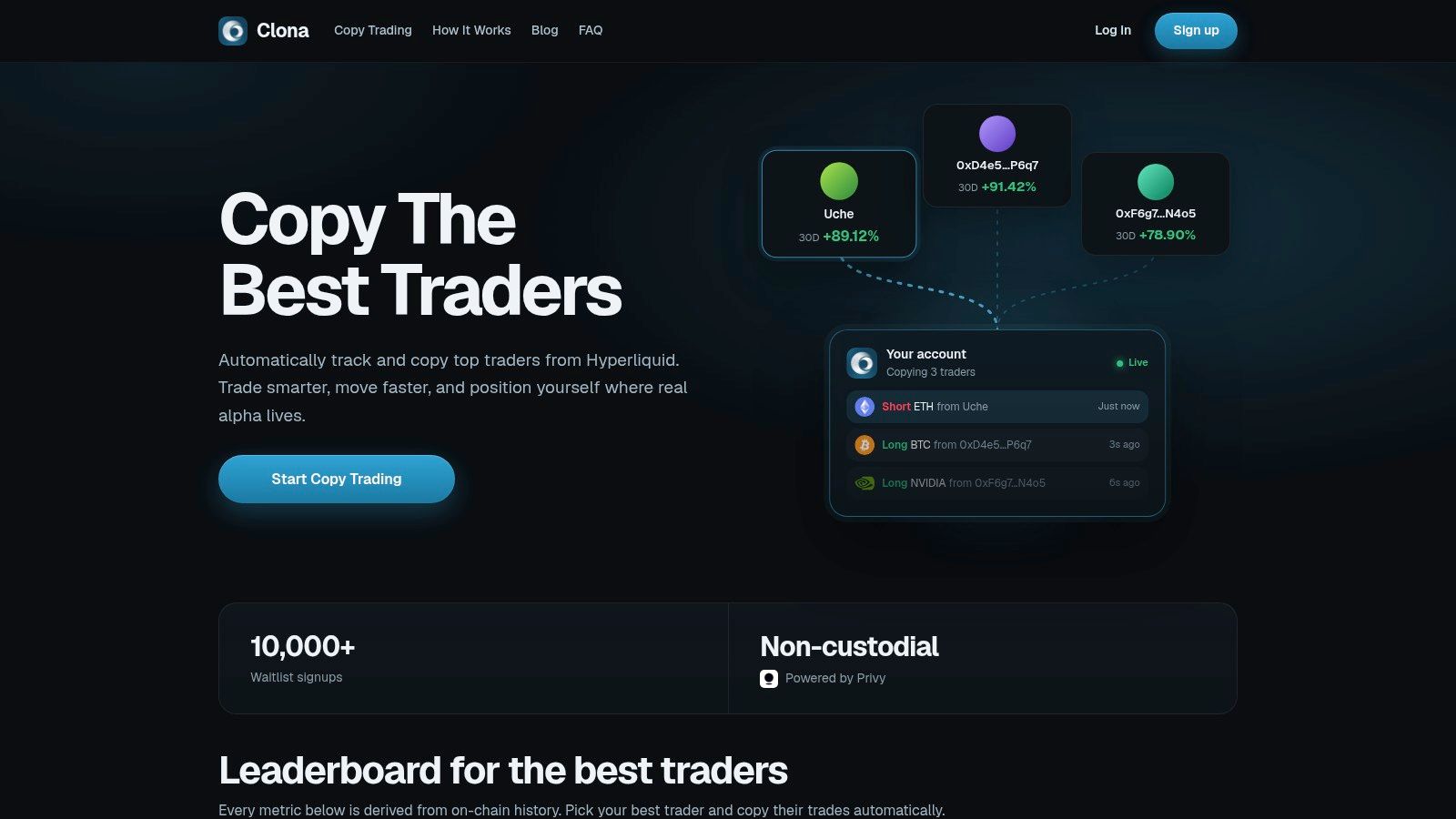
The controls are the reason to look at it. A maximum copied trade size stops a leader's oversized bet from becoming yours, and a cap on borrowed risk does the same for their risk appetite. Those two settings do more for a follower's survival than any leaderboard filter.
The dependency you're adding
Third-party execution sits between you and the venue. Review the app's authorization model as carefully as the trader's record: what it can place, what it can close, and what happens when it's unavailable. In fast or illiquid markets, copied fills can differ from the leader's regardless of how good the software is.
On the three checks, realized performance comes from the leaderboards, so verify a record against public venue data where you can. Trading history on a single venue tells you about perp trading only, and nothing about how that trader handles spot or memecoins. Risk is margin use first: funding payments and liquidation distance decide outcomes on perps, and a copied position inherits both.
This is an alternative to depositing into a managed vault, with the trade-off that you keep your own account and take on an extra execution layer. Neither arrangement makes the underlying strategy safer.
How the seven options compare on the attributes that matter before copying
| Item | Main focus | Chains or markets | Built-in controls |
|---|---|---|---|
| copy.top | Non-custodial trader copy trading | Solana, Base, BNB Chain, Ethereum, Robinhood Chain, Arc; Hyperliquid perps; Polymarket data | Copy sizing, first-buy-only, take-profit, stop settings, fair-play ratings |
| eToro CopyTrader | Social investing and crypto trade copying | Eligible crypto markets; availability varies | Loss threshold, adjust or stop copying, demo account |
| Binance Copy Trading | Spot and futures copy trading | Spot and futures; eligible regions | Fixed-amount or fixed-ratio copying, slippage protection, stop-loss |
| Bybit Copy Trading | Master-trader copy trading | Eligible markets; jurisdiction restrictions apply | Allocation, slippage, take-profit, stop-loss |
| Bitget Copy Trading | Spot, futures, and bot copy trading | Spot, futures, and bots | Fixed-ratio or fixed-margin copying; separate copy accounts |
| Hyperliquid Vaults | Depositing into trader-managed vaults | Hyperliquid | Vault-specific deposit and withdrawal terms; leader profit sharing may apply |
| Clona | Automated trader copying | Hyperliquid | Allocation, maximum trade size, leverage, take-profit, stop-loss |
Copy Only What You Can Check, and Size for a Loss
Run the same four steps before funding any of these tools. Verify realized performance and median hold time, so you know whether gains were closed and whether your order could realistically arrive in time. Check the length of the trading history and whether it includes a falling market. Cap size per trader and use stops where they exist. Confirm the access rules for your region before you deposit, not after.
The base rate is the reason for the discipline. A Bank for International Settlements working paper on crypto trading and Bitcoin prices, covering daily crypto-exchange-app use across 95 countries from 2015 to 2022, found the median investor was down approximately $431 by December 2022, close to half of the roughly $900 invested since downloading a crypto app. Most participants weren't unlucky. They were on the wrong side of a market where better-informed sellers met eager buyers.
Sizing rule: allocate an amount per trader that you can lose entirely without changing your plan. Then set the stop before the first copy fills.
A public record is a screening input, not a reason to copy. Separate realized from unrealized PnL, look at how many trades produced the result, and check whether one extreme winner carries the whole curve. For broader context on how broker platforms are ranked, see FruitPunch's online brokerage rankings.
Nothing here is financial advice. Past performance doesn't predict results, copying adds execution risk on top of market risk, and you can lose what you put in. Browse the live coin feed to see what named traders are buying, and the Hyperliquid view to check perp positions and size before you commit a budget.
copy.top gives you named traders from fomo, pumpfun and Hyperliquid with public realized PnL, win rate, median hold time and fair-play flags, so you can apply the three checks before you copy a single trade. Set a fixed size or a share of the trader's buy, keep the funds in your own wallet, and let both buys and sells mirror automatically across Solana, Base, BNB Chain, Ethereum, Robinhood Chain and Arc. Pick a trader and start copying at copy.top, with a size you can afford to lose.