 copy.top
The most popular advice in crypto is to hold your own keys. That's incomplete. A wallet you control but can't recover after a lost device, serious injury or death isn't a complete custody plan. The useful comparison isn't which model sounds safer. It's who can move the assets, who can restore access, and what happens when that person or provider fails.
For traders copying memecoins or perps, there's another question: are you handing over your funds, or granting limited permission to trade from your wallet? Those are different arrangements. Treating them as the same is how traders misunderstand both their control and their exposure.
Table of Contents
- Custodial vs Non Custodial at a Glance
- Who Holds the Keys and Who Signs
- How Copy Trading Works on Each Model
- Recovery, Inheritance and Lockout Scenarios
- Where the Risk Sits and the Controls to Set
- Pick Your Custody Model Before You Copy
Custodial vs Non Custodial at a Glance
A custodial wallet puts the private keys with a provider. A non-custodial wallet puts them with you. The provider can usually help recover a custodial account. With self-custody, recovery relies on your own credentials and backup arrangements.
That's the direct answer to custodial vs non custodial. For copy trading, the practical question is narrower: does the tool take custody of my funds, or do I keep the wallet and authorize trading?
Custodial and non custodial wallets compared
| Factor | Custodial wallet | Non custodial wallet |
|---|---|---|
| Who holds the private key | Third-party provider | You, the user |
| Who signs transactions | Provider, on your instruction | You, on each transaction |
| Access after a forgotten password | Provider can usually restore it | Only through your recovery phrase or backup |
| Main counterparty risk | Provider solvency, freezes and policy | Your own key security and phishing exposure |
| Typical use | Exchange balances and bank funding | On-chain transfers and self-managed trading |
The signing row needs a distinction for automation. You can authorize a trading permission rather than manually approve every copied order. That doesn't make the application the owner of your wallet, but the permission still deserves scrutiny.
Yield Seeker's explanation of what non-custodial actually means is a useful companion when a service's description blurs wallet ownership and transaction access. Read the custody claim alongside the permissions you're being asked to grant.
Choose the failure you can manage
A forgotten exchange password and a missing recovery phrase aren't equivalent problems. The former may have an identity-check and reset process. The latter may have no recovery route at all.
The SEC's crypto custody bulletin warns that losing a private key can permanently remove access, while a custodian's hack, shutdown or insolvency can also leave customers unable to access assets.
Practical rule: Custody trades direct control for dependence on the provider. Self-custody trades provider dependence for personal key responsibility.
Neither model removes market risk. A wallet can work exactly as designed while the assets inside it lose value. Users can lose what they put in.
Who Holds the Keys and Who Signs
The custodial flow
You deposit funds into an account controlled by a provider. The provider credits your balance on its own books. You submit instructions to trade or withdraw, and the provider handles the underlying wallet operations.
The Congressional Research Service distinguishes custodial wallets, where an intermediary maintains the keys and may record transactions internally off-chain, from non-custodial wallets, where users control the credentials required for blockchain transactions. That difference affects more than the login screen. It determines whose authorization moves funds.
Internal trading doesn't necessarily produce a blockchain transaction for every customer action. The platform can update its ledger while retaining control of the assets underneath it. A visible account balance therefore isn't the same thing as independently held signing authority.
This arrangement works naturally with bank funding and trading inside a platform. It also reduces your key-management workload. You're relying instead on the provider's availability, security, policies and solvency.
The non-custodial flow
Your wallet manages the key pair used to authorize blockchain transactions. You approve a transfer, swap or permission, and the transaction is submitted to the relevant network. The application supplies an interface, but wallet control remains distinct from the application.
The assets aren't stored inside the wallet software. The blockchain records them, while your signing credentials provide the authority to transact. That's why installing another interface can restore access when you still have the necessary recovery material.
The responsibility changes with that authority. You need usable backups, a secure signing device and a process for checking approvals. Customer support can explain a failed transaction, but it can't manufacture a lost private key.
NIST's blockchain guidance explains the consequence directly: losing a private key can permanently eliminate access to associated tokens, while a stolen key gives an attacker control. An exported key is therefore an escape route from an interface, not a harmless account file.
Self-custody removes a custodian from transaction authorization. It doesn't remove network constraints, contract restrictions or the consequences of permissions you've already signed.
Test the service, not the label
Run these questions against the actual account you'll use:
- Who holds the key? Establish whether you possess signing authority or only a platform login.
- Who can move funds without another approval from you? Include existing allowances and delegated trading permissions.
- Can you revoke access or export the key yourself? Confirm your exit route before you need it.
An application that sends instructions to a custodial exchange doesn't turn that exchange balance into self-custody. Assess the custody of the underlying assets, not just the software sending orders.
How Copy Trading Works on Each Model
On a custodial platform, copying starts with a deposit into the provider's account system. You pick a trader, set an allocation, and the provider executes from a balance it controls. The mechanics are simple because the platform already holds your funds.
Non-custodial copying keeps the wallet in your hands. You grant trading authority instead of handing over the key. The distinction that matters is permission to execute versus possession of the private key: an authorized trade can still commit your balance, so non-custodial doesn't mean your funds sit untouched.
What the user gets
copy.top is a non-custodial, multichain copy trading web app. You pick a named trader from one of four sources, the fomo app, pumpfun, Hyperliquid and Polymarket, set a size, and that trader's trades are copied automatically from your own wallet. The app matches a trader's positions on-chain to find the wallet behind the profile. You can also watch up to ten wallet addresses without a fomo account and get pinged when they trade, which lets you observe a wallet before copying it.
Each trader has a public page with realized pnl, win rate, median hold time, open positions and recent trades. Read open exposure alongside closed-trade results; a strong record on finished trades can sit next to a losing open position.
Setup separates wallet ownership from trading access:
- Your wallet stays yours. You keep the keys, and the wallet key can be exported.
- You grant an allowance. Trading runs on an allowance from your wallet that you can revoke at any time.
- You set the size and the ceiling. Token copying supports a fixed buy size or a percentage of the trader's buy. On percentage sizing, max per trade caps each position at $50, $100, $250 or a custom ceiling, and defaults to $250. Guardrails cover first buy only, sell with the trader, take profit and stop. Hyperliquid perps run on a budget you set.
The guide to starting copy trading walks through a practical setup. Decide custody first, then decide whose trades to follow.
Entries and exits both matter
Copying covers buys and sells, so a position closes when the trader closes. By default, the copy sells when the trader sells, including when the trader exits at a loss. The hold when down option mirrors an exit only when your position is in profit.
That option changes the strategy. It can leave you holding a position the trader already exited. Don't treat it as loss protection, and don't assume the trader's later decisions still describe your exposure.
Token copying covers Solana, Base, BNB Chain, Ethereum, Robinhood Chain and Arc, with perps on Hyperliquid and prediction-market traders on Polymarket.
A public track record helps you inspect a trader. It doesn't make your entry price, execution or outcome identical to theirs.
copy.top is independent and isn't affiliated with fomo, pumpfun, Hyperliquid or Polymarket. Past performance does not predict results. Copy trading carries risk, and users can lose what they put in.
Recovery, Inheritance and Lockout Scenarios
Who can recover the wallet when something goes wrong? That question is more useful than declaring either custody model safer. Recovery after a broken phone is different from recovery after a compromised key, and neither solves inheritance automatically.
Use the failure scenario, not the wallet label, to test your continuity plan.
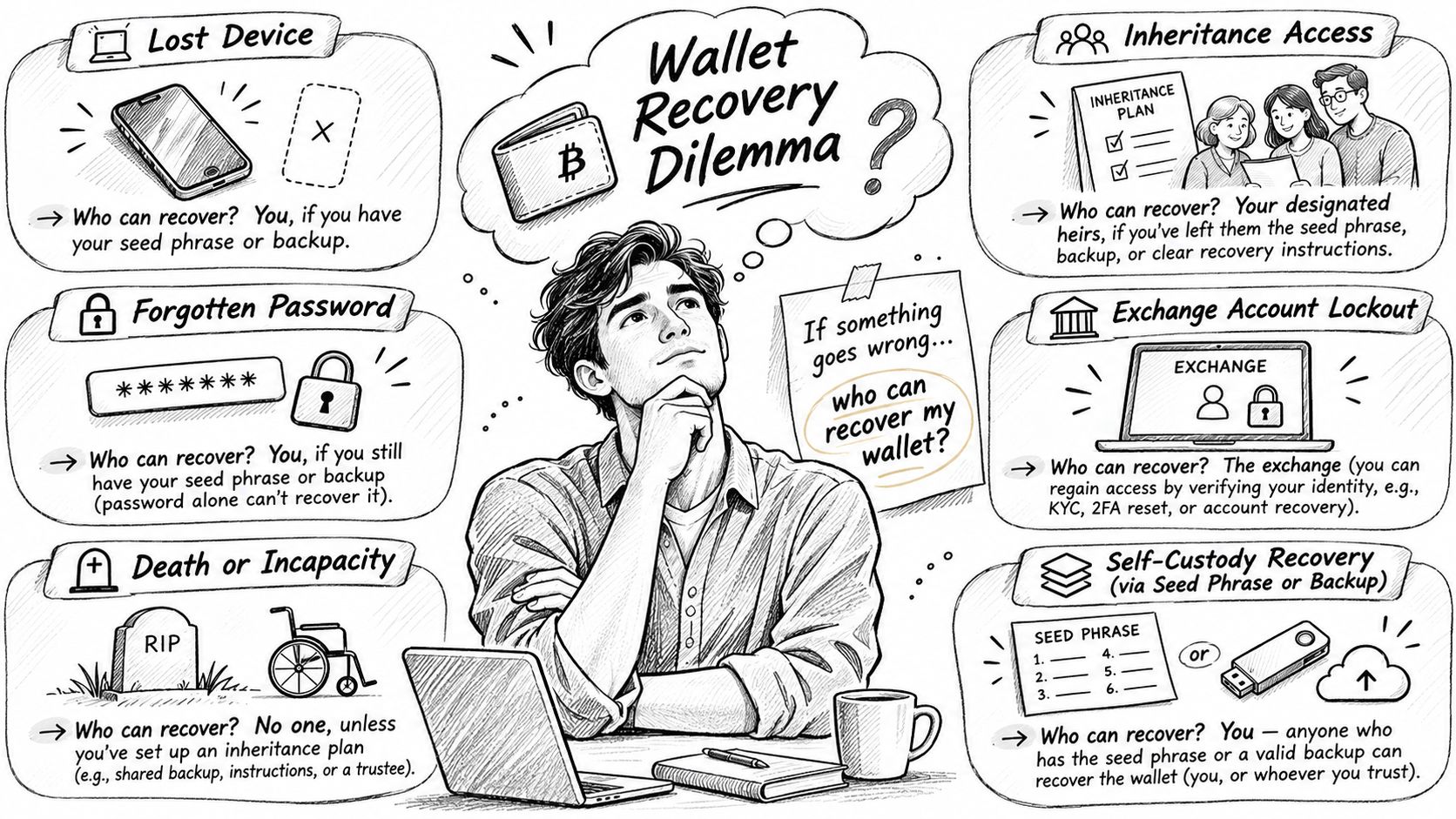
Recovery scenarios under each custody model
| Scenario | Custodial path | Non custodial path |
|---|---|---|
| Lost phone or device | Provider resets access after identity checks | Restore from the recovery phrase on a new wallet |
| Forgotten password | Provider reset flow | No provider reset; use the recovery phrase or key |
| Death or incapacity | Estate process through the provider | Heirs need authorized access through recovery material or a written plan |
| Provider lockout or closure | Access may remain paused until resolved | Sign through another compatible interface if you retain the keys |
| Legal dispute over assets | Provider and courts may hold assets | Control must be established; legal ownership still requires resolution |
| Congested or failed chain | Provider manages settlement timing | You manage timing, retries and network fees; recovery requires a functioning network |
A replacement device doesn't solve a missing backup. Equally, a backup won't undo key theft. If someone else has the signing credentials, restoring the wallet merely gives both parties access.
Inheritance needs more than a hidden phrase
A 2025 ACM study found that among 279 participants who correctly recognized a seed phrase, only 22% had shared it with family for recovery after death or serious injury, while 9% had shared it specifically for account recovery. Those figures describe that participant group, not all crypto holders.
Sharing the phrase isn't automatically the right answer. Anyone who can access it may be able to move the assets before the intended handover. A backup needs confidentiality as well as availability.
A workable inheritance arrangement addresses beneficiary enrollment, changes to beneficiaries, disputed claims, privacy and post-transfer auditability. It should tell the authorized person what exists, how to obtain access, and what authority they have to act. Don't put the full secret in an ordinary shared document.
For a family or business, a wallet only one person can access may be less resilient than a custodian's estate process or a carefully documented multisignature recovery arrangement. That's a trade-off, not a verdict in favor of either model.
Separate recovery from trading permission
A copy-trading emergency plan should distinguish the owner's credentials from the application's allowance. Revoking an allowance stops that permission from being used. It doesn't rotate a stolen private key or close existing market positions.
- If the application is unavailable, retain an independent route to the wallet and relevant positions.
- If a permission is suspect, revoke it and review other approvals.
- If the key is compromised, treat the wallet itself as compromised, not merely the application connection.
Recovery test: Your authorized successor should know how to find the plan without receiving unrestricted access before they need it.
Don't assume technical control settles a legal dispute. A person may possess the key without being entitled to the assets. Recovery planning needs both operational instructions and appropriate legal arrangements.
Where the Risk Sits and the Controls to Set
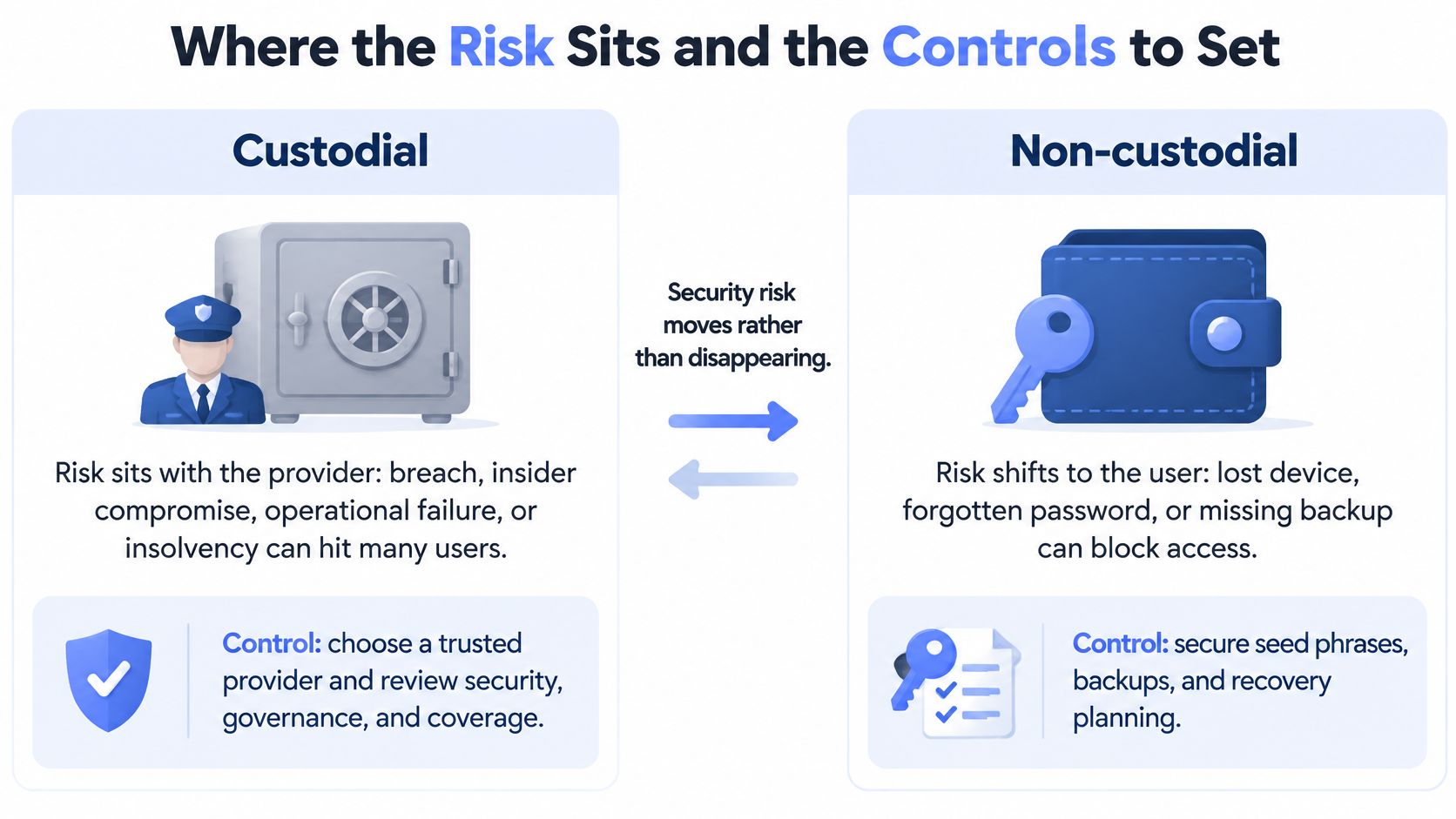
Security risk moves rather than disappearing. A custodial provider concentrates control: a breach, insider compromise, operational failure or insolvency can affect many customers at once, and a withdrawal freeze can stop you from acting when it matters most. Whoever holds the keys also decides who can get back into the wallet after a lost device, a death or an account lockout.
Self-custody shifts failure to a different set of points. A phishing page, infected signing device, stolen recovery phrase or malicious approval can defeat a sensible trading setup, and sending assets to the wrong address leaves no practical reversal route. The distinction is about where failure occurs, which controls you can operate, and whether anyone can restore access when something goes wrong.
A 2023 wallet-security survey's incident analysis reported that custodial wallets accounted for 70% of observed attacks and non-custodial accounts for 30%. That distribution describes observed incidents, not per-user attack probability or proof that either model is intrinsically safer.
Find the single point of failure
For a provider, examine security controls, governance, withdrawal policies and any coverage terms. A familiar brand or polished login tells you nothing about whether customer assets will remain accessible during a freeze or insolvency.
For self-custody, inspect the whole signing process. A hardware-protected key doesn't make a malicious approval sensible, and a recovery phrase stored in a screenshot can undermine an otherwise secure device.
Use these checks before enabling automation:
- Where does the key sit? Identify every device, backup and person with access.
- Who can stop a transfer? Include the custodian, network, contract and any relevant account restrictions.
- What fails if a single component disappears? Test your dependence on an email account, device, application interface or sole authorized person, and confirm someone can still reach the wallet.
The objective isn't to eliminate every dependency. It's to avoid discovering an undocumented dependency during an incident.
Copying adds execution and position risk
A copied trade can execute at a different price. Thin liquidity, price movement and transaction timing can produce slippage, and smart-contract failure can create losses even when the trader's directional call was correct.
Perps add margin, collateral requirements and liquidation. Venues can offer borrowing high enough that an ordinary market move rapidly eliminates the supporting margin. Copying a trader's direction without matching their sizing, margin, collateral and liquidation buffer produces a materially different outcome from the one their track record shows.
Perpetual positions also carry ongoing funding payments between long and short holders, a mechanism that pulls the contract price toward the underlying spot market. A copied position's visible profit and loss doesn't show how much funding it paid or received while open, so two wallets holding the same position for different durations can end up with different results.
If you're assessing prediction-market trading, read the event definition and settlement terms rather than treating the displayed price as certainty. The CFTC's prediction-market guide explains that these contracts commonly use binary outcomes and settle according to the specified event. That risk sits apart from custody.
The video below offers additional context for evaluating the custody decision.
Set controls before enabling the copy
Use a separate trading wallet. Keep long-term holdings outside the wallet you connect to trading applications. Separation limits what an approval mistake or compromised trading workflow can expose.
On copy.top the allowance works from your own wallet: assets stay under your key, and you can revoke the trading permission at any time, so a provider problem can't trap funds the way a custodial freeze can. Set the allowance to an amount you can afford to lose, review what the permission authorizes, and run a small revocation test before relying on it during an emergency. An allowance is a spending permission, not a stop-loss or a cap on every possible market exposure.
Choose sizing deliberately. A fixed amount makes each copied buy easier to budget. Percentage sizing follows a share of the trader's buy, so the per-trade ceiling matters.
Our Max per trade control offers $50, $100, $250 or a custom ceiling. It defaults to $250 and applies only to percentage sizing. That's a sizing control, not a statement that the default is suitable for your balance.
Decide how exits behave before the first losing trade. When the trader sells at a loss, the default is to sell with them; the hold when down option mirrors an exit only when your position is in profit. Add take-profit and stop rules where supported, keeping in mind these are execution instructions rather than promises about the price available when an exit occurs. Watch open positions closely enough to notice failed exits or exposure that no longer matches your intended strategy.
Maintain the setup
Keep recovery material offline and away from ordinary cloud notes, chat messages and screenshots. Verify destination addresses, network selection and contract details before signing. Never give an application your recovery phrase to repair a connection.
Use the token approval checker guide to support periodic permission reviews. Remove approvals you no longer need, and distinguish disconnecting a website from revoking its on-chain authority.
An application disconnect is a session action. A permission revocation is an authorization change. Don't assume one performs the other.
Memecoins, perps and prediction markets all carry substantial risk. Losses can include the full amount allocated. Self-custody doesn't protect against market loss, smart-contract failure, execution slippage or liquidation.
Pick Your Custody Model Before You Copy
Make the custody decision before the trader decision. The copy-trading platform guide can support the comparison, but your recovery and permission requirements should determine the setup.
- Choose who holds the keys. Accept either the provider's failure modes or your own backup and signing responsibilities. Don't choose self-custody without a recovery plan.
- Prepare a separate trading wallet. Record recovery instructions offline, including who is authorized to access them during incapacity or death.
- Set the allowance and sizing ceiling. Confirm the revocation path before enabling automatic trades.
- Inspect the public record. Review trader profiles using realized pnl, win rate, median hold time, open positions and recent trades. Past performance does not predict results.
- Check the market. Inspect memecoin activity or Hyperliquid perps with the relevant liquidity, position-size and execution risks in mind.
- Start within your loss budget. Review permissions after the first week and whenever you stop following a trader.
Copy trading carries risk. Users can lose what they put in, even when the custody setup works correctly.
copy.top offers named traders, public track records and automatic copying from your own wallet, with an allowance you can revoke. Visit copy.top to pick a trader, set a size you can afford to lose and start copying with your custody and recovery plan in place.