 copy.top

Sort the leaderboard by profit and copy the name at the top. That's the advice most traders get, and it fails for a reason you can measure: a leaderboard ranks a record, not a strategy you can reproduce.
A wallet's history is one account, doing one thing, under one set of conditions. The chain shows the trades. It doesn't show whether you'd have got the same entry price, the same exit, or the same fill at your size. Those gaps don't appear on any trader page, and they decide most of the outcome.
So read a trader page the way an analyst reads a lab report. Separate what was measured from what was inferred, and separate the trader's result from the follower's.
Table of Contents
- What Crypto Wallet Analytics Measures
- Core Metrics Every Trader Record Should Show
- How Realized PnL Is Reconstructed Step by Step
- Why Wallet Attribution Is Never Certain
- Lead Trader Results Versus Follower Results
- Memecoin and Prediction Market Records Need Different Checks
- Confirm a Trader's Record Before You Copy
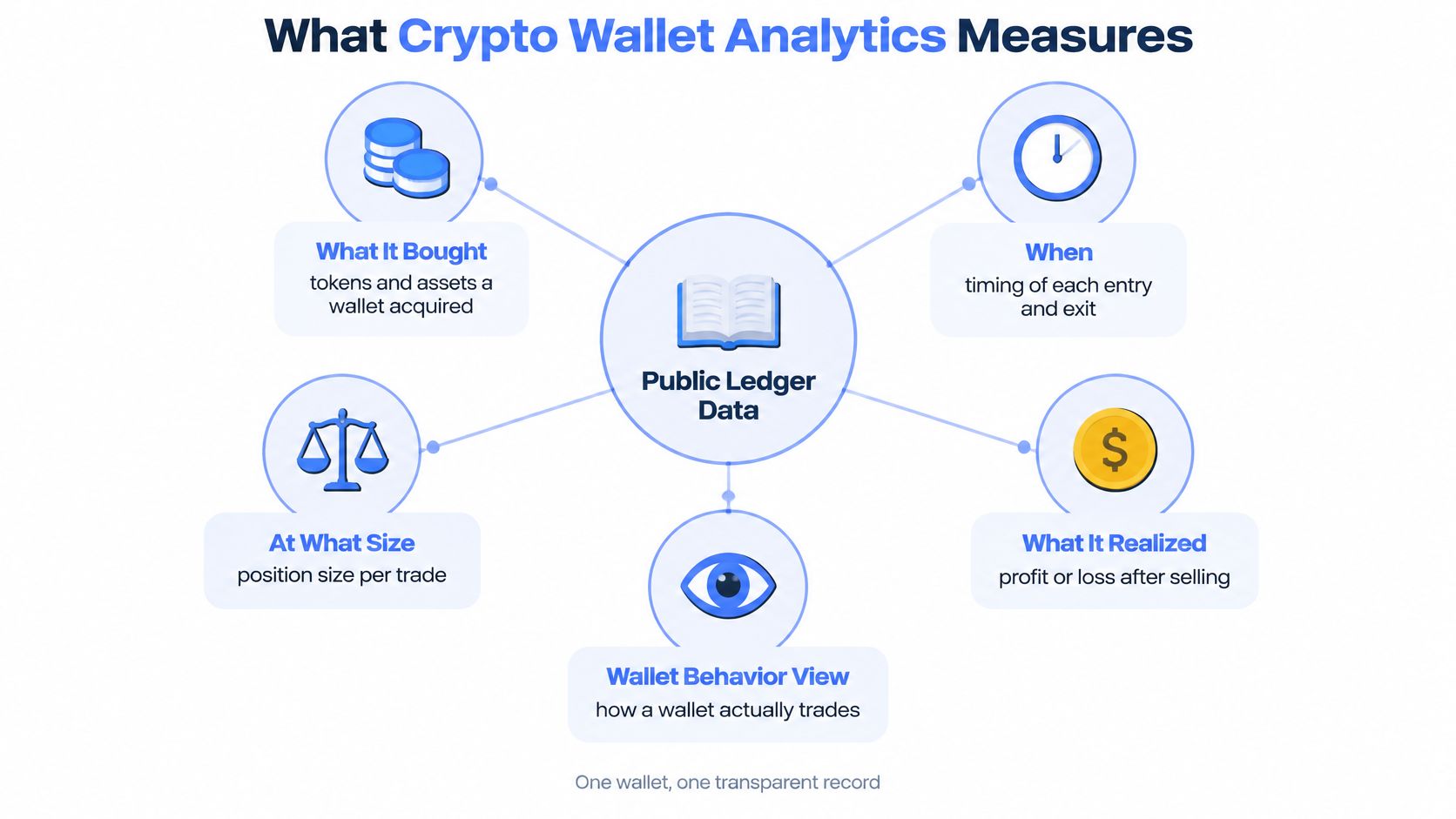
What Crypto Wallet Analytics Measures
A wallet record can look precise while answering only a narrow question: what happened at a particular address. Crypto wallet analytics organizes public ledger activity into a view of transactions, holdings and trading behavior. The chain records transfers and swaps; an analytics service classifies them and estimates what they mean.
Addresses are not people. One trader may use several addresses, while a single exchange address may serve many users. Analysts therefore group addresses that appear to share control. A foundational Bitcoin study applied the common-input heuristic, treating addresses spent together in one transaction as evidence of shared ownership. It identified 2,197 clusters covering more than 1.8 million addresses, as described in the published clustering study. The result is an estimate of control, not proof of identity.
Clustering resembles grouping bank accounts by evidence that they belong to the same household. The ledger records each transaction, but the grouping is inferred. Errors in that inference can change which activity gets attributed to a trader.
The same distinction matters in crime statistics. Blockchain analytics firms report totals for funds sent to addresses they have labelled illicit, but those totals depend on which addresses are identified and when. Newly labelled addresses can also raise estimates for earlier periods. Such figures describe attributed activity, not a complete count of all illicit transactions.
A trader record combines direct observations with interpretation. Transaction amounts and timestamps are recorded on-chain; wallet ownership, trade intent and realized performance may require classification or estimation. That difference matters for accounting for crypto investors, where transaction-level details inform how activity is categorized. A record can describe what an address did, but it cannot by itself show what another trader could have achieved after differences in timing, position size, liquidity and exit options.
Core Metrics Every Trader Record Should Show
Six numbers carry most of the signal on a trader page. Each is worth reading. None is worth reading alone.
| Metric | What It Shows | Where It Misleads |
|---|---|---|
| Realized PnL | Profit or loss from closed positions | Leaves out gains and losses still open |
| Unrealized PnL | Value of open positions at current prices | Can reverse before the position is closed |
| Win rate | Share of closed trades that made money | Ignores how large the wins and losses were |
| Median hold time | Typical length of time a position stays open | Averages hide a mix of very short and very long holds |
| Max drawdown | Largest peak-to-trough loss on the account | Depends on the time window chosen |
| Exposure concentration | Share of capital in one token, event or market | One launch or outcome can drive the whole record |
Nothing in that table ranks a trader by itself. Realized PnL counts closed positions, so a wallet sitting on a large winner shows nothing until the winner is sold. Win rate treats a $200 win and a $9,000 loss as one unit each.
A hypothetical makes the arithmetic plain. Say a trader closes 60 positions: 52 winners averaging $90, and 8 losers averaging $1,100. The win rate is 87%, which reads like a strong record. The net is minus $4,120. That trader doesn't have a luck problem. They have a broken loss side, and the win rate column hid it.
Read size next to frequency. A wallet that wins nine times in ten and gives four wins back on the tenth has a sizing problem, and no win-rate figure will show it.
Median hold time describes the shape of a process, not its consistency: a 12-minute median can sit on top of a handful of week-long positions that carry the whole result. Exposure concentration answers a different question, whether one token, one launch or one market produced the record. A concentrated winner and a repeatable process look identical on a leaderboard.
The window is where comparisons break. Max drawdown computed from a chosen start date can make the same account look placid or brutal. A 30-day win rate placed next to a 12-month realized PnL describes two different traders wearing one page. Confirm all six metrics cover the same period before you compare anyone. If you want the lot-level math behind those figures, this breakdown of how crypto PnL trackers reconstruct a record walks through it.
How Realized PnL Is Reconstructed Step by Step
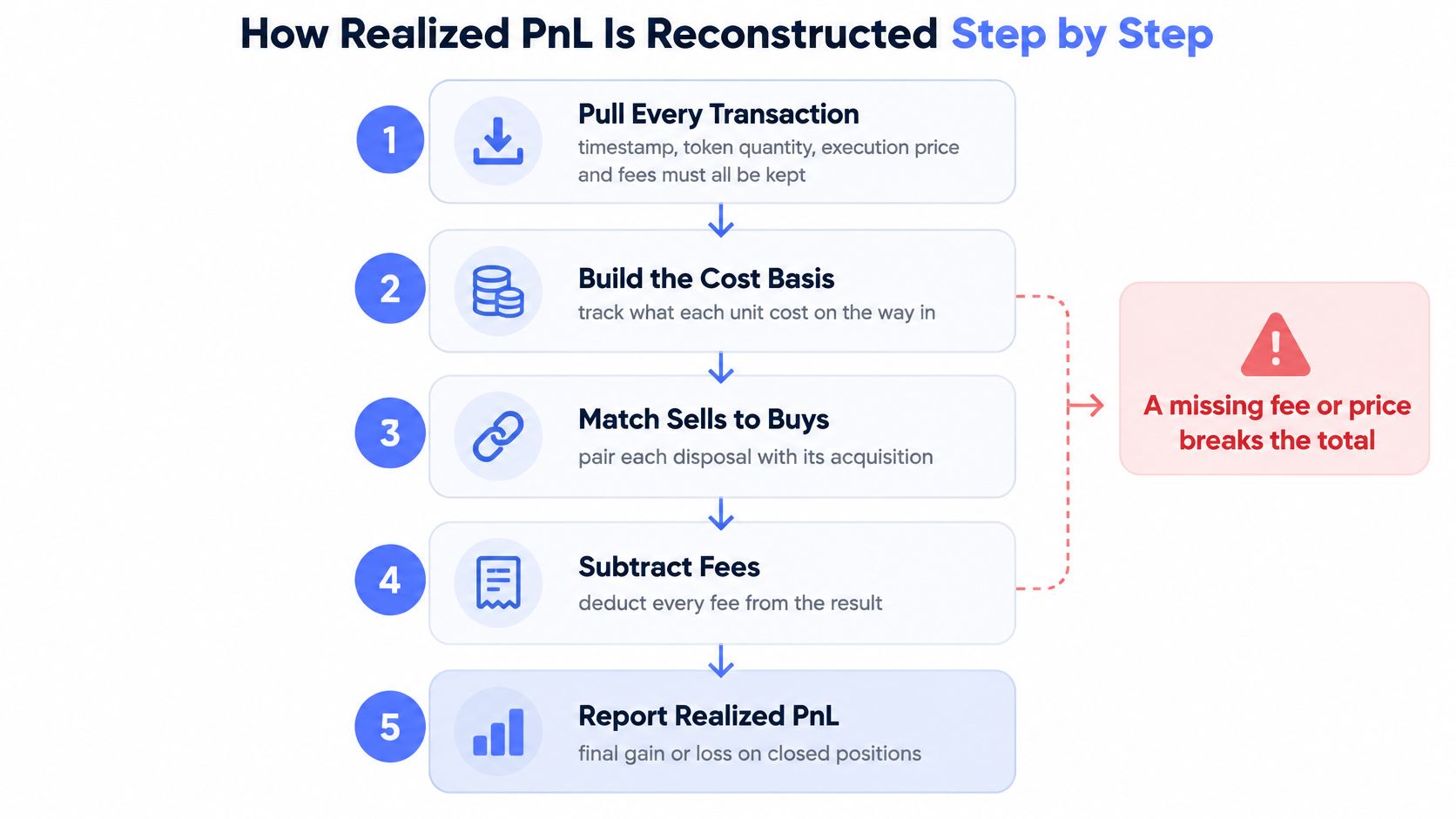
Realized PnL isn't a number the chain hands you. It's a reconstruction, and these steps decide whether two sites show the same total.
- Pull every transaction with its raw fields. Timestamp, token quantity, execution price, fees. A missing fee or a rounded price changes the answer, so those fields have to survive the pipeline intact.
- Strip internal transfers. Tokens moving between addresses the same trader controls are neither a buy nor a sell, and counting them inflates volume and distorts cost basis.
- Sort deposits, swaps and sales. An external deposit sets a cost basis, a swap is a disposal and an acquisition in one event, and a sale closes a position. Mixing the three is the most common source of nonsense PnL.
- Pick one inventory rule and hold it. FIFO or average cost. Apply the identical rule to every trader you compare, or you're ranking accounting methods rather than performance.
- Match each sale to its cost lots. A realized gain or loss per closed position appears here, and the difference between a good trader and a good accountant shows up.
- Report realized and open PnL together. Mark-to-market gains stay unrealized until the position is sold, so ranking on paper gains rewards holding, not closing, as Galaxy Research's introduction to on-chain analysis sets out.
Where the total breaks
Price source and block-level execution timing move the result on volatile memecoins. Two sites can publish different totals for the same wallet and both be internally consistent, because one used a pool price at the block and the other used a candle close.
Write down the inventory rule and the price source next to any PnL figure you save. A number without those two labels isn't comparable to anything.
The same transaction-level record feeds a tax return. If gains come from matched lots, the lots have to hold up under review. Audit-ready crypto records for San Diego taxpayers covers what a defensible lot record looks like. Ranking traders and filing a return need the same underlying discipline.
Why Wallet Attribution Is Never Certain
Attribution is probabilistic. That's the first thing to establish before you trust the name on a trader page.
Co-spend clustering works where the chain gives you a change address. Bitcoin does. Account-based chains don't, so platforms fall back on labels, transaction behavior, contract interactions and corroborating evidence, as an analysis of wallet attribution methods lays out. Those fallbacks are weaker than they look. Heuristic clustering produces false positives, and in some evaluated settings cluster-level precision and recall fell as low as 0.36 and 0.44.
Treat any address as evidence. Never as proof.
- Carry a confidence level. Every label gets one, and a high-confidence label should be able to explain why it's high.
- Record the evidence. If two addresses were merged, the reason should be readable months later.
- Don't merge on shared behavior. Trading the same token, touching the same protocol or funding each other once doesn't make two addresses one trader.
- Recompute when labels move. Rankings change when a label is corrected, and a stale page keeps publishing the old version.
Practical rule: the trader page is a claim. The label history is the evidence. Keep them readable separately.
Solana and EVM wallets need the most care. Token-account mechanics, routers, aggregators and smart-contract custody distort naive wallet-level PnL and win rate, because an address can hold assets it never chose and trade through contracts that route around its balance.
Three checks settle it for any page: the confidence level behind the label, the source of the label, and whether internal transfers were stripped before the PnL was calculated.
Lead Trader Results Versus Follower Results
Here's the number that reframes the whole subject. In a 2025 multi-exchange dataset covering more than 100,000 copy-trading outcomes, 97% of lead traders had positive personal returns, while 43.61% produced positive returns for followers, and 48.48% of followers were profitable over 90 days, per this review of crypto copy trading. The same review reports that only about 12% of top-ranked traders held their ranking for more than six months.
That gap isn't deception. It's structure. A lead trader's edge often sits in early entry, concentrated position size, borrowed capital, or execution speed a follower can't match. The record is real. It just isn't transferable as printed.
The simulation checks that close the gap
- Delayed-entry PnL. Recompute the record as if every entry landed seconds or minutes later. On a fast memecoin, that alone can flip a winner.
- Slippage sensitivity. Size the copied order at what you'd trade and price it against the liquidity at that moment, not the lead's fill.
- Maximum adverse excursion. Measure how far each position went against the trader before it worked. A strategy that survives a 40% drawdown in flight isn't the same trade as one that never dips.
- Time-to-fill. Compare when the trader got in with when a follower's order could plausibly have cleared.
- Funding costs on perps. Carry is paid for as long as the position stays open, and a hold measured in days turns carry into a real line item.
- Fixed-dollar sizing. Recompute with the same dollar amount per trade instead of a proportional share, because proportional sizing compounds the lead's equity curve, not yours.
Rankings also overrepresent survivors. A leaderboard shows who is visible now, not who stayed visible. For how these mechanics play out across venues, defi copy trading covers the execution side.
Ask this instead: not who made the most, but who stayed copyable after realistic timing, size and exits.
That question filters harder than any PnL sort, and it's the one that turns a record into a decision. Trading memecoins and perps is risky, and users can lose what they put in.
Memecoin and Prediction Market Records Need Different Checks
A market can rise while most buyers lose money. Analysis of roughly 1.48 million wallets that bought the $TRUMP token found 988,905 wallets, about two thirds, sitting on losses totalling $3.81 billion, while 492,285 wallets in profit held gains of about $4.04 billion. Winners were concentrated among early buyers before the sharp rise, according to reporting on the token's buyer distribution.
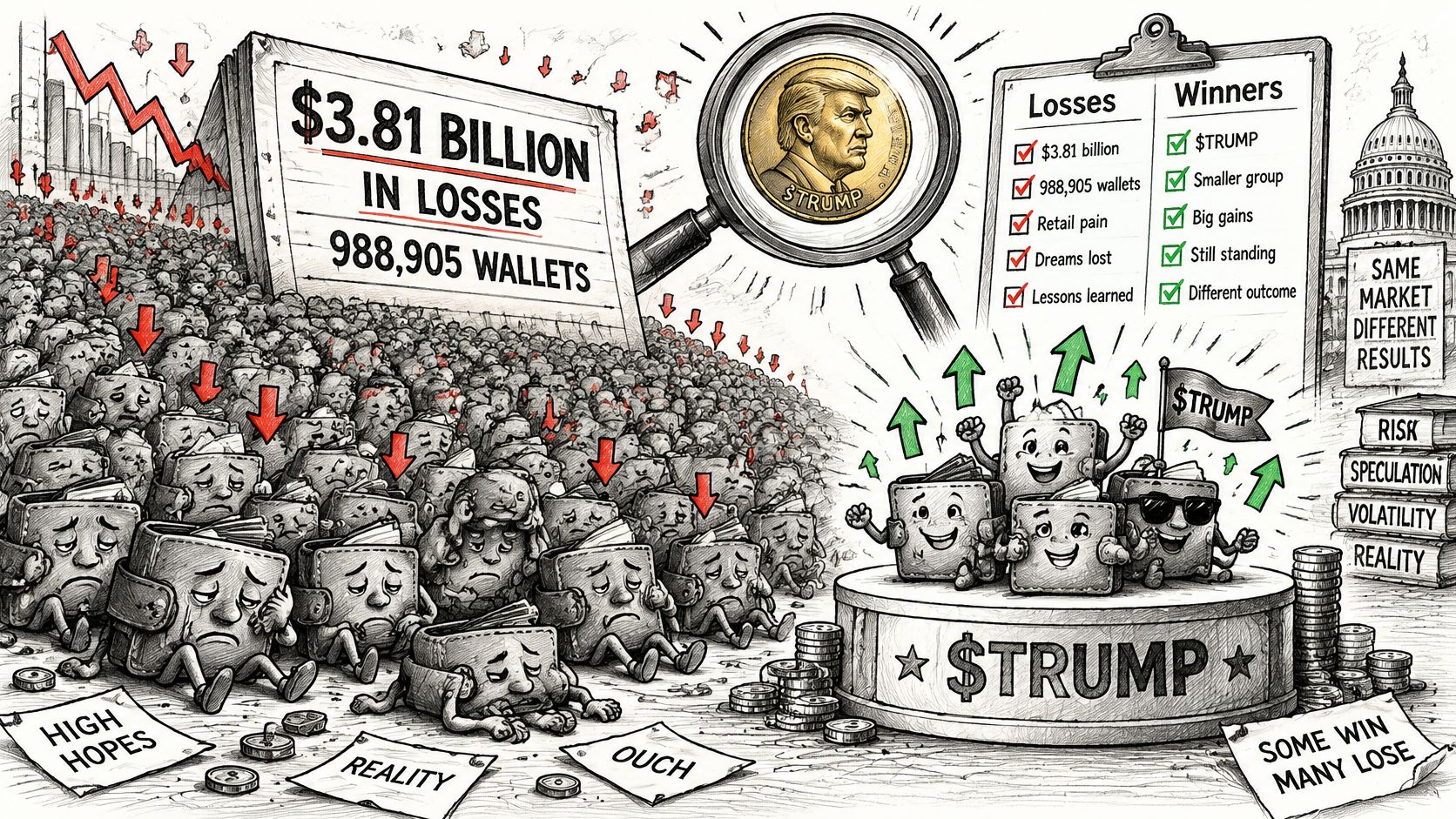
The token "did well," yet two thirds of its buyers lost money. A follower's result depends on when they entered, how much they could buy at that price, and whether they could exit at a comparable price. For memecoin-specific mechanics, see this guide to how memecoin trading works. Segment records by entry cohort, wallet size, holding period, realized versus unrealized PnL, trade count, and whether gains came from one launch or repeated activity.
| Market | Mechanics | Effect on the record |
|---|---|---|
| pumpfun | Constant-product bonding curve with virtual SOL and token reserves; 1.25% fee split between creator and protocol; automatic, irreversible graduation to PumpSwap (pumpfun bonding curve docs) | Entries and exits price against a moving curve; a copied buy after graduation faces a different pool |
| Polymarket | Outcome shares priced $0.00 to $1.00 as implied probability; peer-to-peer central limit order book; winning shares redeem for $1.00 (Polymarket 101) | Positions stay open until the outcome is final; final value depends on the published resolution criteria |
Why a pumpfun entry doesn't transfer
Each new pumpfun coin starts on a bonding curve, where trades change the reserves and therefore the quoted price. At the market cap threshold, the curve closes and liquidity migrates to PumpSwap in one irreversible step. A follower entering near graduation may face different liquidity and a different price from the lead trader.
Why a Polymarket position can sit open
Outcome shares represent exposure to a defined event and its resolution rule, rather than ownership of a spot token. The fastest path is a proposal plus a two-hour challenge period with no dispute; a challenge opens a second proposal round, and continued disputes can escalate to UMA token-holder voting through the Data Verification Mechanism before winning tokens redeem at $1.00 each, per Polymarket's resolution documentation. A position can therefore remain unresolved even when its displayed value looks profitable. Its final value depends on the published resolution rules.
A record built on one launch or one market outcome may reflect a single event rather than a repeatable process. Polymarket traders can be followed and copied on copy.top, but a follower's result still depends on entry timing, available size, liquidity, and the market's resolution. Past performance does not predict future results.
Confirm a Trader's Record Before You Copy
A trader's record can be accurate and still overstate what a follower could have earned. Check the conditions behind the numbers before choosing a copy size.
- Compare realized and open PnL over the same window. Figures covering different periods do not describe the same record.
- Read win rate alongside average win and average loss. The size of gains and losses determines what the win rate means.
- Check concentration. Ask how much of the record comes from one token, launch or market.
- Compare hold time with drawdown. Typical holding duration and the largest peak-to-trough fall show both the time and volatility involved.
- Test the record against execution constraints. Later entries, slippage and fixed-dollar sizing can change the result for a follower.
- Account for market rules. Pumpfun's bonding-curve graduation and Polymarket's resolution process affect what a trade and its outcome mean.
- Inspect wallet labels. Check the stated confidence, label source and treatment of internal transfers in the PnL calculation.
For concentration, remove the trader's single best position from your mental calculation. If the record then collapses, it may depend on one event rather than a repeatable approach.
copy.top provides trader pages with realized PnL, win rate, median hold time, open positions and recent trades. Its public leaderboard ranks traders by realized PnL, and its live view shows coins top traders are buying and who bought them. Hyperliquid perp traders' positions and size are also visible. These records help with comparison, but they do not erase the gap between a trader's fills and a follower's results: timing, size, liquidity and exit conditions can differ.
Copy trading on copy.top runs from your own wallet, with buys and sells copied automatically. The wallet's private key can be exported at any time. Start with an amount you can afford to lose; past performance does not predict future results.