 copy.top

Late at night, the leaderboard is easy to believe. A trader shows a realized PnL figure that would change your month, a win rate that looks strong, and a public record that reads like a straight line up. The copy button sits right there.
Copy trading doesn't move anyone's skill into your wallet. It moves their trades, at your size, at whatever price the book gives you when your order lands. The distance between those two things is where money disappears, and it's worth understanding before you fund anything.
Table of Contents
- Four Crypto Social Trading Models Compared
- Judging a Trader's Public Record
- Memecoin, Perp and Prediction Market Differences
- Sizing and Exit Rules That Limit Damage
- Where Copy Trading Goes Wrong
- Set Up Your First Copy and Confirm Limits
Four Crypto Social Trading Models Compared
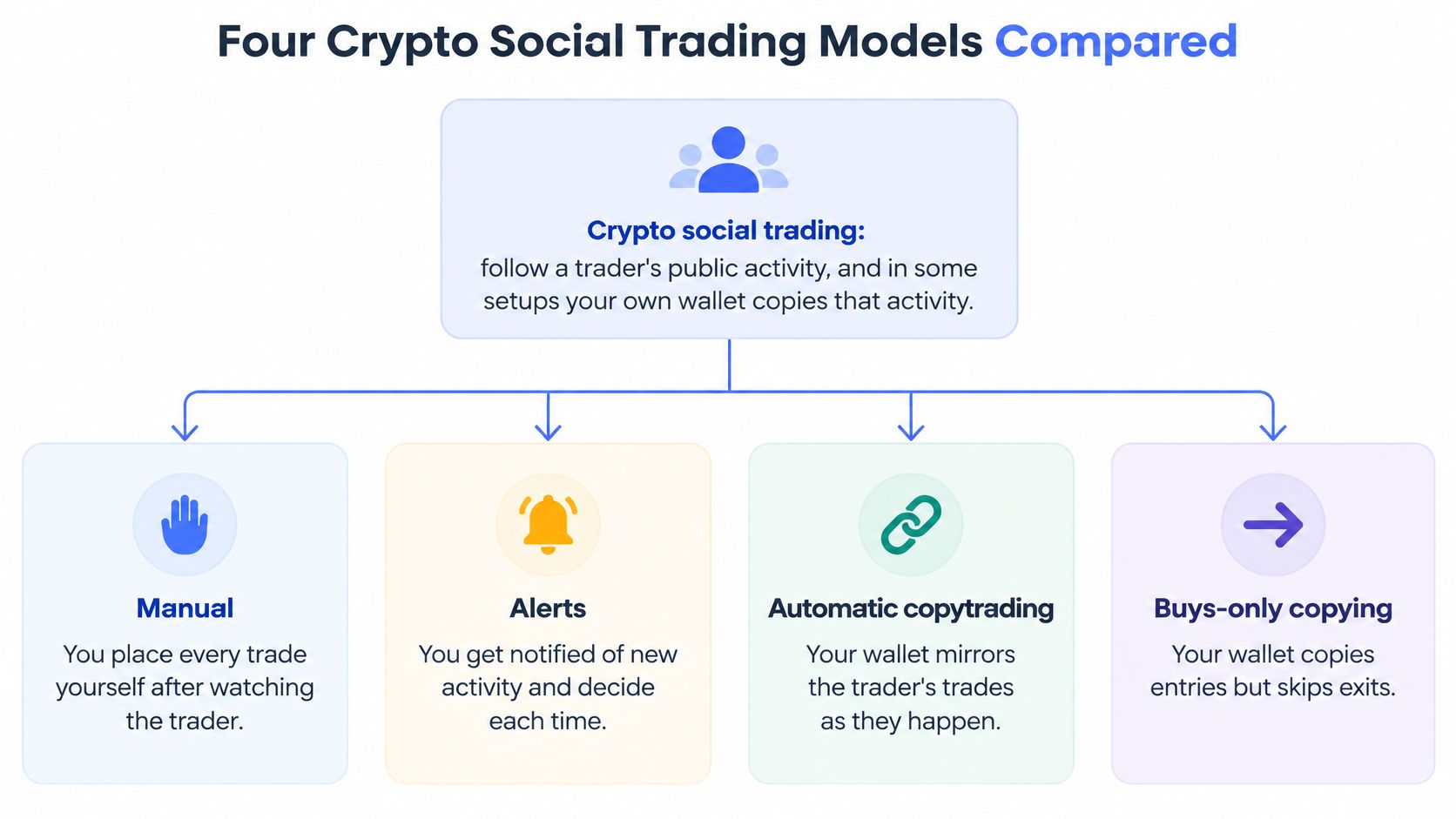
Crypto social trading means following a trader's public activity, and in some setups your own wallet copies that activity. The label covers four arrangements that look alike on a landing page and behave very differently once real money is live.
Crypto social trading models at a glance
| Model | What You Do | Who Decides Entries | Main Risk |
|---|---|---|---|
| Manual following | Watch a trader and copy by hand | You | Late entries and missed exits |
| Signal alerts | Get pinged on a trader's buy and choose to act | You, after the alert | Delay and slippage before you act |
| Automatic copytrading | Set size and guardrails, trades mirror into your wallet | The trader, executed automatically | Copying losses, leverage and sizing you did not choose |
| Buys-only copying | Entries are mirrored, exits stay manual | The trader for entries, you for exits | Holding a position after the trader has sold |
Manual following keeps every decision with you, which is also its weakness. You see the entry after it happens, you size it yourself, and the exit is yours to find. Someone scalping memecoins can be flat again before you've finished reading the chart.
Signal alerts shorten that gap without handing over control. The alert tells you what a trader did. Your order still lands after theirs, at a different price, often in a token that moved on the first wave of buyers.
Automatic copytrading gives the entry decision to the trader. You set the size and the guardrails, and the app mirrors buys and sells from your own wallet. The risk shifts from your timing to their judgement, and to whether your size and exposure match what they're running.
Buys-only copying sounds safer because you keep control of the sell. In practice it's the model that leaves people holding a token long after the wallet they copied is out.
The idea predates crypto. eToro launched OpenBook in 2010 and added its CopyTrader functionality in 2011, and the platform had attracted 1.5 million registered users by the end of 2010, as Lucidity Insights' eToro profile records. On-chain markets extend that model, because public transaction histories let anyone check a trade record instead of trusting a screenshot.
Presentation shapes the market more than most traders assume. A 2024 study of crypto copy trading on TraderWagon and Bybit found that interface and leaderboard design significantly influenced how novice followers picked leaders, with each leader entrusted with more than USD 10,000 of follower funds on average (ACM study on copier behaviour).
If the plumbing behind self-custody and settlement still feels vague, Mega Income Stream's DeFi explainer walks through how a wallet interacts with a protocol before you connect one.
Pick the model before you open any trader page. The right one follows your available time, the amount you can lose, and whether you want to sign every trade or let a rulebook act while you sleep.
Judging a Trader's Public Record
A high realized PnL is a starting point, not a forecast. It tells you what someone closed at, in the market conditions that existed then, using a position size and risk level you probably don't share.
Realized PnL counts only closed positions. A trader can look strong on that column while carrying an open loss that hasn't been booked yet. That single distinction has changed more copy-trading outcomes than any other detail on a profile.
Performance metrics to check before copying
| Metric | What It Shows | What It Misses |
|---|---|---|
| Realized PnL | Profit from closed positions | Open gains and losses still in play |
| Win rate | Share of closed trades in profit | Size of wins compared with losses |
| Median hold time | Typical time a position stays open | Whether holds fit your schedule |
| Open positions | Current exposure and what the trader still holds | Where the trade goes next |
| Maximum drawdown | Largest fall from a peak in the record | How often smaller drops happen |
| Position concentration | How much capital sits in one token or market | Whether a single bet drives the result |
Read the rows together, not separately. A high win rate with a poor drawdown figure usually means the losses are rare and enormous. A short median hold time can mean the trader is faster than any follower can reasonably be, so your fills will sit on the wrong side of the move. Position concentration tells you whether the record is a strategy or one lucky token.
Why the leaderboard shapes attention
Rank order decides who gets looked at first. Sort by realized PnL and the top of the page collects the capital, whether or not the number at the top reflects repeatable process. That's a presentation effect, not a performance effect, and it's the reason a trader can be popular and unremarkable at the same time.
Open positions deserve their own look because they're the live part of the record. What the trader still holds, at what size, tells you the risk you'd inherit on the next copy. A record full of closed wins with one oversized open position is a different proposition from a flat book.
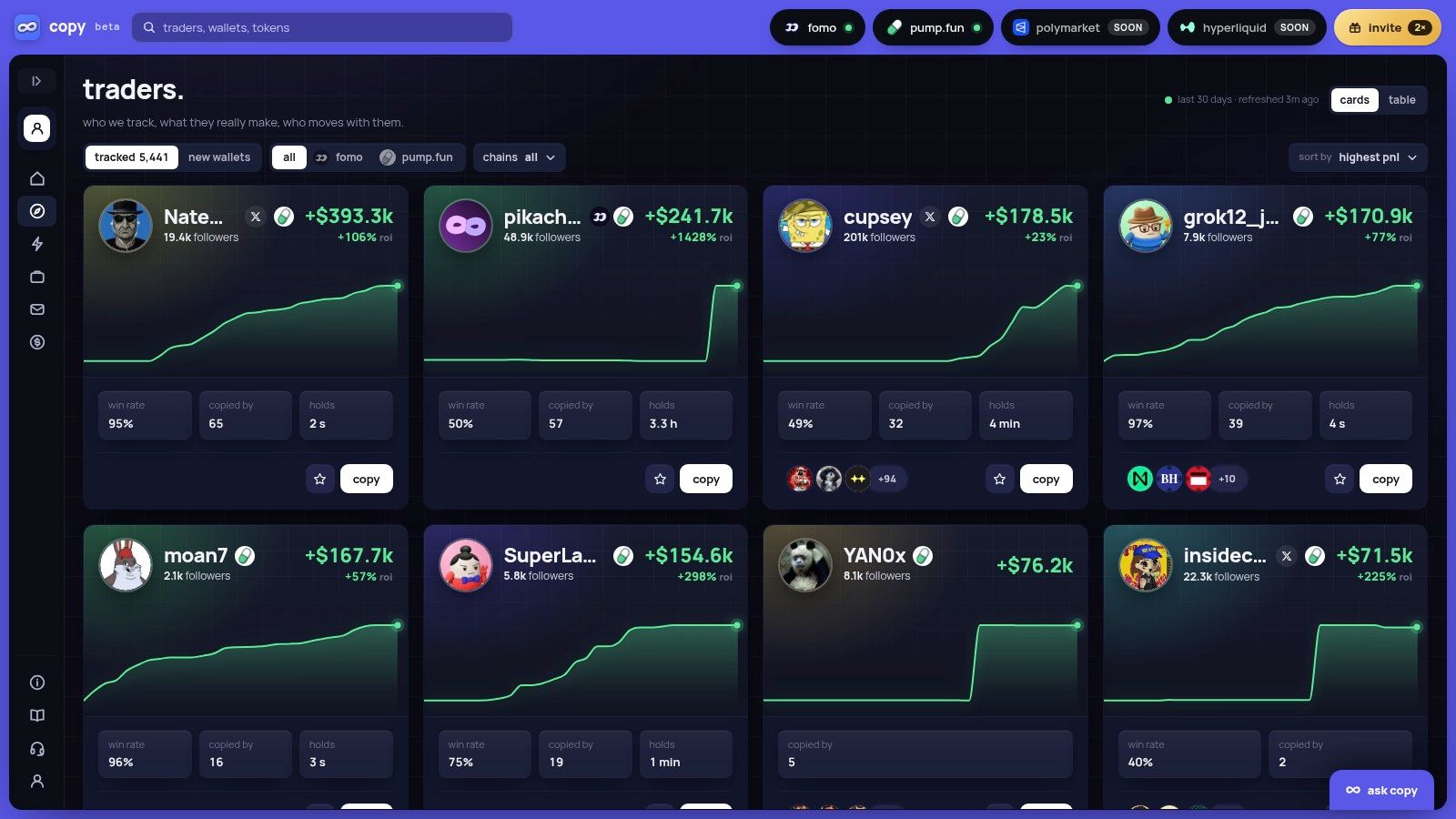
On copy.top, every trader page shows realized pnl, win rate, median hold time, open positions and recent trades, so you can check those columns yourself instead of taking a leaderboard row at face value.
Before you copy, answer three questions. Does the record cover enough trades to mean anything? Do the hold times fit the hours you're at a screen? Could you sit through the worst drawdown in the history shown without changing your behaviour?
Practical rule: if a record needs an explanation to look good, skip it and move to the next trader.
Then keep your own log. For every copied trade, record the fill you got, the delay between the trader's entry and yours, and the size you used. After a few weeks you'll have something almost nobody has: your follower result, on the same dates as the leader's public record. A written method for reading those numbers is set out in this guide to judging a copy trader's history.
Memecoin, Perp and Prediction Market Differences
Copy risk depends on the market, not only on the trader. A record built on Solana memecoins and a record built on Hyperliquid perps are different skills. Copy both the same way and the difference shows up in your PnL.
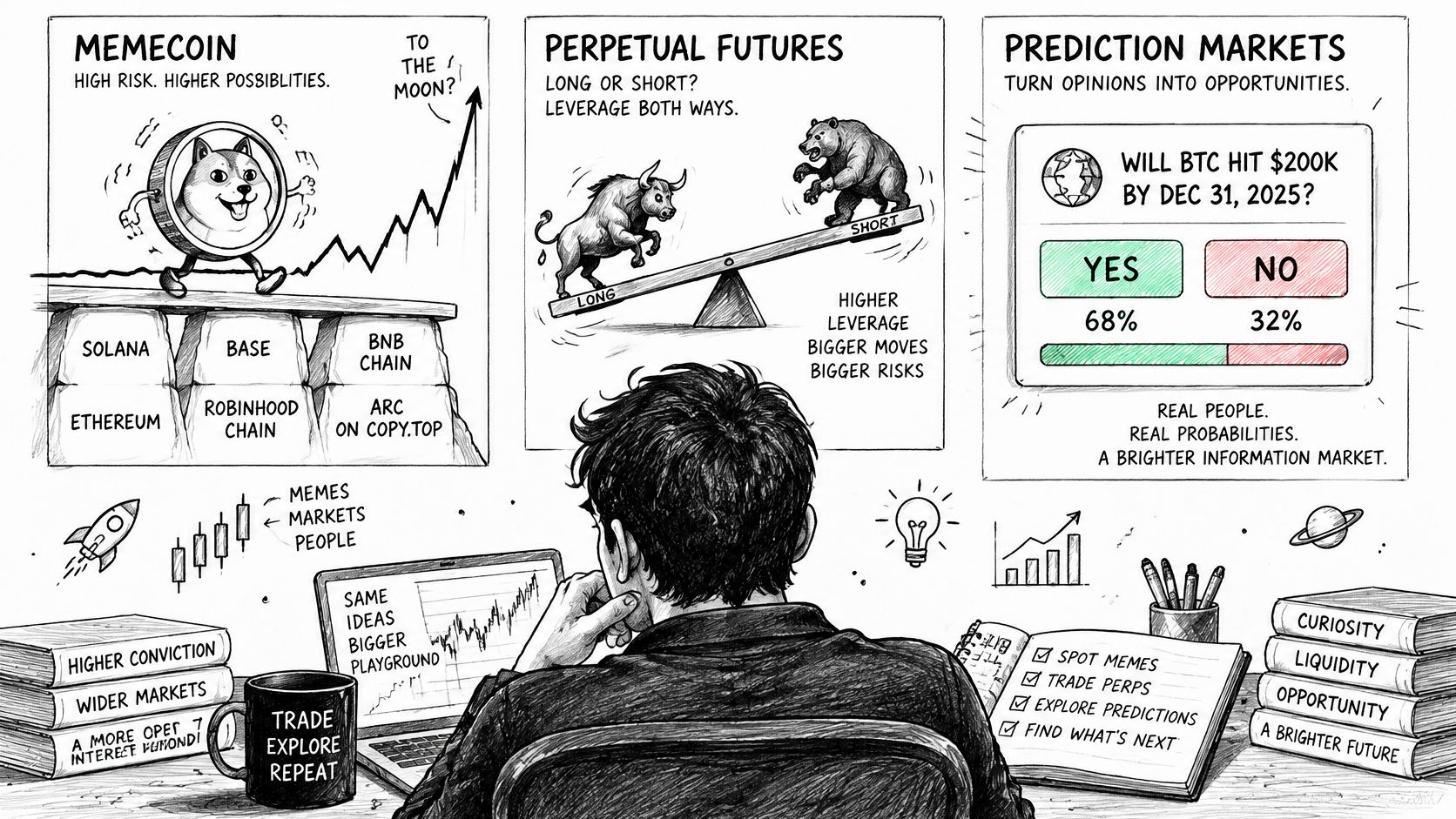
Memecoins carry liquidity risk first. A leader buying a thin token moves the price with their own order, and your copy lands after that move. You pay more than they did, and the thin book that let them in fast punishes you on the way out. Before you mirror anything, check token age, holder spread and how much the pool holds.
Copy risk by market
| Market | Where It Runs | Main Risk | Status |
|---|---|---|---|
| Memecoins | Solana, Base, BNB Chain, Ethereum, Robinhood Chain, Arc | Thin liquidity and sharp moves | Available |
| Perps | Hyperliquid | Leverage, funding and liquidation | Available |
| Prediction markets | Polymarket | Settlement rules and concentrated gains | Available |
Perps add three mechanisms spot trading doesn't have. Borrowed size multiplies the move, funding drains a position held in the wrong direction, and liquidation closes it for you at the worst moment. A copied entry also inherits the leader's position size rather than yours, so a gain that looks well timed on their page can arrive with a risk profile you never chose. The record does show sizing history, which tells you whether the gains came from a large position or a good one.
Prediction markets are a different problem again: outcome wording, resolution rules, and the gap between being right and being paid. copy.top covers Polymarket traders among its sources, so the market is tradeable today, but read the resolution rules on each market before you copy anyone in it. The caution holds regardless of how good the trader's record looks. Research on Polymarket data covering more than 2.4 million users and $67 billion in volume found that roughly 69% of users ended the sample at a loss, while the top 1% of users captured 76.5% of all gains (Ontario Securities Commission research paper). A visible winning account says very little about the typical user.
The practical rule is one check per market. For perps, read the funding terms before you copy. For memecoins, read liquidity and token age. For prediction markets, read the resolution rules and the exact wording of the outcome before anything else.
Sizing and Exit Rules That Limit Damage
Sizing decides how much a copied trade can hurt you. It matters more than which trader you pick, because even a good record has losing runs and your position size is the only part of the equation you control.
Two sizing modes cover almost everything. Fixed size per buy keeps every copied entry the same, so the most you can lose on any one copy is known before it fires. A share of the trader's buy follows their conviction instead, which is useful until a trader sizes up hard on a token you don't want a large position in.
Here's the trade-off in practice. Fixed size protects you from a leader's sudden aggression but underweights their best setups. Proportional sizing tracks their intent but imports their appetite for risk, including the part where they add to a losing position.
Guardrails and what each one costs you
- First buy only: restricts the copy to a trader's opening entry in a token, so you don't follow every add. You'll miss scale-ins that work, and you'll also miss the adds that deepen a loss.
- Take profit: closes your copied position at a gain you set. It can take you out before a leader's larger move, which is the price of a known exit.
- Stop: closes the copy at a loss you set. A short dip can trigger it moments before a recovery, so pick the level against the token's normal range, not against your mood.
- Sell with the trader: mirrors their exit when it happens. The trade-off is timing, since your sell follows theirs into the same liquidity.
Automation runs while you're asleep, offline, or busy. That's the point of it, and it's also why limits set in daylight beat decisions made in a panic. Set them before you close the laptop.
The exposure test: total every open copy. If losing all of it at once would change how you trade tomorrow, the size is too large.
Sizing maths carries across markets, and the probability-first approach in this how to size prediction market positions guide is worth reading before you set a share-based copy. For the crypto side, this walkthrough of position sizing for crypto copy trading covers fixed versus proportional sizing in more detail.
Where Copy Trading Goes Wrong
Execution is the first failure, and it hits every copy eventually. Your entry arrives after the trader's, in a market that already reacted, with slippage you didn't budget for. Copying a profitable trader isn't the same as obtaining their returns.
Volatility comes second. A leader's gains may come from positions larger than yours, or from borrowing power you'd never choose. When the trade turns, your smaller position can still be closed out by a move that the trader survives on a bigger margin buffer.
Thin markets come third. A leader who scales in and out of small tokens moves the price against everyone following. On the way in you chase, and on the way out you're behind the queue.
The IOSCO report on copy trading and online trading risk treats copy trading in crypto and other complex or margin-based products as a significant retail-risk area, noting that borrowing, volatility, frequent trading and transaction costs can produce cumulative losses. Cumulative is the word to hold onto. Small costs and small timing gaps repeat on every trade.
Set a loss you accept before the first copy fires, and treat it as a limit, not a target. Check slippage on every copied trade rather than assuming the first one was typical. Review open positions regularly, because the book changes while you aren't looking.
Stop copying a trader whose record changes shape. A shift in hold times, a jump in position concentration or a sudden run of adds to losing positions tells you more than any single PnL figure.
Copy trading carries risk. Users can lose what they put in. Past performance does not predict results, and a public record is a description of what happened, not a plan for what comes next.
Set Up Your First Copy and Confirm Limits
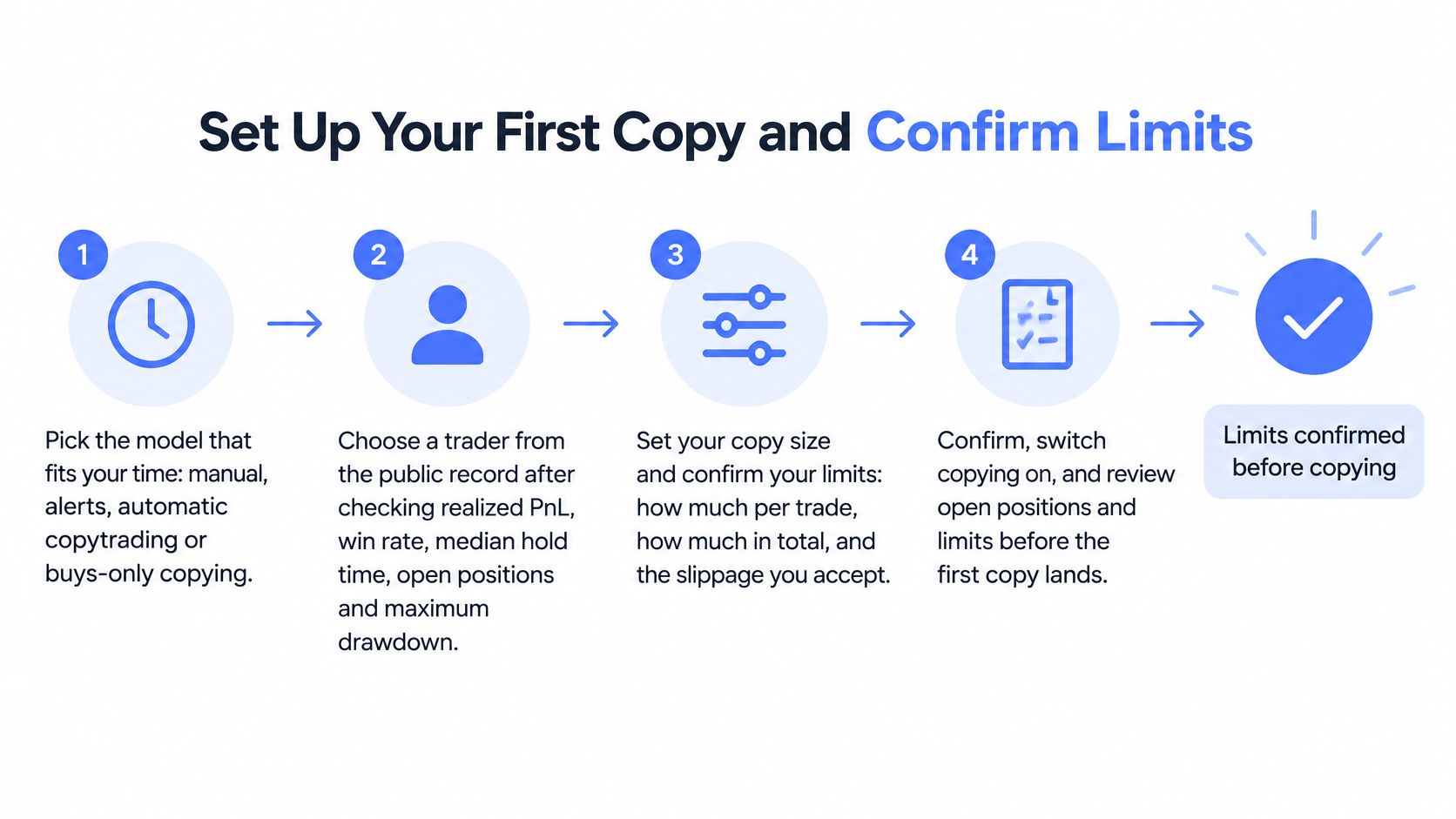
You have picked a trader. The next decisions belong to you, not the leaderboard. Work through them in order.
- Pick the model. Manual, alerts, automatic copytrading or buys-only. Match it to the hours you can watch and the control you want. Rank says nothing about the losses you can sit through.
- Choose a trader from the public list at copy.top's trader leaderboard. The trader page shows realized PnL, win rate, median hold time, open positions and recent trades. Treat that record as a starting point, not a forecast. Your entry price, size and timing will produce a different result.
- Set the size. Fixed amount per buy, or a share of the trader's buy. Then set the total exposure you accept across all copies. That ceiling protects you during a bad week, when several copied positions move against you at once.
- Set the guardrails. Take profit, stop, first buy only, and whether sells mirror the trader. Confirm each setting before you fund anything. Automation acts on what you left behind.
- Fund your own wallet with only what you can lose. The wallet belongs to you and its key can be exported at any time.
- Watch the mirror against the trader's activity. Compare your entries and exits with theirs for the first few sessions. Note where prices differ. Slippage and timing gaps show up there first.
Before you commit, look at what's moving. Live coins sit at what top traders are buying right now, perp traders and their positions at Hyperliquid copy trading, and the longer explanations at the copy.top blog. A step by step walkthrough of your first copied trade lives in this how to copy trade guide.
Start with the smallest size you would accept losing entirely. Review the copy after the first week, then decide whether to keep the trader, change the size, or stop. A trader's record can stay strong while your result lags if your sizing or entry timing differs.
Copy trading carries risk, users can lose what they put in, and past performance does not predict results. When you are ready to pick a trader and start copying at copy.top, do it with a size you have already decided you can lose.