 copy.top
On-chain trading is a swap or perp that settles from the user's own wallet on a public chain, and the quote is not the price received.
The usual advice is to find a profitable trader and copy their trades. That skips the part that determines what you own: execution. A public trader's entry can look good while a follower's later entry leaves little room for the same exit.
On chain trading is an execution-quality problem. Wallet control matters. So do pool depth, transaction ordering, and the price at which your trade lands.
Table of Contents
- What an On Chain Trade Really Costs
- Your Wallet Holds Keys Not Coins
- How a Swap Gets Included
- Memecoin Swaps Versus Perp Copies
- When Ordering Moves Your Fill
- Judge the Fill Not the Leaderboard
- Pick a Trader and Copy From Your Wallet
What an On Chain Trade Really Costs
A displayed quote is not the trade you receive. A swap fills against the liquidity available when its transaction executes. A perp position is determined by its executed price, not the figure shown before submission. In both cases, a trader's public fill and a follower's fill can differ because execution happens at different times and under different pool conditions.
A token swap trades against liquidity on a blockchain, rather than an internal company order book. The network must include the transaction, and the pool or contract must meet its execution conditions. Delay, pool depth, and transaction ordering can all affect the result.
Cost stack of an on-chain trade
| Cost | What moves it | What the trader controls |
|---|---|---|
| Network fee | Congestion and priority on that chain | Tip or priority fee, and which chain |
| Price impact | Order size versus pool depth | Smaller size, deeper pool |
| Slippage tolerance | How far price may move before a revert | Minimum output or a maximum percentage |
| MEV or sandwich | Public ordering around the swap | Tighter slippage, protected flow where it exists |
| Failed or reverted swap | Stale quote or a route that disappeared | Simulation and a smaller size |
The network fee pays for transaction processing and inclusion. Congestion can raise the cost of inclusion. Paying for priority may help a transaction get included sooner, but it does not reserve the pool's current price.
Price impact is the price change caused by your own order. A large order against shallow reserves consumes liquidity at progressively worse prices. A busy chain does not make every token liquid. What matters for a thin memecoin pool is the liquidity available in that pool, not the chain's headline activity.
Separate an expected cost from an allowed loss
Slippage tolerance is not an extra fee. It sets the worst price movement your transaction will accept before reverting. A wider setting may let the trade complete, while allowing a less favorable fill.
Ordering risk can also affect execution. Other participants may arrange transactions around yours. A reverted swap is a different kind of failure: the position does not open as intended, but you may still pay a network fee.
Practical rule: Start with the expected output after price impact. Then check the worst output your slippage setting permits. The quote is not a reserved price.
Do not add price impact and slippage tolerance as if both were certain charges. Read the quoted output, network cost, and minimum received together. Memecoins and perps can lose the amount put in, and past results do not predict later results.
The key comparison is between the leader's execution and the follower's. A copy may reach the pool later, when less liquidity remains or the price has moved. The public trade is a reference, not a guarantee of the same fill.
Your Wallet Holds Keys Not Coins
Say you open a wallet and see a token balance. The tokens aren't sitting inside the wallet software. The balance is recorded on the network, and the wallet provides the authority needed to move it.
The SEC's crypto custody bulletin explains that a wallet holds the private key or passcode used to authorize transactions, not the crypto asset itself. Under self-custody, you control access to those keys and are responsible for protecting them.
The distinction is between storing an asset and controlling its movement.
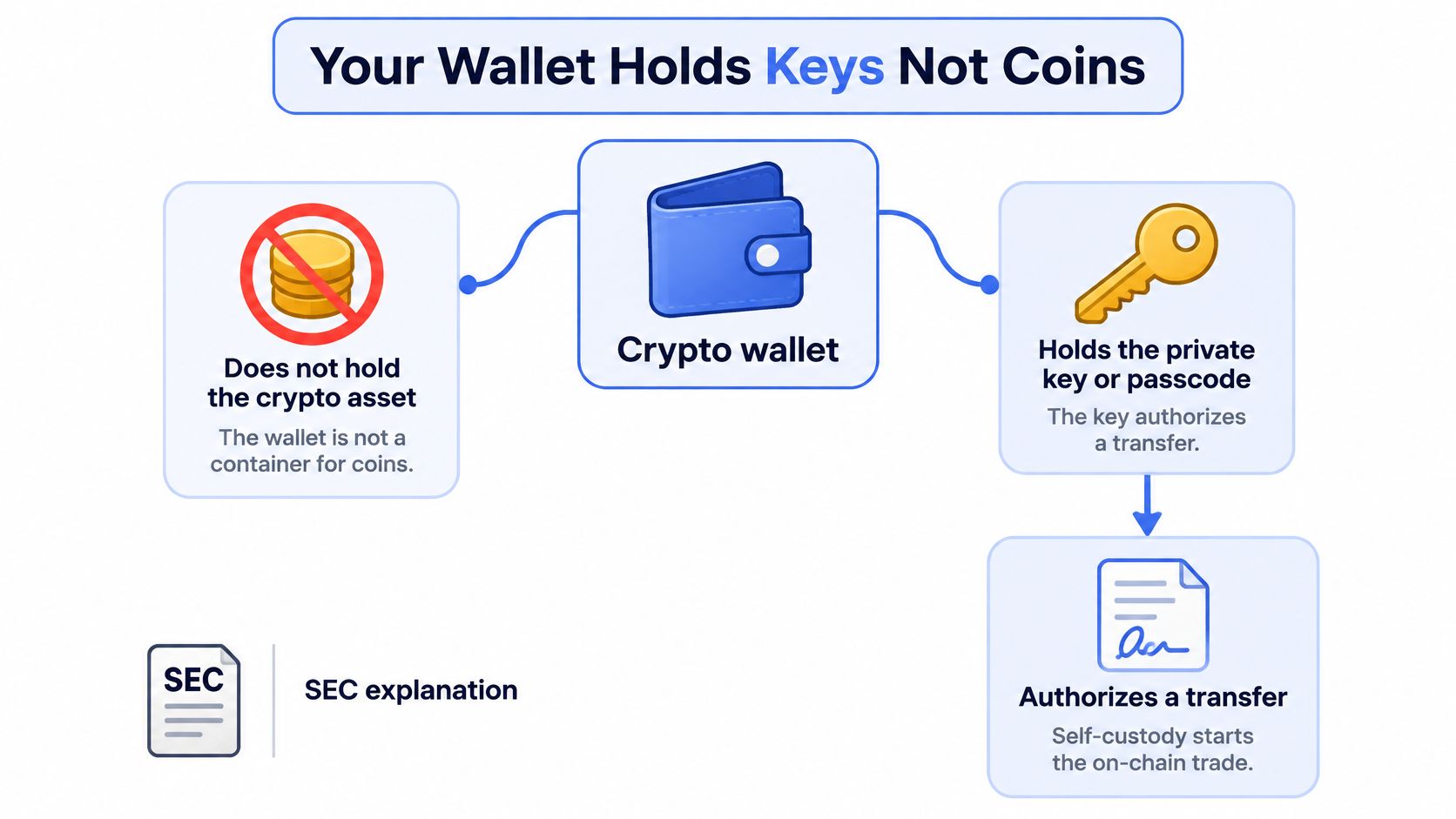
The signature belongs to you
Think of the wallet as a signature stamp, the chain as the ledger, and the token balance as a line on that ledger. Whoever controls the stamp can authorize changes. If someone steals it, the ledger doesn't know that the person signing isn't you.
A custodial account changes that arrangement. A company controls the keys, and you depend on the company to process access and withdrawals. With self-custody, you retain signing control, but you also carry the consequences of lost keys and unwanted approvals.
Our non-custodial wallet guide explains that responsibility in a trading context. In our setup, you keep your keys and wallet and grant a trading allowance that you can revoke at any time.
- Signing access: Protect the key and review what an approval permits.
- Trading authority: Revoking an allowance stops that authorization. It doesn't reverse completed trades.
- Wallet addresses: Our trading wallet provides two addresses, one for EVM chains and one for Solana.
- Spendable balance: Cash is distributed across four chains, and a trade spends from one. The biggest single-chain balance, not the combined total, sets what one copy can spend.
Custody and market risk are separate
copy.top is a non-custodial, multichain copy trading web app. Users select named traders with public records from fomo and pumpfun, or perp traders on Hyperliquid, and automatically copy buys and sells from their own wallet.
Token coverage includes Solana, Base, BNB Chain, Ethereum, Robinhood Chain and Arc. Perpetuals use Hyperliquid. Those supported networks shouldn't be confused with the separate question of where spendable balances are held.
Keeping the keys doesn't validate a token, protect collateral, or make an exit liquid. You can retain full wallet control and still lose what you put into a copied position.
How a Swap Gets Included
A swap isn't complete when you press the button. It must pass from a proposed route to an authorized transaction and then to execution. The failure at each stage is different.
The process below separates an expected output from a confirmed balance change.
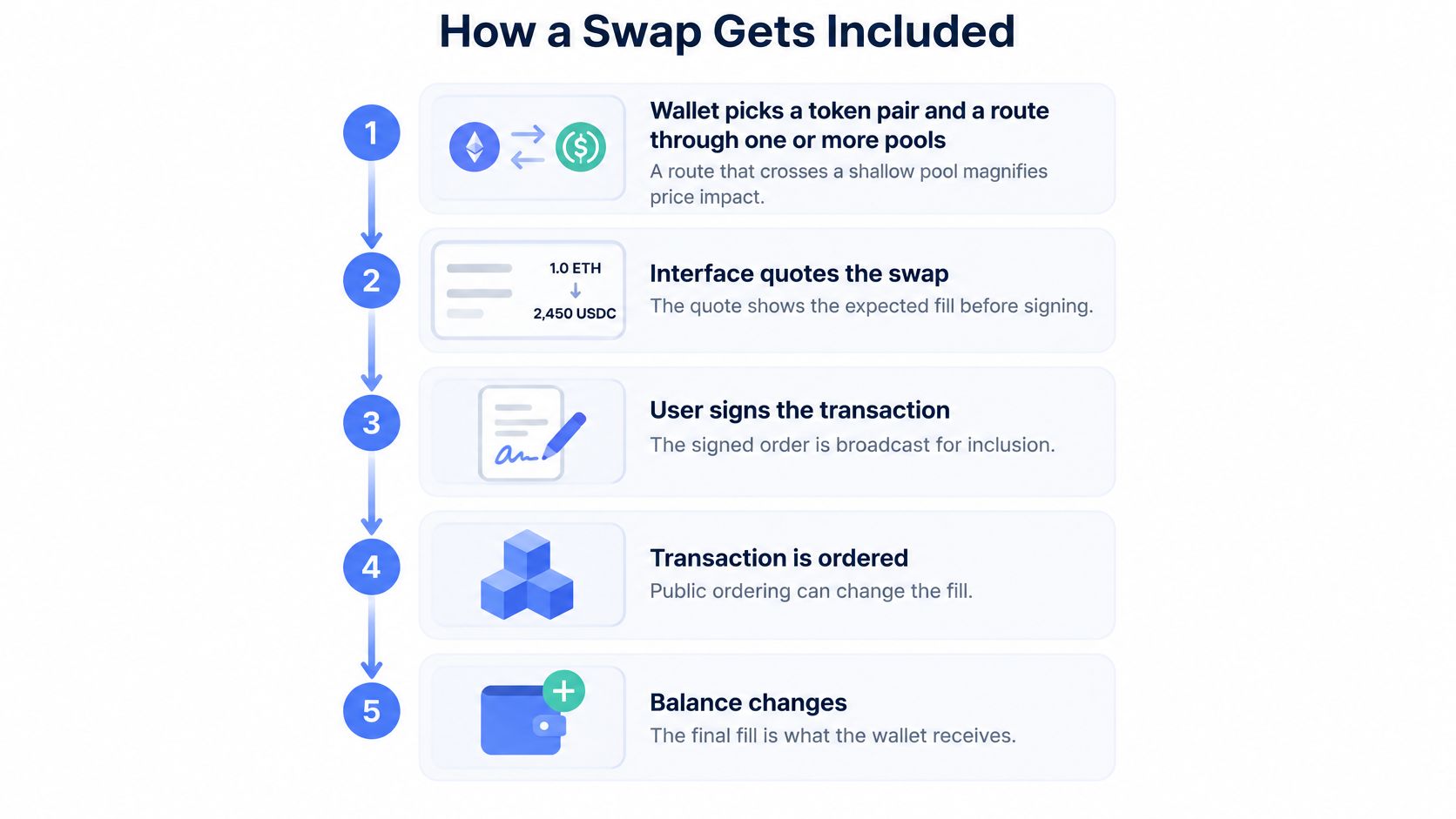
From route selection to execution
Choose the pair and route. The interface finds a path between the asset you're spending and the asset you want. That path can cross several pools. A shallow pool along the route can limit the whole trade, even when the other pools have substantial liquidity.
Read the quote and set minimum output. The interface estimates what current reserves can return. Your minimum received defines the execution boundary. If the quote becomes stale, the transaction must either satisfy that boundary or fail rather than complete the intended swap.
Sign the transaction. Your private key authorizes the specified action. Check the network, asset, amount, and approval scope before signing. A valid signature doesn't mean the trade is sensible, and an incorrect approval can authorize something you didn't intend.
Wait for ordering and inclusion. A submitted transaction awaits processing by the network. Other transactions can execute before it and change the relevant reserves. Waiting longer can make the original route or quote unusable.
Confirm the balance change. On execution, the pool updates its state and your balance changes. If the output breaches your minimum, the swap reverts. A revert can still consume a network fee without leaving you with the position.
A confirmation screen is more useful than an animation saying the order was sent. Read the actual asset received and amount spent. If the transaction failed, establish that before submitting another attempt.
A copy is another transaction
A comparison of centralized and decentralized market execution describes the contrast between centralized markets' high liquidity and near-instantaneous execution and decentralized markets' liquidity constraints and settlement latency. That doesn't make every centralized market deep or every decentralized market shallow. It identifies why a displayed DEX quote can't be treated as immediate execution.
For a follower, the leader's completed trade is a signal, not a transferable fill. Your order has its own size, route conditions, and inclusion time.
Our copied buys land within seconds of the trader's buy. That's not a promise of matching prices. We display slippage on each copied trade so the execution difference remains visible.
When the trader sells, we mirror the fraction sold, or close the position in full if you selected all at once. That choice changes your remaining exposure, so it belongs in the setup rather than being an afterthought.
Use the video alongside the transaction stages, not as a substitute for checking the final receipt.
A completed memecoin swap only proves execution. It doesn't prove that the asset can later be sold at an acceptable price.
Memecoin Swaps Versus Perp Copies
Copying the same trader does not give every follower the same fill. A memecoin swap uses a pool whose reserves change with each trade. By the time followers arrive, the leader's buy and other orders may have changed the price and available depth. A follower's order therefore faces a different pool state.
For trades associated with fomo and pumpfun, the practical question is whether the order fits the available depth. A percentage of the leader's position does not guarantee a suitable order size. The follower's own amount and the pool's capacity determine the price impact.
A pool entry and a leveraged position
A fixed ticket puts a clear limit on how much goes into a swap. It does not remove execution risk: even a modest order can move the price in a pool with little usable liquidity. The leader's fill is a reference, not a price the follower can reproduce.
A Hyperliquid perpetual works differently. The follower holds a position backed by collateral, with a liquidation boundary. Funding may be paid or received while the position stays open. Copying the trader's direction does not reproduce their collateral allocation, so the same price move can have a different effect on each account.
A public analysis of Hyperliquid transaction activity, covering approximately $1.95 trillion in notional volume and 386,211 wallets from March through November 2025, reported retail traders losing about $731 million after fees, while market makers and algorithms were net positive. These are aggregate findings, not a verdict on every trader.
Spot copy versus perp copy
| Check | Memecoin swap | Perp on Hyperliquid |
|---|---|---|
| Where it settles | A pool on Solana or an EVM chain | A perpetual position |
| Size risk | Price impact in a thin pool | Leverage and liquidation |
| Carry | No funding | Funding paid or received |
| Exit | Sell the token | Close, or get liquidated |
| What to read first | Delay, pool depth, both buy and sell | Leverage used, buffer, funding, hold time |
Read the exposure behind the result
A realized PnL screenshot does not show how close a trader came to liquidation. It may leave out the collateral supporting the position, funding paid while waiting, or open positions that remain at a loss.
For perps, inspect maximum size used, distance to liquidation, average holding time, funding, and liquidation history. A closed directional trade is different from a gain supported by a temporary funding regime or squeeze.
A follower can copy the right direction and still be liquidated before the leader exits.
A smaller account may not have the same buffer once its other positions and collateral commitments are considered. Matching the entry is not enough if the follower cannot withstand the same adverse move.
Both markets can cost you what you put in. Past performance does not predict results, and a margin call can close a position before the trade thesis plays out.
When Ordering Moves Your Fill
A sandwich attack is a before-and-after trade around yours. An attacker buys before your swap, your purchase executes against the changed reserves, and the attacker sells afterward. You can receive fewer tokens while still remaining inside the execution boundary you authorized.
Maximal extractable value, or MEV, concerns value extracted through transaction inclusion and ordering. A sandwich is one form. Arbitrage is another, but the mechanisms and effects aren't interchangeable.
This diagram shows the ordering sequence. The loss figure displayed is an intent-execution study average, not a charge applied to every swap.
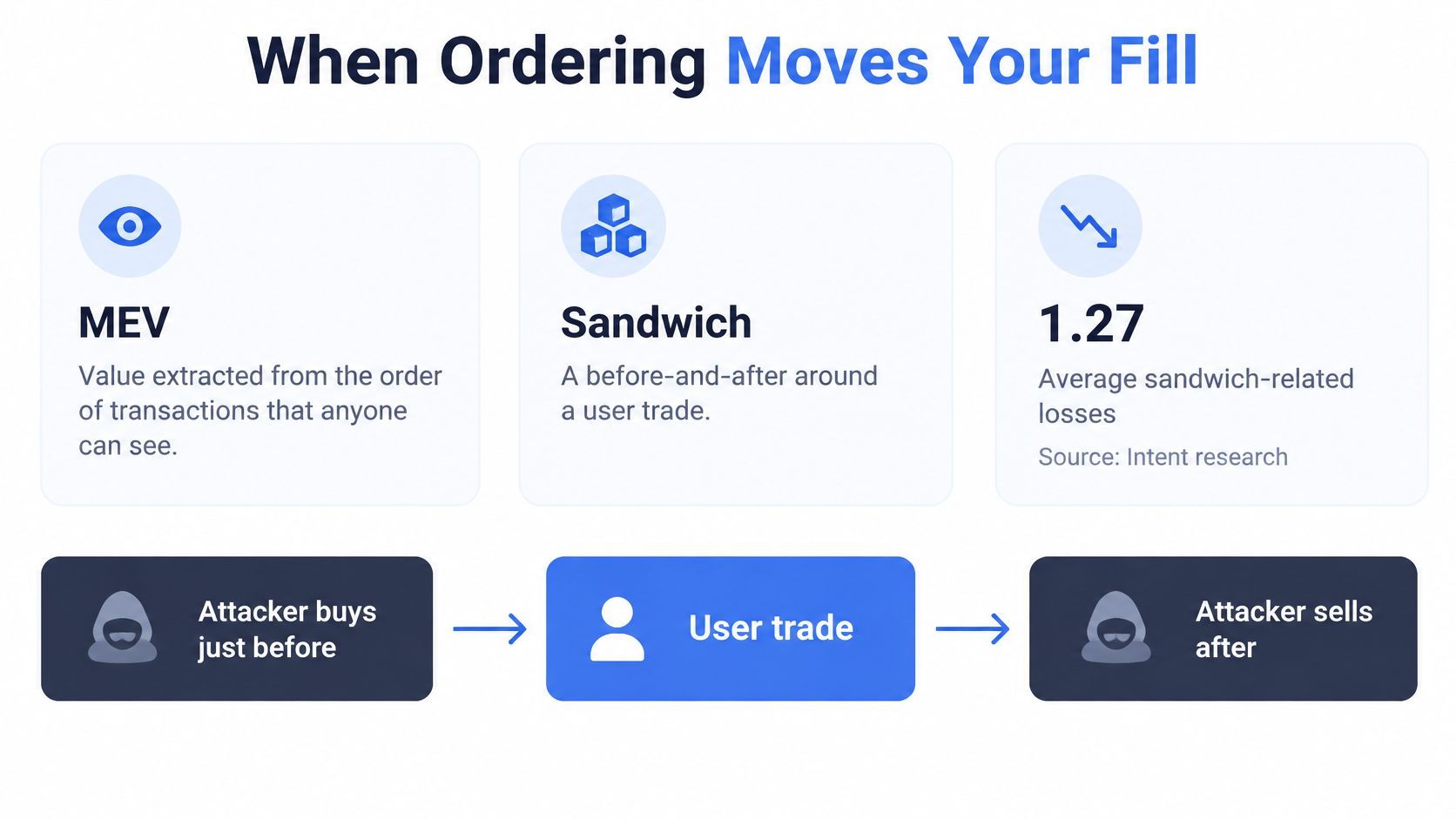
What the observed activity establishes
An Ethereum study of MEV activity identified approximately 9.4 million MEV activities, including 6,331,851 arbitrage events and 3,016,971 sandwich attacks, with reported false-positive and false-negative rates no greater than 2.4%. Those counts describe the study's detected activity. They aren't a probability estimate for your next transaction.
The practical issue is permission. Signing a swap with a loose minimum gives execution more room to worsen before the transaction fails. An attacker may exploit that room when the transaction and pool conditions make it possible.
For a copied buy, the follower also arrives after an observable source trade. The relevant exposure is the follower's actual order against the current pool, not the leader's allocation percentage.
Choose controls by the failure they address
- Minimum output: Reject execution below the amount you're prepared to receive. Don't widen it just to make repeated failures disappear.
- Transaction simulation: Check whether the proposed transaction can execute against the state being simulated. A successful simulation doesn't freeze that state.
- Protected order flow: Use private or protected submission where supported. Don't assume every chain, route, or interface provides equivalent protection.
- Liquidity-based sizing: Reduce or reject an order that would consume too much available depth.
Our slippage tolerance guide addresses the execution boundary. A tight setting can reject an unfavorable fill, but it can also mean no position is opened. That's a trade-off, not a reason to remove the limit.
Protection changes how a transaction is exposed. It doesn't reserve liquidity or insure the position.
Pool reserves can change after a simulation or quote. A route can disappear, a transaction can fail, and a successfully protected trade can still lose value afterward. These controls reduce specific execution risks. They don't remove market risk or prevent the loss of what you put in.
Judge the Fill Not the Leaderboard
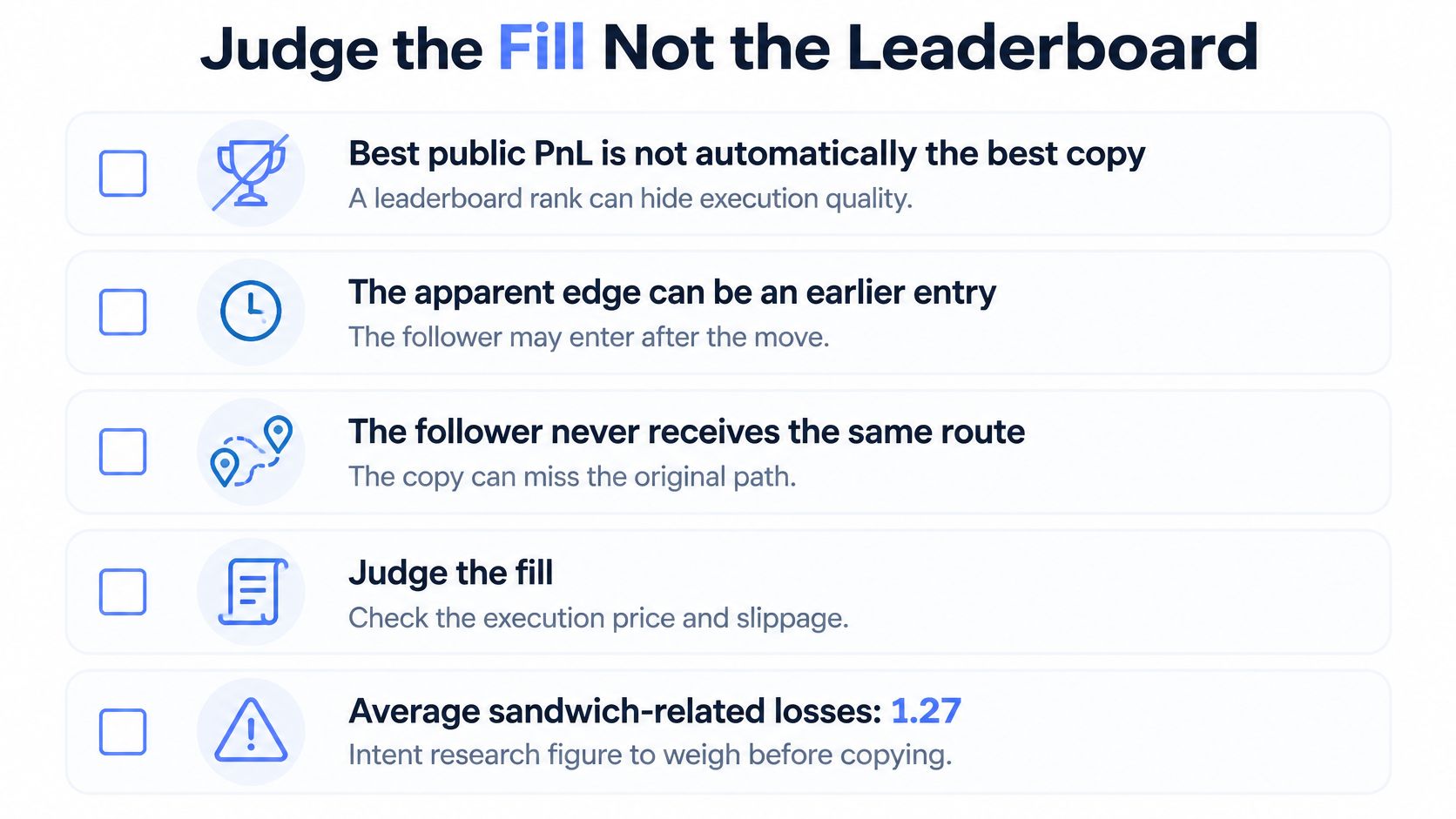
The wallet at the top of a PnL leaderboard can be a poor copy. Its trader may enter before followers, use a route followers don't receive, or trade opportunities that disappear once others participate.
A public record establishes what happened to that trader. It doesn't establish that you could have executed the same strategy at the same prices.
The checklist below focuses on what survives the move from a public result to a follower's account.
Test whether the edge survives execution
An analysis of intent-based execution reports average sandwich-related losses of 1.27% per transaction for conventional DEX swaps, compared with 0.19% under an intent-auction design, an 85% decrease. Those are reported study averages, not a copy.top charge, a prediction of your loss, or evidence that all protected routes behave alike.
Use the same checks on any public track record:
- Compare quote and fill. Read actual execution rather than relying on the price shown before submission.
- Inspect entry liquidity. The token name doesn't reveal how much depth was available when the trader entered.
- Model your own size. Estimate impact from your intended order, not from the leader's historical ticket.
- Measure the delay. Compare the source transaction with the copied transaction and the price movement between them.
- Count incomplete execution. Include failed and partial fills when evaluating the copying process.
- Confirm exit coverage. A buy-only copy leaves selling entirely in your hands.
Read profiles as records, not forecasts
Realized PnL, win rate, median holding time, open positions, and recent trades answer different questions. Realized results describe closed activity. Open positions reveal unresolved exposure, while holding time helps show whether the strategy depends on rapid execution.
Our guide to evaluating a copy trader puts trader selection in that broader context. Don't compress a record into a single rank or treat a high win rate as evidence that losses are small.
A trader with lower historical returns, deeper liquidity, and slower turnover may be more practical to copy than a fast wallet entering thin pools first. That's a criterion for investigating execution, not a promise of a better outcome.
Memecoin copying can lose the amount put in. Past performance does not predict results. The useful comparison is the exposure and execution you can reproduce, not the screenshot you would like to match.
Pick a Trader and Copy From Your Wallet
Start with a named trader, then read the public record before enabling automatic copying. Compare realized results with open positions and recent trades. Consider whether the trader's market, holding time, and position sizes fit your own approach.
Set the copy before leaving the screen
For each trader, choose a flat ticket amount or a share of the trader's size, then set a cap. A copied trade can open while you're asleep, using your chosen size and staying within the limit you set. Your own fill may differ from the trader's because execution depends on timing, pool depth, and ordering.
The max chase setting skips a copy when the price has moved past the trader's entry by more than your chosen percentage. Options are 10%, 25%, 50%, custom, or off. It filters late entries. It does not protect against losses after a trade executes.
- Review the trader: Check public results and recent activity, not rank alone.
- Set the exposure: Choose sizing, a cap, and an entry boundary before enabling copies.
- Review completed trades: Compare your fills and remaining positions with what you intended to copy.
Token copying covers Solana, Base, BNB Chain, Ethereum, Robinhood Chain and Arc, with Hyperliquid for perps. Traders come from fomo, pumpfun, Hyperliquid and Polymarket.
copy.top is independent and isn't affiliated with fomo, pumpfun, Hyperliquid or Polymarket. The trading blog has more explanations.
Use the trader directory to inspect profiles, the live coin view to see tokens traders are buying, or the Hyperliquid page to examine perp traders. Copy trading carries risk. You can lose what you put in, and past performance doesn't predict results.
copy.top offers named traders, public track records, and automatic copies of buys and sells from your own wallet. Visit copy.top to choose a trader, review the execution record, set your size and cap, and start copying.