 copy.top
Most advice on this topic stops at one line. Use a DEX aggregator, it finds the best price. That's true about the quote. It's incomplete about the fill.
A quote is a calculation against pool state at one moment. A fill is what lands in your wallet after gas, fees, price movement and transaction ordering. The two numbers differ, and the gap is where your money goes.
Table of Contents
- What a DEX Aggregator Does on Every Swap
- One Pool, Split or Multi-Hop
- Intent-Based Swaps and Filler Auctions
- Price, Slippage, Fees and Gas in One Quote
- Why the Executed Price Differs from the Quote
- Cross-Chain Swaps and Where the Risk Stacks
- Check the Route Before You Sign
What a DEX Aggregator Does on Every Swap
Say you need a specific laptop charger. You check three shops, compare prices, then pay at one till. A DEX aggregator does that for a token swap. It takes one request, reads liquidity across many decentralized exchanges, builds a route, and submits one transaction. You sign once. The router does the comparison you'd otherwise do by hand on each venue.
The role exists because liquidity is fragmented. The same pair trades in many pools, on several networks, at different depths and fee tiers. One venue rarely has the best price at every trade size.
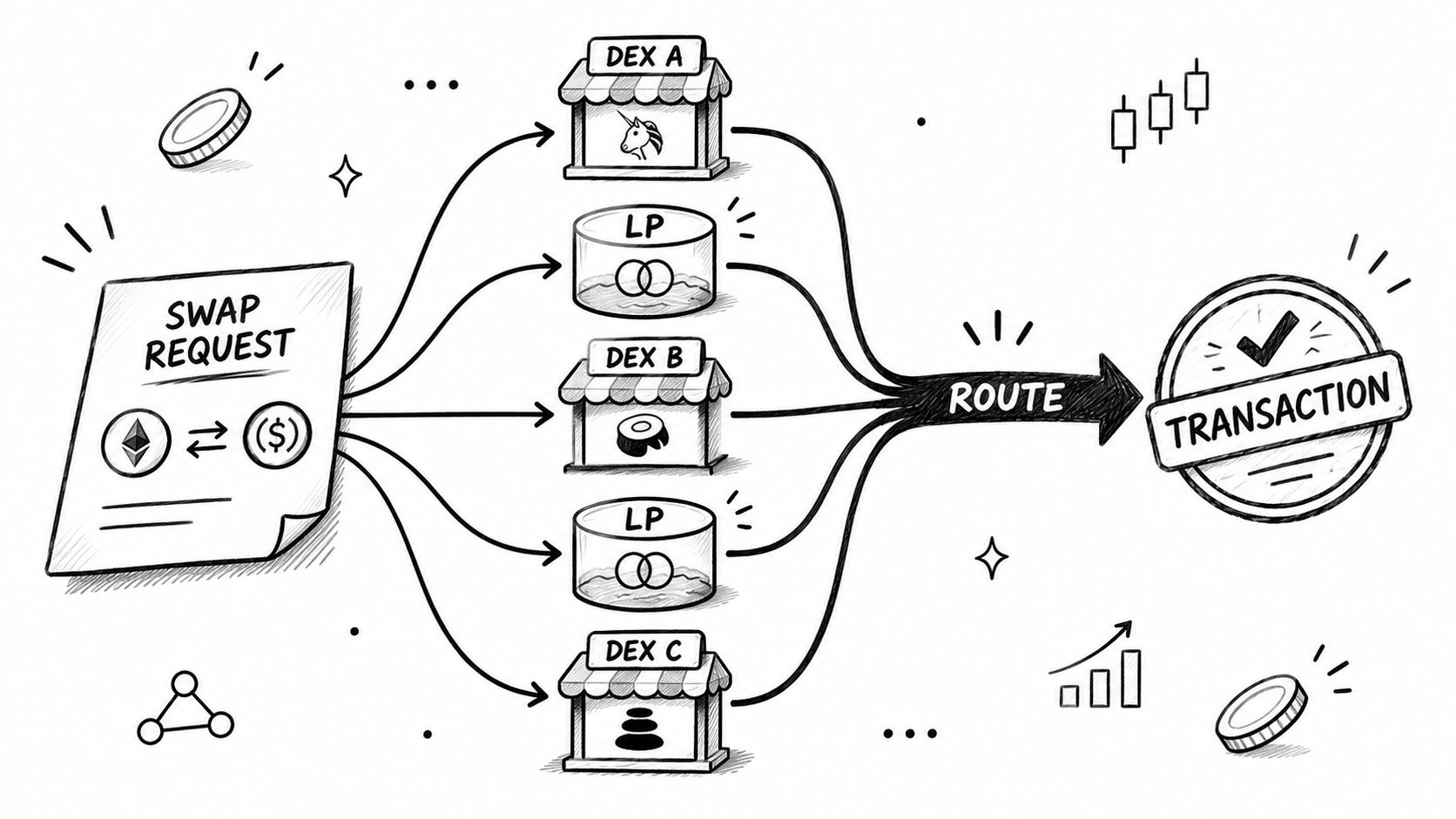
Three stages in one transaction
- Liquidity discovery. The router reads pools across venues and networks. A pool is a contract holding two or more tokens that trades against its own reserves.
- Route construction. It picks one pool, splits the order across several, or chains hops through an intermediate token.
- Execution. It submits the transaction and the output tokens arrive in your wallet.
This is execution infrastructure, not a price widget. 1inch started as a hackathon project in 2019, and by the second quarter of 2025 its aggregation protocol averaged approximately $848.2 million in daily volume, according to the Blockworks State of 1inch Q2 2025 report.
Take a swap you already made. Name the three stages in it. Then say which one you'd check first if the output came in light.
One Pool, Split or Multi-Hop
The router isn't picking the lowest quoted price. It's solving a constrained problem across automated market maker pools, each with its own curve, fee tier and reserves, and reserves move between the quote and your signature. The empirical audit of Ethereum WETH to USDC routing frames it that way: curved liquidity functions, heterogeneous fees, gas costs and rapidly changing reserves all enter the decision, and convex price impact is why dividing an order across sufficiently deep pools can reduce the marginal price move in each one.
Three shapes come out of that decision.
| Route shape | How it executes | Helps when | Breaks when |
|---|---|---|---|
| Single pool | whole order goes through one AMM pool | the pool is deep and the order is small | the pool is thin and price impact rises |
| Split across pools | order is divided across two or more pools | the trade is large relative to each pool | extra approvals and gas erase the saving on small orders |
| Multi-hop path | token is swapped through one or more intermediate tokens | no direct pool exists for the pair | each hop adds fees and exposure to state changes |
Why splitting stops paying
Splitting buys you a smaller price move per pool. It costs you more work on chain. Extra approvals, more calldata, more pool interactions, more gas. On a small order, that overhead can exceed the price improvement, so the route that looks cheaper on the screen is the worse trade after costs.
Multi-hop has the same arithmetic. Two hops through a deep intermediate pair can beat one thin direct pool. Each hop still charges its fee and each hop reads reserves that can change before inclusion.
A route is only as good as the pools it can actually reach. A pool that isn't activated or isn't tradable at that moment contributes nothing, whatever its reserves say.
That's the part traders miss on long-tail tokens. The nominally superior path can degrade after a state change or a failed pool interaction, and you find out at settlement.
Run this test on any quote on your screen. Name the route shape. Then check whether the depth of the pools it uses fits your size. If you can't answer both, you're guessing.
Intent-Based Swaps and Filler Auctions
Some aggregation no longer sends your transaction through every hop. You sign an outcome instead. In the UniswapX model, the user signs an off-chain order specifying the required output, and independent fillers compete to satisfy it from their own inventory or external liquidity, including on-chain AMMs and private sources, as set out in the UniswapX developer overview.
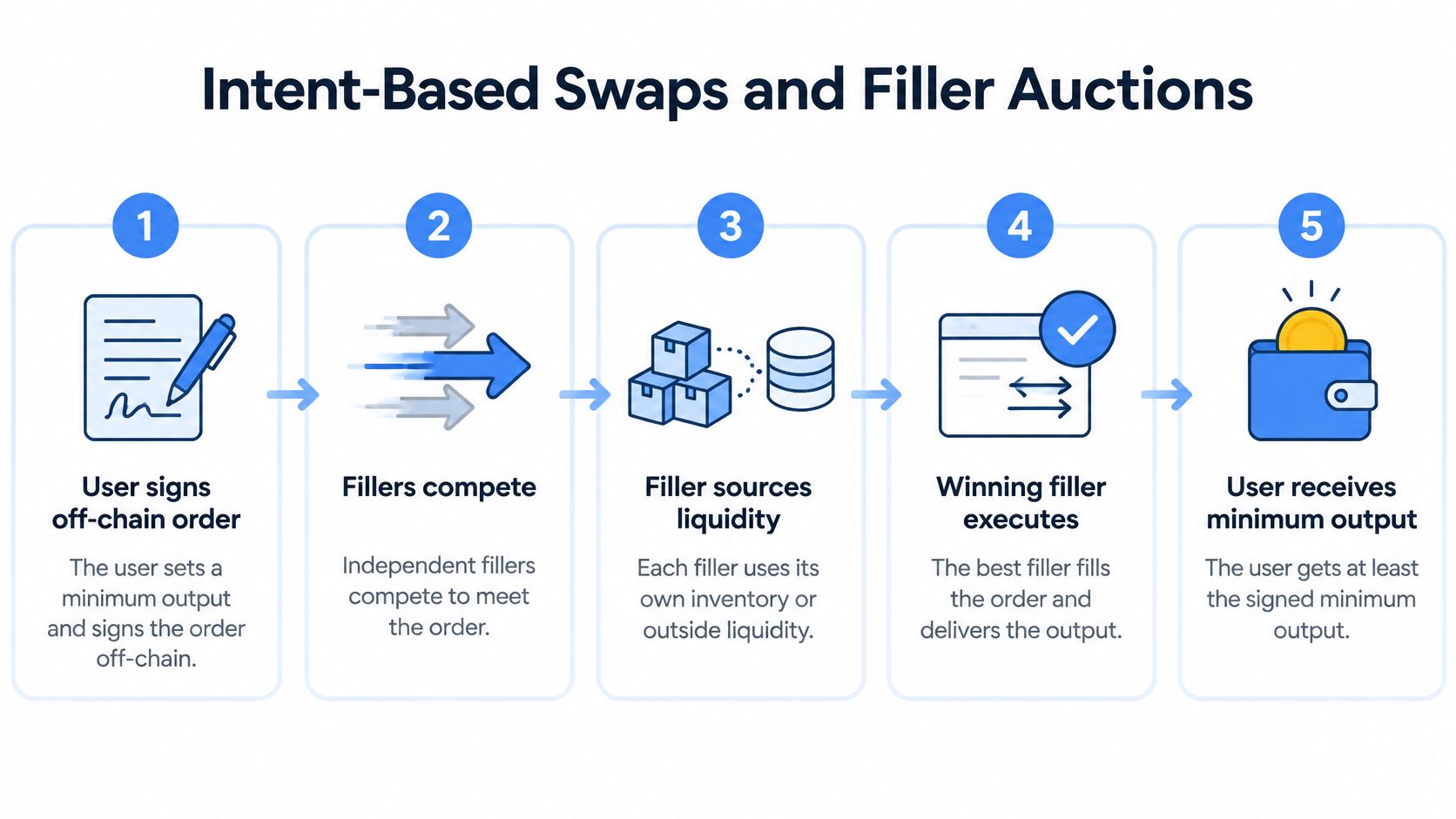
How the auction runs
- You sign an order with a minimum output and a deadline. That minimum is your protection, written into the signature.
- A filler checks whether a hard quote, priced by request for quote, is competitive enough to take.
- If no hard quote qualifies, the order moves to an open Dutch auction.
- The executable price changes over time or block by block, so waiting costs the filler money.
- A filler submits a profitable settlement. Uniswap's documentation states Ethereum mainnet currently uses a 24-second, two-block exclusivity period before all fillers compete equally.
Route work and gas decisions move to the filler. Your job shrinks to the constraints you sign. The same idea applies to moving assets between networks, and Mayan's write-up explaining intent-driven asset bridging is a useful companion read on how a signed outcome replaces a hand-built path.
Check four things before you rely on it:
- Signature and deadline: confirm what you signed and when it stops being valid.
- Exclusivity and expiry: an order nobody fills is an order that didn't happen.
- Staleness: a signed minimum set against old prices can sit unattractive to every filler.
Intent systems can reduce failed-swap exposure. They don't remove price, liquidity, smart-contract or execution risk.
Price, Slippage, Fees and Gas in One Quote
Open a quote and read it as a cost sheet, not a price tag.
| Component | What it covers | Where to check it |
|---|---|---|
| Quoted output | tokens expected before costs | quote screen before signing |
| Price impact | how far your order moves the pool price | quote screen, larger in thin pools |
| Pool and route fees | fee each pool or hop charges | route breakdown |
| Network gas | cost to execute on the chain | wallet confirmation |
| Priority fee | extra fee to speed inclusion on chains that use it | wallet or network settings |
| Slippage tolerance | the worst output you accept | swap settings before signing |
| Minimum received | output floor implied by slippage | confirmation screen |
The two numbers people mix up
Price impact is caused by you. Your order changes the ratio of tokens in the pool, so the pool quotes you a worse rate as your size grows against its depth. It's already inside the quoted output. Raising your size raises it. Nothing about a faster connection changes it.
Slippage tolerance is a permission you grant. It says how far the output can fall below the quote before the transaction should revert. Set it tight and a normal price tick kills the trade, and you still pay gas on the failure. Set it wide and you've agreed in advance to accept a worse fill. Our guide to slippage tolerance walks through the setting itself.
Practical rule: the tolerance is your setting, not the router's promise. Minimum received is the only floor you actually control.
Gas and priority fees sit outside both numbers. A route can improve your rate by less than it adds in execution cost, and the quote screen won't always net that out for you.
Label each row of the table against a live quote. Find the minimum received line. That's the number you're agreeing to.
Why the Executed Price Differs from the Quote
An aggregator can find the cheapest available route and your fill can still be bad. Those aren't contradictory statements. An audit of 2.98 million WETH to USDC swaps on Ethereum found an average routing shortfall of 2.02 basis points per trade, estimated at roughly $24 million in aggregate value, and attributed the losses to execution frictions, MEV and order-submission context.
Read that as a list of separate line items. Realized slippage is one. Priority fees are another. Failed transactions that cost gas and return nothing are a third. MEV losses, where someone trades around your pending order because they can see it, are a fourth. Collapsing all of them into "best price" hides which one is eating your size.
What each symptom points to
| Symptom | Likely cause | First check |
|---|---|---|
| Small gap below the quote | price moved between quote and inclusion | time from quote to signing and pool depth |
| Large gap below the quote | thin pool or order too large for its depth | price impact at your size and route shape |
| Transaction failed or reverted | slippage limit hit or deadline passed | tolerance setting and deadline |
| Cheap route but poor fill on a memecoin | pool state changed or a pool interaction failed | liquidity depth and recent route history |
| Copied trade filled worse than the lead trade | copy submitted after the lead trader's transaction | timing of the copy against the lead trade |
Route quality is conditional. It depends on trade size, chain congestion, pool depth, latency, and whether your transaction details are visible before inclusion. On a volatile memecoin, a short delay is the whole difference between the quote and the fill. Our explanation of slippage in crypto covers the mechanics of that movement.
The copy-trading version of the same problem
A copied buy is submitted after the lead trader's transaction. The lead trader's fill already moved the pool. The route that was optimal a moment earlier may not be optimal now, and your entry is worse by construction, not by bad luck.
That's why a chase limit matters more than a leaderboard number. We let you cap it: max chase skips a copy when the price has already run past the trader's entry by more than your chosen amount, with options of 10%, 25%, 50%, a custom value or off. Skipping a stretched entry is a valid outcome. Compare realized fills and failure rates, not quotes.
Cross-Chain Swaps and Where the Risk Stacks
One click doesn't mean one risk. A cross-chain route is several transactions wearing one button.
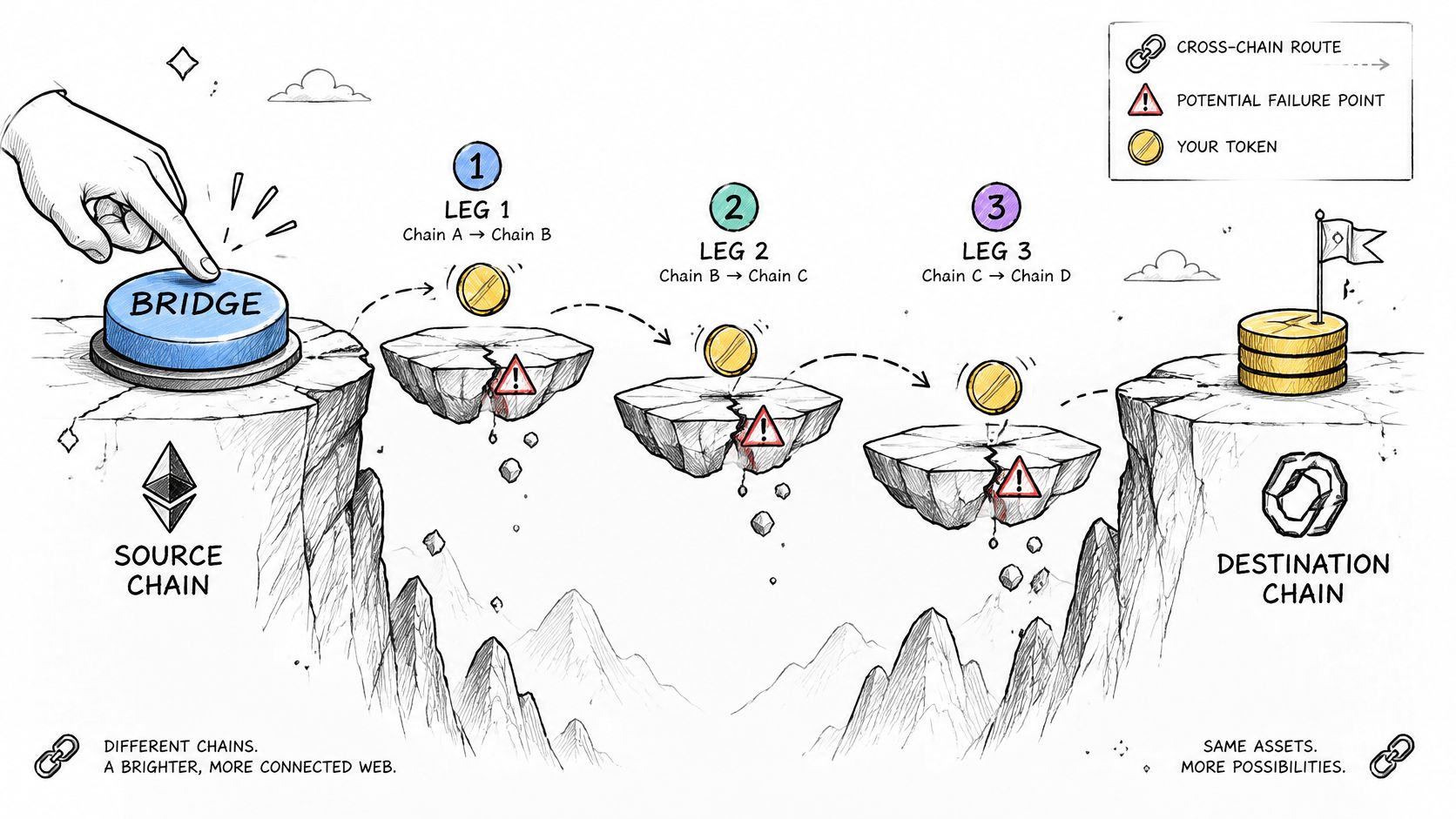
The legs run in order:
- The source-chain transaction.
- Bridge settlement.
- Liquidity on the destination chain.
- The final swap into the token you wanted.
Each leg can add delay, slippage, fees, contract risk or a temporary liquidity problem. They don't cancel out. As Stablecoin Insider's guide to using a cross-chain aggregator notes, bridge and destination-swap slippage stack rather than occurring independently, and thin destination liquidity plus settlement time can worsen the final amount you receive.
Inspect the legs before you confirm
- Bridge provider and settlement time: know who holds the assets in between and for how long.
- Destination asset: confirm what arrives, not just what you asked for.
- Gas on the destination chain: arriving with tokens and no gas means you can't trade.
- Refund or recovery path: find out what happens if a leg stalls.
- Tolerance, not certainty: the quoted output is a figure within a stated tolerance.
Two separate transactions are sometimes the better trade. You see the result of the first leg, then decide whether the second is still worth doing. That option disappears inside a single click. Liquidity and operational support are uneven across Solana, Ethereum, Base, BNB Chain and newer networks, so the same route behaves differently depending on where it lands.
For copied trades, there's a design question you should answer in your own settings. Should a copy wait for funds to arrive, or be skipped when the destination route has become materially worse. Convenience doesn't prevent losses.
Check the Route Before You Sign
Run this before every confirmation. It takes less time than reading a chart.
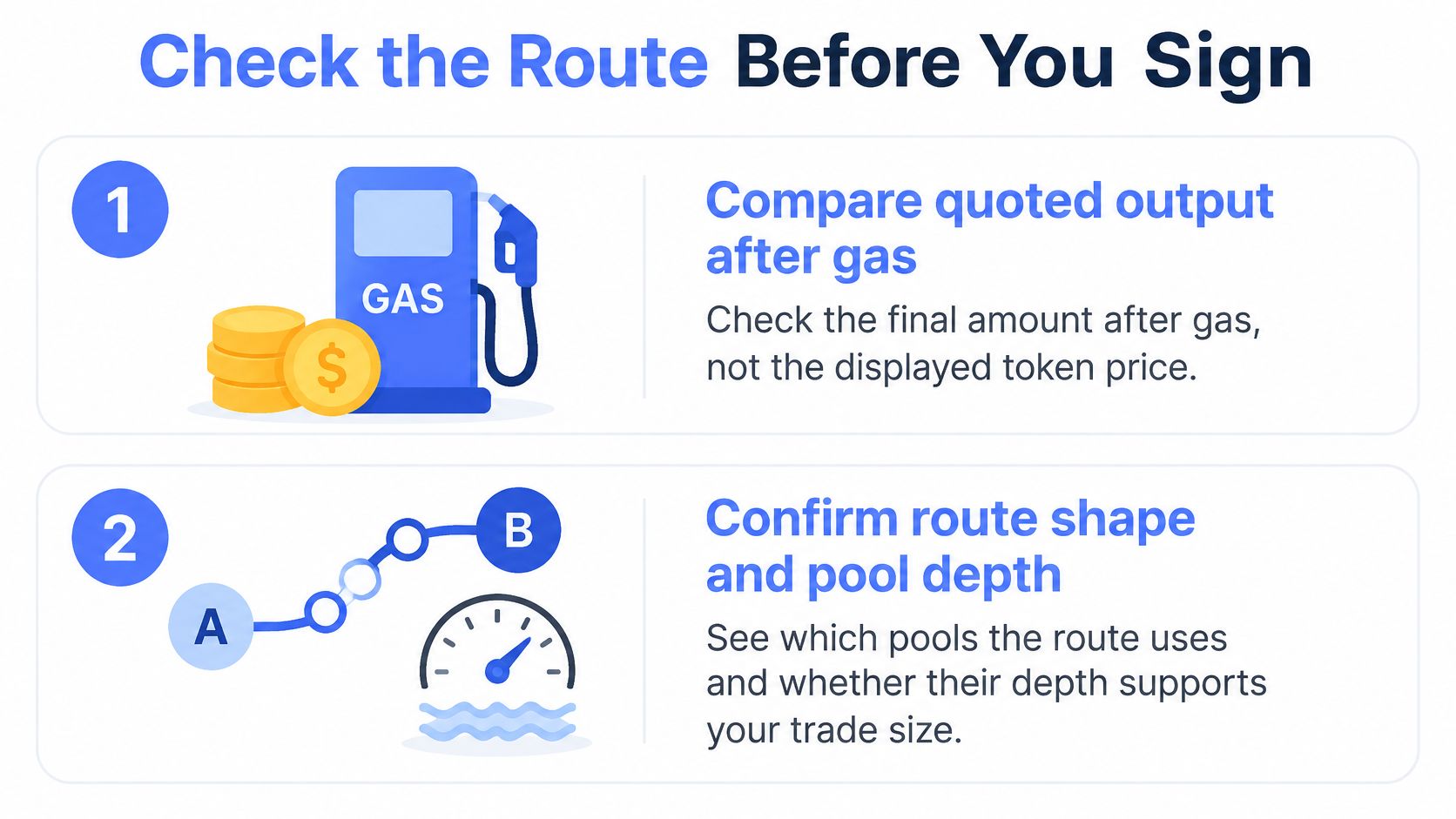
- Compare the quoted output after gas, not the displayed token price.
- Confirm the route shape and the pool depth at your size.
- Set the tolerance for that pool's depth, that token's volatility and that order size. Don't leave a wide setting in place from your last memecoin trade.
- Check the deadline or expiry. On an intent-based order, check the signature and whether it can go stale.
- Limit token approvals to what the swap needs, and revoke approvals you no longer use.
- On a cross-chain route, run the leg check.
- After the swap, compare the fill with the quote and note any failure.
Swaps, memecoins, perps and prediction markets carry risk. You can lose what you put in. Past performance doesn't predict results, and no route makes a profit certain. If you're sizing copied trades, treat exposure as a separate decision from the trader's record, and read the mechanics in our overview of DeFi trading bots.
If you follow named traders on memecoins or perps, review public track records on our trader pages, see what's active on the coins view, and check perp traders on the Hyperliquid page. More guides sit on the copy.top blog.
copy.top is a non-custodial, multichain copy trading web app. You pick a named trader with a public track record from the fomo app, pumpfun or Hyperliquid, set your size, and their buys and sells are copied from your own wallet. Since every copied fill lands after the lead trader's, set your size and your chase limit before you start, then judge the results on realized fills rather than the leaderboard. Go to copy.top, pick a trader and start copying.