 copy.top
“Use a stop-loss and copy a trader with a strong record” is incomplete advice. Neither tells you how much you can lose if your entry arrives late, your stop slips, or the trader exits a token you can't sell.
Crypto trading risk management starts with your loss budget and your execution. A public track record describes the trader's fills, not yours. Before copying anyone, define the exposure you'll accept and the conditions that make you stop.
Table of Contents
- Size Every Position by the Loss You Can Accept
- Set Your Limits Before You Copy Anyone
- Stop-Losses and Take-Profit Rules That Hold Up
- How Leverage Shortens the Distance to Liquidation
- Execution Gaps Between a Trader and Your Copy
- Why a Strong Track Record Is Not a Risk Limit
- Write Your Risk Plan Before You Start Copying
Size Every Position by the Loss You Can Accept
Start with the loss, not the position. Choose the portion of your account you're prepared to lose on a trade, then calculate the position that fits that budget.
The arithmetic has two parts. Maximum planned loss equals account size multiplied by risk per trade. Position value equals that loss divided by the distance from entry to stop, expressed as a decimal.
Calculate the ticket from the stop distance
These are hypothetical sizing examples, not recommended risk levels. They assume a position without borrowing, a complete exit at the stop price, and no execution costs.
Maximum loss and position size by account and risk level
| Account size | Risk per trade | Max loss on one trade | Position at 25% stop | Position at 50% stop |
|---|---|---|---|---|
| $1,000 | 1% | $10 | $40 | $20 |
| $1,000 | 2% | $20 | $80 | $40 |
| $1,000 | 5% | $50 | $200 | $100 |
| $5,000 | 1% | $50 | $200 | $100 |
| $5,000 | 2% | $100 | $400 | $200 |
| $5,000 | 5% | $250 | $1,000 | $500 |
| $10,000 | 1% | $100 | $400 | $200 |
| $10,000 | 2% | $200 | $800 | $400 |
| $10,000 | 5% | $500 | $2,000 | $1,000 |
Walk through the first row. A hypothetical $1,000 account risking 1% has a $10 planned loss budget. Divide $10 by 0.25 and the position is $40. Divide it by 0.50 and the position is $20.
At 2% risk on that same hypothetical account, the budget becomes $20. A stop 25% below entry permits an $80 position; a stop 50% below permits $40. The planned loss stays constant. The ticket changes.
The position-sizing guide gives this calculation a practical role: set the exit distance first, then determine the ticket. Don't choose a large position and widen its stop to avoid closing it.
Separate a planned loss from a possible loss
A BIS working paper on retail crypto adoption estimated that 73% to 81% of retail investors likely lost money on their initial crypto investment after price declines. That estimate doesn't predict a particular copy strategy. It does undermine the assumption that access to a market solves sizing.
The table describes losses at the stated exit price. An unsellable token can cost the entire ticket, so distinguish stop-based risk from full-position risk.
Run a hypothetical sequence of ten losses before approving a size. If that sequence would badly damage the account, the position is too large. Keep money needed for living expenses outside active trading.
Set Your Limits Before You Copy Anyone
Set limits before selecting the trader. Otherwise, an attractive leaderboard makes it too easy to change the rules until the trader qualifies.
Use this order. Each limit addresses a different failure point, so a careful ticket size doesn't replace an account cap.
Account cap. Set the total amount you accept losing across all copying, separate from money you need to live on. The common slip is sizing each trader carefully while leaving the entire balance available to a bad week across several traders.
Per-trader allocation. Give each trader a maximum allocation and a loss threshold that ends the relationship. Don't keep topping up an allocation because the trader's previous record looked strong.
Token or theme exposure. Count overlapping positions together, including positions opened by different traders. Several names buying the same memecoin, or taking the same directional perp exposure, aren't independent risks.
Minimum trade size. Filter out trader buys that are too small to represent the activity you intend to follow. A minimum filter can remove noise, but it doesn't prove that a larger trade reflects stronger conviction.
Trader-specific exits. Decide stop and take-profit levels for each trader's copied positions. Applying identical exits to traders with very different holding periods can close a slower strategy prematurely or leave a fast strategy exposed too long.
Maximum open positions. Decide how many simultaneous positions you can fund and monitor. Don't assume spare cash means spare risk capacity when existing trades already share the same downside.
Separate the limits you set
The diagram separates the account, trader, position and loss controls.
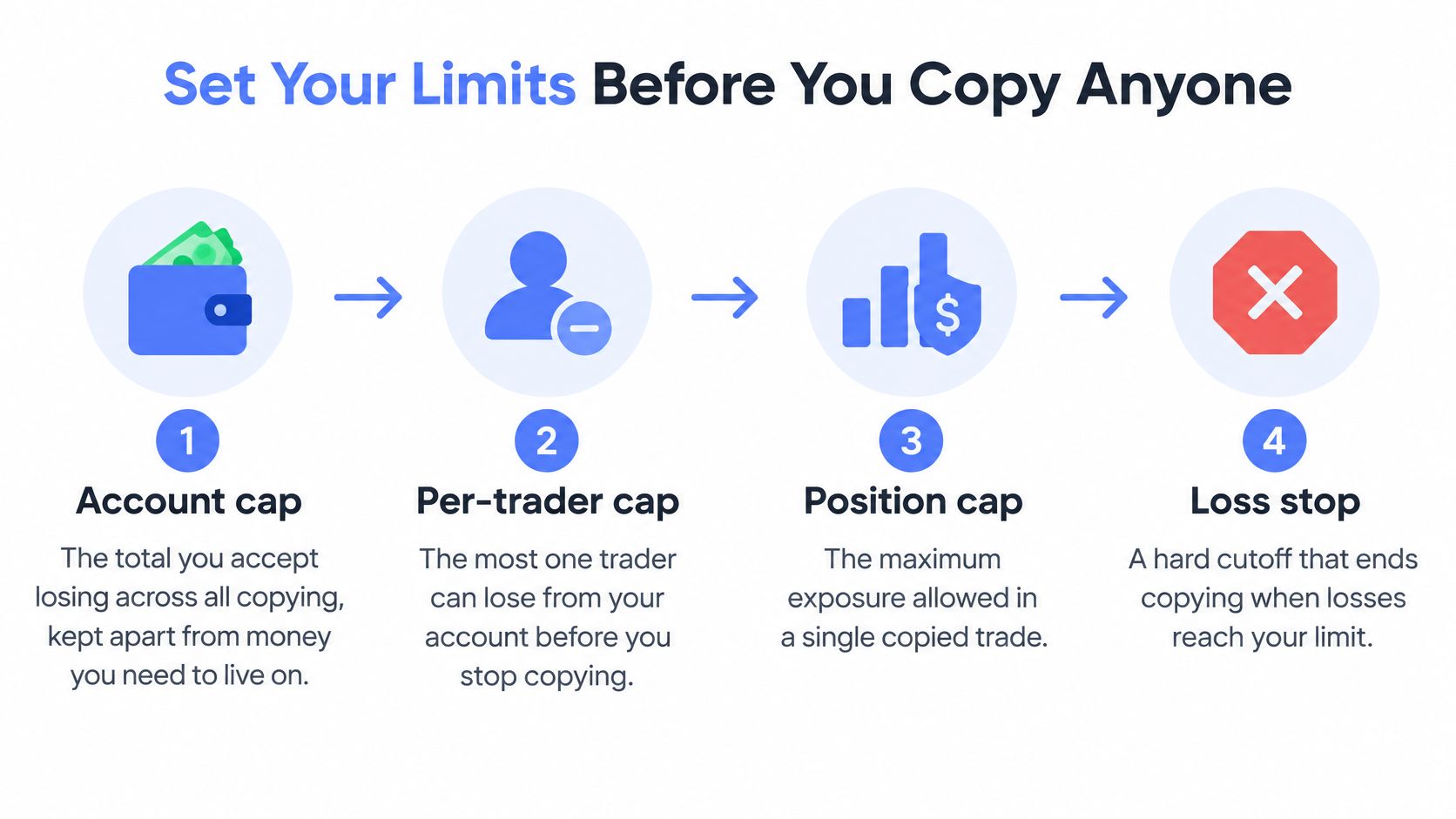
A position cap limits a single ticket. A trader cap limits the accumulated exposure from that person's activity. An account cap remains necessary when several traders lose together.
Treat the maximum-open-position rule as your own operating constraint. Don't assume every written limit is an automatic platform setting. If you can't enforce a rule automatically, specify when you'll review it and what action you'll take.
Custody doesn't replace exposure control
copy.top is non-custodial. You keep your keys and wallet, and grant a trading allowance from your own wallet that you can revoke at any time. Copies run from your own wallet.
That reduces reliance on third-party custody. It doesn't remove smart-contract, market, liquidity, execution or trader-behavior risk. Protect the keys, review permissions, and keep reserves outside the amount committed to copying.
Before starting, write down your maximum acceptable loss for the week. If you can't name the amount and the action it triggers, the limits aren't finished.
Stop-Losses and Take-Profit Rules That Hold Up
A stop is an exit instruction, not an assured execution price. When a thin token falls through your trigger, the available selling price may already be lower.
Consider a hypothetical stop at 25% below entry. If buyers disappear near that level, the exit can execute beyond the planned loss. Widening your slippage tolerance may help an order execute, but it also permits a worse fill.
Practical rule: Size for the possibility that price gaps through the stop, not just for an orderly exit at the trigger.
Know which positions the rule covers
A stop inside a trader's copy flow applies only to that trader. A stop set from /settings applies across every trader you copy. Minimum trade and max chase are account-wide.
Say two traders buy the same token. A trader-specific stop affects only that trader's copied position. A matching account-wide stop applies to both copies when their relevant trigger conditions are met. It isn't necessarily a portfolio drawdown circuit breaker that closes unrelated assets.
Keep manually purchased tokens separate in your exit checklist. Copy-position controls aren't a substitute for managing a token you bought yourself.
Reduce exposure without leaving an accidental remainder
Take-profit rungs let you sell portions rather than choose between holding everything and closing everything. For example, selling 25% at a 50% gain reduces exposure while leaving part of the position open. That's an exit arrangement, not a prediction that price will reach the level.
Check whether each sale percentage refers to the original position or what remains. Make the final action explicit, including what happens to any unsold balance. The take-profit and stop-loss guide provides context for arranging those exits.
We print slippage on every copied trade. Use that execution record rather than assuming the price you requested was the price you received.
Before leaving exits unattended, check:
- Stop scope. Confirm the level and the trader's positions it covers.
- Observed slippage. Compare recent fills with expected prices, especially on sells.
- Remaining exposure. Confirm your take-profit rungs and final exit account for the full position.
A trigger can initiate a sale. It can't create buyers where none remain.
How Leverage Shortens the Distance to Liquidation
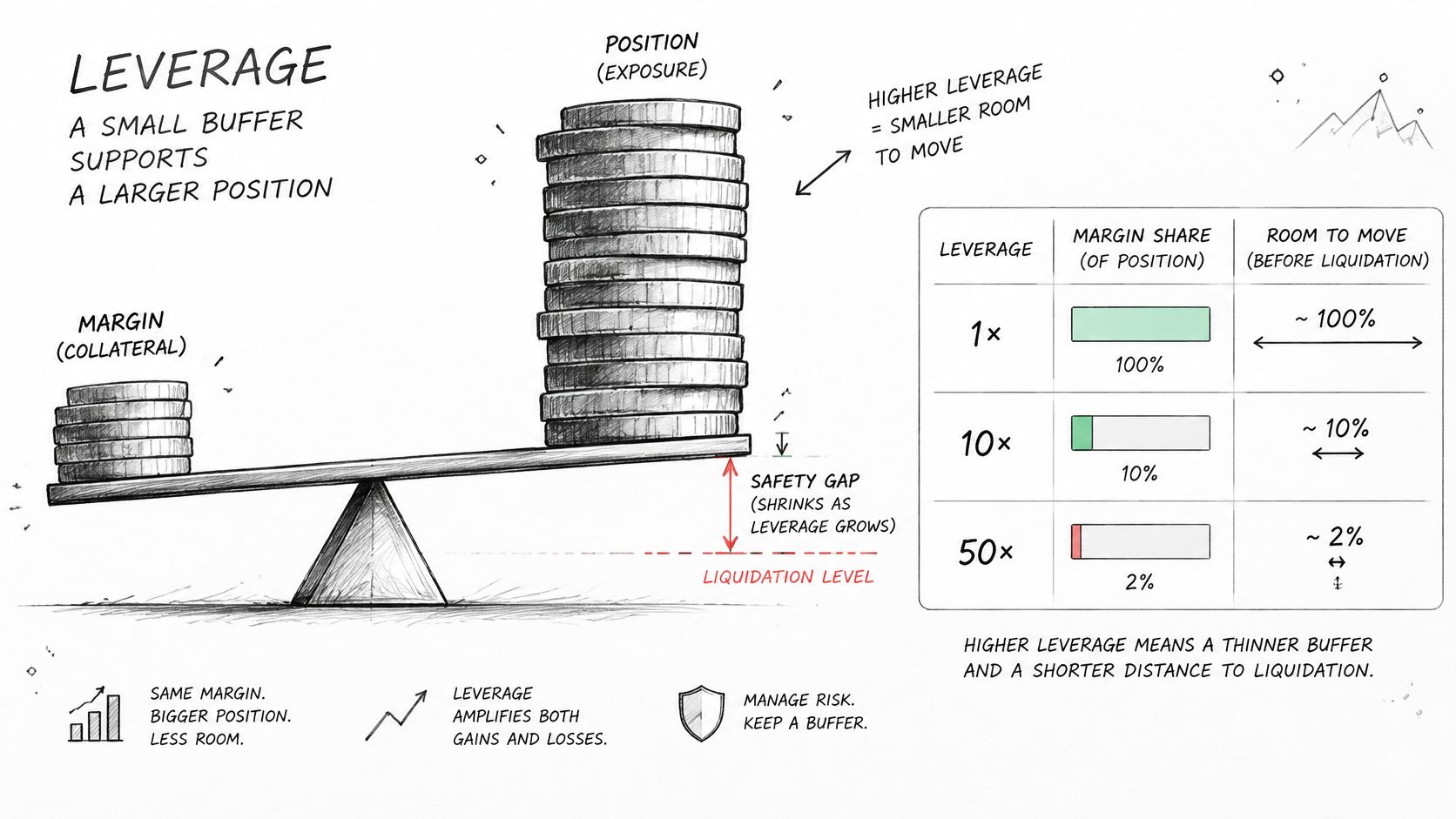
Margin reduces the backing of a position's notional value. The table gives simplified arithmetic for a linear position, not a venue-specific liquidation calculation.
Simplified margin buffer by exposure
| Leverage | Share of position covered by margin | Approximate adverse move that uses all margin |
|---|---|---|
| 2x | 50% | 50% |
| 5x | 20% | 20% |
| 10x | 10% | 10% |
| 20x | 5% | 5% |
| 40x | 2.5% | 2.5% |
Each margin share is calculated as one divided by exposure. The adverse-move column assumes that price losses consume that margin without maintenance requirements, funding or fees. It isn't your liquidation distance.
The illustration shows how increasing exposure narrows the available buffer.
Liquidation can arrive before margin reaches zero
CME's futures margin guide distinguishes initial margin, required to open a position, from maintenance margin, the minimum that must remain. Failure to restore required margin can lead to position reduction or liquidation. Don't plan around exhausting every dollar of posted margin.
Forced selling also affects the market around your position. The BIS Quarterly Review described how falling prices, margin calls and liquidations reinforced market stress during the September 2021 cryptoasset crash. A protective order can be competing with forced sellers while available liquidity shrinks.
This video provides additional context on margin trading.
Match the buffer, not just the displayed leverage
A lead trader's risk label doesn't describe your entire account. Collateral, margin mode, position size, funding and entry timing all matter.
Consider a hypothetical trader holding a 10x position in cross margin with substantial additional eligible collateral. Your copy may have less collateral available relative to the position. The same adverse move can therefore reach your liquidation threshold sooner.
A smaller account alone doesn't necessarily change liquidation distance. If exposure and collateral scale proportionally under identical conditions, the relative buffer can be similar. The problem is assuming those conditions match without checking.
- Set an independent cap. Don't inherit the trader's maximum automatically.
- Inspect the actual liquidation level. Leave room between the intended stop and forced closure for adverse execution.
- Count correlated positions together. Separate contracts can still consume the same collateral during a broad move.
- Budget carrying costs. Leave margin for funding and fees rather than allocating every available unit.
Exposure is an exposure multiplier, not evidence of skill. Perpetual trading is risky, and users can lose what they put in.
Execution Gaps Between a Trader and Your Copy
A public track record shows what the trader's wallet did. Your copy executes from your wallet, at your time, with your fills.
The main gaps are entry delay, thin liquidity, missed sells, illiquid exits and perp funding. Evaluate buys and sells separately. An acceptable entry doesn't establish that you can later exit the same size.
Execution gaps a copier faces and the control for each
| Gap | What the copier sees | Control to set |
|---|---|---|
| Entry delay | Fill at a different price from the trader | Cap how far price can run past the trader's entry |
| Thin liquidity | Order moves the price or exit is slow | Cap position size by token liquidity |
| Missed sells | Position stays open after the trader closes | Set your own exit rule for each open copy |
| Illiquid exit | Token stops trading and cannot be sold | Keep the position small enough to lose in full |
| Perp funding | Hourly payments change your balance while you hold | Count funding in your loss budget |
Reconcile positions rather than assuming closure
Compare your open positions with the trader's recent closes. Investigate any remainder instead of treating the trader's completed sale as proof that yours completed too.
When a memecoin's liquidity disappears, we check repeatedly, from more than one source, over at least a day before marking the position as unable to be sold and booking its cost as a loss. That accounting process doesn't restore liquidity or recover the position's cost.
Fixed-size and proportional copying also create different exposures. A fixed ticket can be large relative to a small trader purchase. Proportional sizing follows the trader's spend, but still needs a cap when the trader makes an unusually large buy.
A trader can have an accurate public record and still be difficult to copy.
Include the cost of waiting
According to Hyperliquid's funding documentation, funding is applied every hour and added to or subtracted from contract holders' balances. It's a recurring payment between sides of the contract, not just an entry charge.
Different position sizes and holding periods can produce different funding amounts. Don't compare a trader's completed trade with your still-open copy without accounting for that difference.
The final test is holding time. Compare the trader's median hold time with your expected execution delay and actual fill history. A trader who enters and exits within minutes leaves little room for a follower to reproduce the trade.
Why a Strong Track Record Is Not a Risk Limit
Headline realized pnl doesn't tell you how much risk produced it. A high win rate doesn't tell you how large the losing trades were.
Consider a hypothetical record with many small gains and a losing trade larger than those gains combined. The trader can win most trades and still finish down overall. Counting wins without comparing their size with losses misses the arithmetic that matters.
Check what produced the headline
Look for concentration in the result. If one exceptional winner accounts for most of the period's realized pnl, the headline gives limited information about the rest of the trader's decisions.
Also inspect open positions. Realized pnl describes closed trades; it doesn't, by itself, describe the risk still being held. A trader who closes winners while leaving losing positions open needs a different assessment from one who consistently realizes both.
The guide to evaluating a copy trader helps organize that review. Use the public page to test a trader against your limits, not to search for a reason to loosen them.
Extra scrutiny is warranted here. The CFTC's virtual-currency advisory warns that futures can amplify losses and that losses can exceed the initial investment in some futures structures. That warning has a specific scope; don't assume every product has identical loss mechanics.
Ask questions the record can answer
Before copying, answer these questions from the public page:
- Loss severity. How large are losing trades relative to winners, and does an exceptional winner carry the period?
- Holding time. Does the trader hold long enough for your expected fills to remain relevant?
- Borrowed exposure. What exposure do they use relative to the size and collateral you would commit?
Treat missing information as uncertainty, not as a favorable answer. If you can't assess an essential risk, don't fill the gap with the leaderboard rank.
Our content is informational and isn't financial advice. Past performance does not predict future results. Copy trading carries risk, and users can lose what they put in.
Write Your Risk Plan Before You Start Copying
Put the operating rules on a page you can read while positions are open. A plan that exists only in your head is easy to rewrite during a drawdown.
Record the amounts and thresholds you've already chosen. Don't recalculate them to accommodate a trader you want to follow.
Keep the plan executable
Your written plan should contain:
- Capital boundaries. Account cap, per-trader allocation and maximum planned loss per trade.
- Exposure boundaries. Token and theme caps, maximum simultaneous positions and borrowing ceiling.
- Exit instructions. Stop scope, take-profit levels and actions for incomplete or missed exits.
- Exclusions. Traders, tokens and trading styles you won't copy.
- Review triggers. A weekly review and a separate review after a losing streak.
Change the plan deliberately, outside the pressure of an active loss. Reducing exposure when a limit is breached is different from moving the limit because you don't want to close.
Keep a short execution log alongside it. Record expected entry, actual fill, exit outcome and any position left behind. That makes the decision to continue copying depend on your results, not just the lead trader's public numbers.
Apply the plan to the public record
Browse named traders, inspect coins top traders are buying, or review Hyperliquid perp traders. Compare realized pnl, win rate, median hold time, open positions and recent trades with your written rules. Start only with a size you could lose in full.
Token coverage includes Solana, Base, BNB Chain, Ethereum, Robinhood Chain and Arc, with Hyperliquid for perps. Polymarket is coming soon. copy.top is independent and isn't affiliated with fomo, pumpfun, Hyperliquid or Polymarket.
Memecoins, perps and prediction markets are risky. Copy trading carries risk, users can lose what they put in, and past performance does not predict results. Pick a trader only if the available information passes every essential check.
copy.top is a non-custodial, multichain copy trading web app for following named traders from fomo, pumpfun and Hyperliquid, with automatic copies from your own wallet. Visit copy.top, compare a trader's public record with your written risk limits, and start copying with a size you can afford to lose.